
Mark Wallis — Sixteen-Time Champion Trainer and Yarmouth's Most Decorated Handler
 Available in US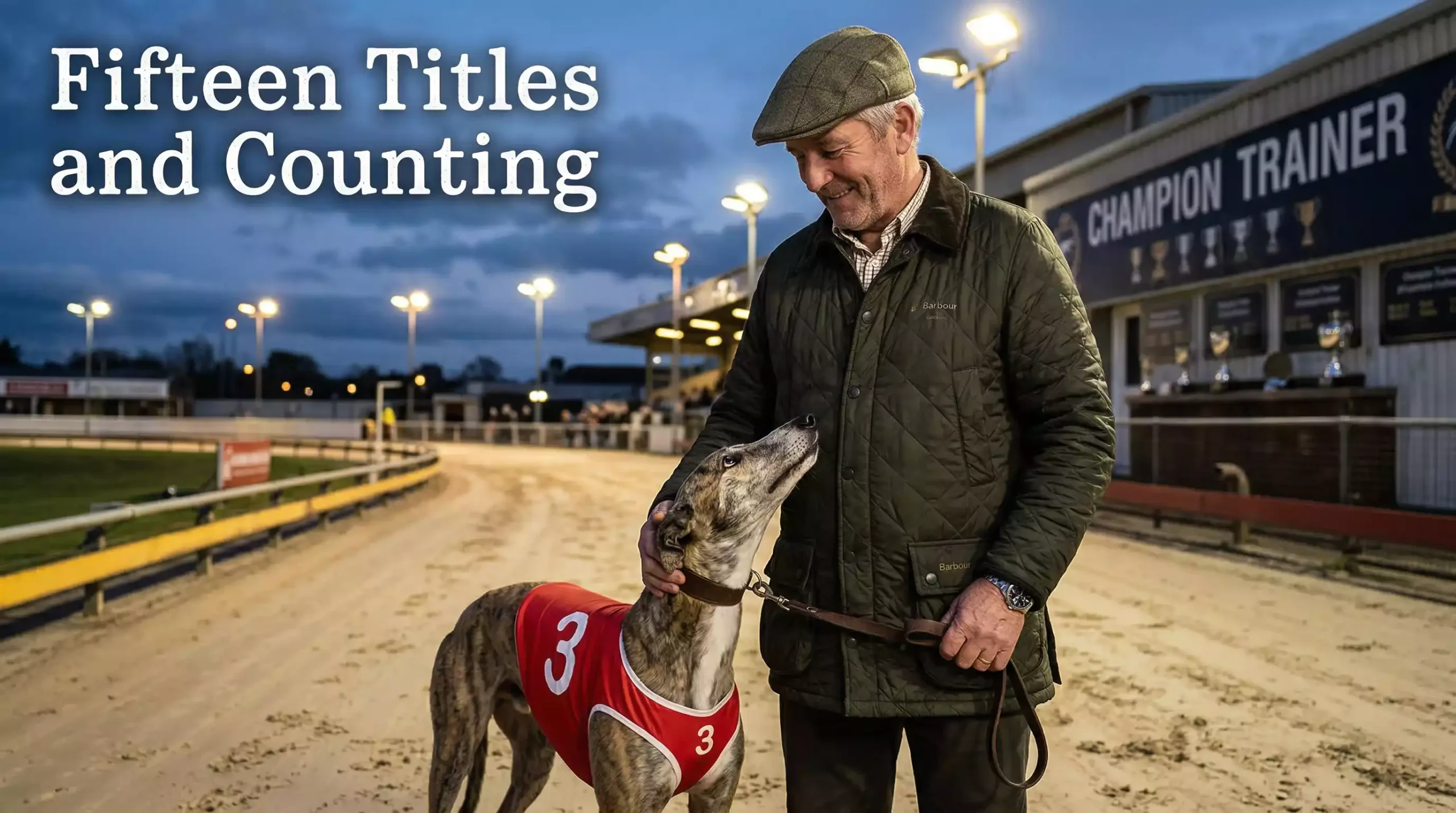
Mark Wallis is, by the numbers, the most successful trainer in modern British greyhound racing. Sixteen Champion Trainer titles — a tally that spans more than two decades of sustained dominance — and a career forged in part at Yarmouth have made his name inseparable from the sport’s elite level. Sixteen titles and counting, and no contemporary rival has managed more than a fraction of that record.
What makes Wallis’s achievement distinctive is not just the volume of winners but the range. His dogs have competed and won at the highest level in open events, feature derbies and the English Greyhound Derby itself, while simultaneously supplying a steady stream of runners for graded BAGS meetings at his home track. That dual capacity — operating at the top of the pyramid while maintaining a commercial kennel at a regional stadium — is exceptionally rare in a sport where most trainers specialise at one end or the other.
This profile traces the arc of Wallis’s career from his early titles through the defining moment of the 2012 English Derby, examines what Yarmouth meant to his operation during his years at the track, and considers the legacy of a trainer who shaped the sport from a coastal track in Norfolk before moving to his current base at Suffolk Downs.
The other handlers at the track are in Yarmouth trainers.
Career Timeline — From First Title to Sixteenth
Wallis’s first Champion Trainer title arrived in the late 1990s, earned through the simple arithmetic of accumulating more winners across licensed tracks than any other trainer in the country during a calendar year. The title is awarded on volume — total winners, not prize money — which means it rewards consistency and kennel depth as much as individual brilliance. To win it once is a statement. To win it sixteen times is an era.
The early titles established Wallis as the dominant force at Yarmouth and across the East Anglian circuit, but the national recognition came with sustained success at the major metropolitan tracks as well. His dogs competed regularly at venues far from Norfolk — London stadiums, midlands circuits, the big-event tracks — and his ability to prepare a dog for an away fixture without losing its form at its home track became a hallmark of his operation. Trainers who travel their dogs extensively often see a dip in home form; Wallis managed both.
Through the 2000s and 2010s, the titles accumulated at a pace that made the Champion Trainer award almost a formality in certain years. The kennel expanded, the quality of stock improved and the flow of winners became self-reinforcing: successful results attracted better dogs from owners who wanted the best handler, and better dogs produced more winners. By the time the sixteenth title was secured at the end of 2025, Wallis had built a record that future trainers will measure themselves against for decades.
The timeline also includes quieter years — seasons where injury, stock turnover or the natural cycles of a large kennel produced a dip in output. Those seasons are instructive because they show the resilience of the operation. A kennel that wins the Champion Trainer title in three out of every four years, even with the occasional gap, is not relying on a single generation of dogs. It is a system, and the system at Yarmouth has outlasted every competitor who challenged it.
Blonde Snapper and the 2012 English Derby
The English Greyhound Derby is the sport’s most prestigious event, carrying a winner’s prize of £175,000 within a total prize fund of £235,000 — the pinnacle of a sport whose overall prize money across all GBGB competitions reaches £15.7 million. It is the race that defines careers, and in 2012 it defined Wallis’s. Blonde Snapper, trained at Yarmouth and prepared through a careful campaign of graded and open races at the home track, won the final in a performance that combined raw speed with the tactical intelligence that Wallis’s best dogs share.
The significance of that victory extended beyond the prize money. Blonde Snapper was trained at a track that most national observers would not have considered a base for Derby-calibre preparation. The metropolitan kennels with proximity to London’s major tracks had historically dominated the Derby, and a winner prepared at a Norfolk coastal track challenged that geography. It proved that quality training infrastructure, rather than proximity to the big stadiums, was the decisive factor.
For Yarmouth, the Derby win was a reputational landmark. The track itself had invested £190,000 in circuit improvements in 2012, coinciding with the year its most prominent trainer delivered the biggest result in the sport. Whether that timing was coincidence or correlation, the pairing of track investment and on-track success gave Yarmouth a profile that endured well beyond the Derby final. Punters and owners who might never have looked at a Norfolk racecard began paying attention, and the flow of quality dogs through the Wallis kennel reflected that heightened interest.
Blonde Snapper’s campaign remains a case study in how a top trainer constructs a path to a feature event. The preparation was visible in the racecard data — a sequence of timed runs at specific distances, building speed and confidence without over-racing. For anyone studying how trainers use entries strategically, the 2012 Derby trail is worth revisiting as a blueprint.
The wider context is set out in our Yarmouth greyhound results guide.
Yarmouth Connection — Training at the Coastal Track
Wallis trained at Yarmouth from 2012 until around 2017, giving his dogs regular access to the track for trials, graded races and open events during that period. That proximity was a tangible advantage. Dogs trained locally avoided the stress of long journeys, arrived at the track in familiar surroundings and could be trialled on the actual circuit they would race on. For a trainer managing a large string of dogs, the ability to run quick trials at the home track between meetings was an operational efficiency that distant kennels could not match. Wallis subsequently moved to Henlow in 2018 and then to his current base at Suffolk Downs (Mildenhall) in 2023, but his Yarmouth years were formative for both his career and the track’s reputation.
The Yarmouth circuit — 382 metres with a Swaffham outside hare — suited Wallis’s training approach during his years at the track. The tight bends rewarded dogs with early pace and tactical awareness, and the outside hare meant wider-drawn runners were not as disadvantaged as they would be at an inside-hare track. Wallis’s dogs were typically trained to handle both inside and outside traps effectively, which gave him flexibility in race entries that trainers less familiar with the circuit could not easily replicate.
The relationship was reciprocal during his time there. Wallis’s presence raised the quality of the Yarmouth card — his entries ensured that even routine BAGS meetings included dogs of genuine quality, which in turn attracted better competition from visiting trainers. A meeting with three or four Wallis runners was a meeting where the form book was deeper and the betting market was more engaged. Though Wallis has since moved, the infrastructure and reputation he helped build at Yarmouth endure.
Legacy and Continued Impact
Wallis’s influence on Yarmouth extends beyond his own kennel. The training methods, the race placement strategies, the emphasis on physical conditioning — these have shaped how other local trainers approach the sport, because the standard he set is the one they measure themselves against. A Norfolk-based trainer watching Wallis prepare a dog for the English Derby does not just see a rival; they see a template for what is possible from this corner of the racing circuit.
The broader context matters too. As Sir Philip Davies, the current GBGB Chair, noted upon taking the role, greyhound racing is a sport that has occupied an important place in British culture for nearly a century. Trainers like Wallis are the living connection between the sport’s heritage and its competitive present. The sixteen titles are not just personal milestones — they are data points in the story of how UK greyhound racing sustained itself through decades of change, track closures and shifting public attitudes.
Whether Wallis adds a seventeenth title or not, the record stands on its own terms. No other trainer in the modern era has matched the consistency, the range or the longevity of his output. For bettors studying Yarmouth, the practical implication is unchanged: when a Wallis entry appears on any card — including at Yarmouth, where his runners still compete as visitors — it carries the weight of a kennel that has been winning races longer than most of its competitors have been training dogs. That is not a guarantee, but it is context — and context, on a racecard, is everything.
