
East Anglian Greyhound Derby — History, Records and Past Winners
 Available in US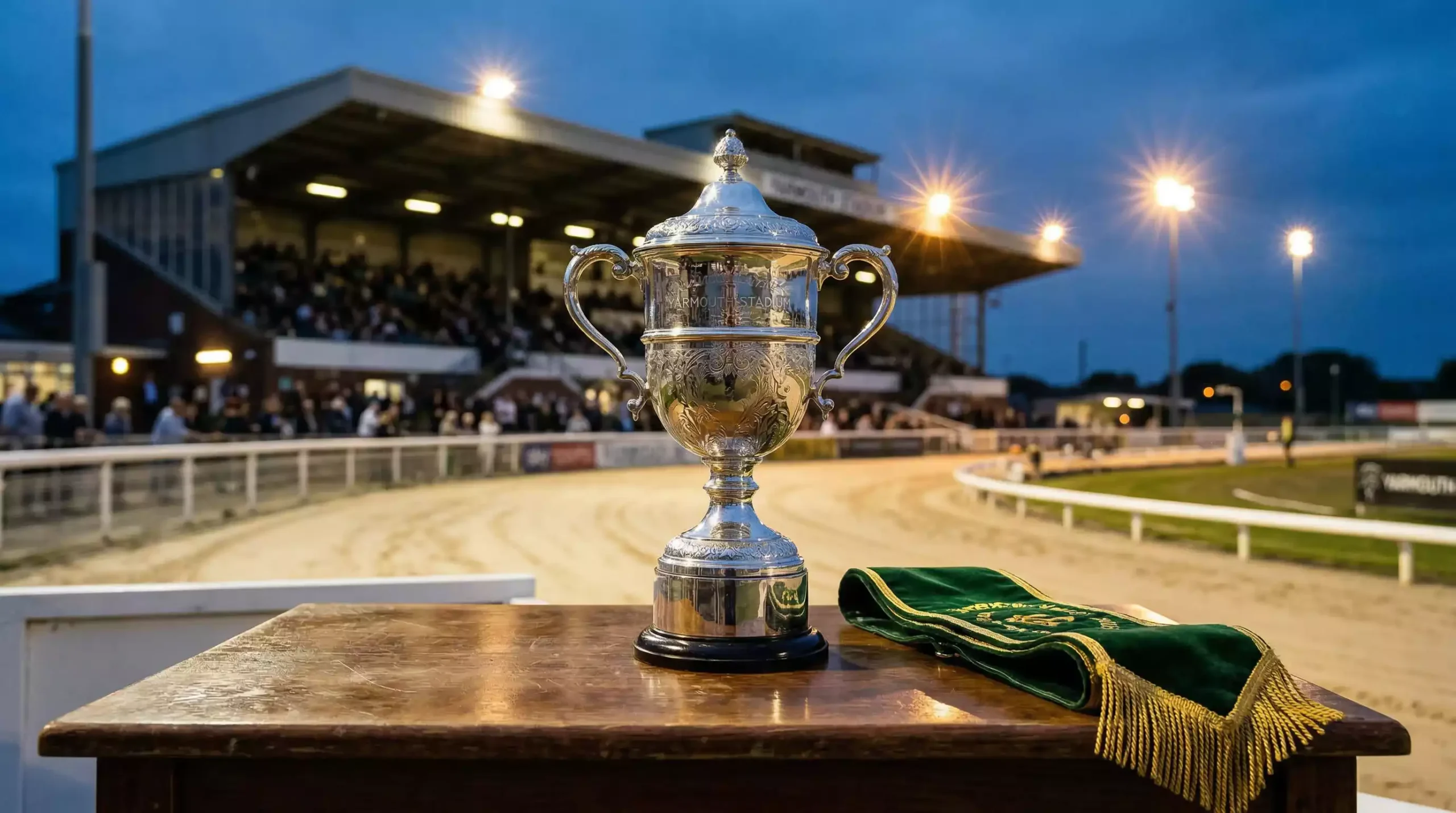
The East Anglian Derby — Yarmouth’s Flagship Competition Since 1947
Some races are important because of the prize money. Others because of the prestige, the history, the sense that winning this particular event means something beyond the cheque. The East Anglian Derby sits comfortably in the second category. Yarmouth’s September showpiece has been contested annually at Yarmouth Stadium since the track reopened after the Second World War, and its first final was run on 3 September 1947, barely a year after the stadium welcomed crowds back through the gates. The current winner’s prize of £15,000 is respectable for a regional Derby, though it has never been the main draw. What the East Anglian Derby offers instead is a direct line to nearly eight decades of Norfolk greyhound racing — a competition that has survived track closures, regulatory upheaval and the slow contraction of the sport, and still manages to produce evenings worth remembering.
The race is run over 462 metres, the standard distance at Yarmouth and the trip over which the track’s character expresses itself most fully. Four bends on a 382-metre circuit, a balance between early pace and sustained effort, and a finish that rewards the dog with the best combination of speed, technique and nerve. Over the decades, certain trainers have made the East Anglian Derby their personal domain — none more so than Charlie Lister OBE, whose record of twelve victories in the event may never be equalled. The Derby’s timeline is populated with names that mean something to anyone who follows the sport: trainers, dogs and moments that defined eras at Yarmouth.
This article traces that timeline from 1947 to the present day, profiles the dominant figures in the event’s history, examines why the 462-metre distance defines the race, and places the East Anglian Derby in the broader context of British greyhound racing — a sport that, in 2026, marks its centenary.
The trainers who win it are in Yarmouth trainers.
From Post-War Norfolk to Modern Classic: A Timeline
The East Anglian Derby was born into a Britain still rationing food and rebuilding from rubble. Yarmouth Stadium had been founded in 1939 or 1940 — records vary on the precise year — but the war intervened before it could establish itself. The reopening came on 7 December 1946, and within months the stadium had launched its flagship competition. The first East Anglian Derby final, held on 3 September 1947, was a statement of intent: this was not a track content to host mid-week BAGS cards and nothing more. It aspired to something larger, and the Derby was the vehicle for that aspiration.
Through the late 1940s and 1950s, the event grew alongside the sport itself. Greyhound racing in post-war Britain was booming — crowds flocked to stadiums across the country, and Yarmouth, positioned in the holiday heartland of Norfolk, attracted both local regulars and summer visitors. The East Anglian Derby became an anchor in the regional calendar, a fixture that trainers from across the eastern counties pointed their best dogs towards. The prize money in those early decades was modest by modern standards, but the honour of winning a named Derby — in a sport where Derby titles carry particular weight — was its own reward.
The 1960s and 1970s brought changes to the format and the competitive landscape. More trainers from outside the eastern region began entering dogs, drawn by the event’s growing reputation and the quality of fields it attracted. It was during this period that the Derby began to establish its identity as a genuine test of all-round ability over 462 metres, rather than simply a fast dog’s race. The track itself was evolving too. Investment in facilities, culminating decades later in the £2.5-million Len Franklin Grandstand in 2006, reflected the stadium’s ambition to compete with larger venues for prestige events.
The 1980s and 1990s saw the rise of the trainers who would come to define the competition. Charlie Lister, based in the Midlands but with a deep affinity for Yarmouth, began accumulating Derby titles at a rate that made his rivals wonder whether the trophy should simply be engraved with his name in advance. His dominance — twelve victories in total — spanned decades and multiple generations of greyhound, a feat of training consistency that has few parallels in any racing discipline. Other trainers competed hard, and the Derby produced its share of upsets, but the Lister era is the period that historians of the event return to most often.
The 2000s and 2010s brought new challenges. Track closures reduced the number of greyhound venues in Britain, and the betting landscape shifted as online wagering grew and traditional bookmaker footfall declined. Yet the East Anglian Derby endured. The stadium’s 2018 media contract with Arena Racing Company, renewed in a new five-year deal from January 2025, ensured that the Derby continued to reach a national audience through broadcast and streaming platforms. In 2012, the same year that £190,000 was invested in track improvements at Yarmouth, trainer Mark Wallis sent Blonde Snapper to victory in the English Greyhound Derby — the sport’s premier event — a reminder that Yarmouth’s training community operates at the highest level.
Now, in 2026, the East Anglian Derby approaches its eightieth running against the backdrop of the centenary of British greyhound racing itself. The first licensed greyhound race in the UK took place on 24 July 1926 at Belle Vue, Manchester. A century later, Yarmouth’s September showpiece remains one of the sport’s most enduring regional competitions — a thread that connects post-war Norfolk to the present day. As Jeremy Cooper, outgoing Chair of the Greyhound Board of Great Britain, observed: “Thanks to the Greyhound Commitment and our long-term strategy, animal welfare has been placed at the heart of the sport; greyhounds now receive a higher level of care than ever before.” That commitment to the future has not come at the expense of tradition, and the East Anglian Derby is proof.
Charlie Lister OBE: The Man With 12 Derby Titles
No discussion of the East Anglian Derby is complete without Charlie Lister. His twelve victories in the competition represent a record that stands alone in the event’s history and ranks among the most remarkable training achievements in British greyhound racing. To win a named Derby once is an accomplishment. To win it twelve times requires a sustained level of excellence across decades, through different eras of the sport, with different generations of greyhound.
Lister’s approach to the East Anglian Derby was methodical and, for his competitors, deeply frustrating. He understood the Yarmouth circuit intimately — the bend tightness, the surface characteristics, the way the Swaffham outside hare influenced running lines — and he selected and prepared his Derby candidates with that understanding at the centre of every decision. His winners were not always the fastest dogs on paper. They were the dogs best suited to Yarmouth’s 462 metres, the ones that combined early pace with the bend technique needed to navigate four turns on a 382-metre circuit without losing position.
The breadth of his record is what elevates it from impressive to extraordinary. Lister’s first East Anglian Derby victory came early in his career, when the competition was still building its modern reputation. His last came decades later, by which point the event had attracted stronger fields and more nationally recognised trainers. That he continued to win in both eras speaks to an ability to adapt — to new types of dog, new training methods, new competitive pressures — that few in the sport have matched. In between, he produced Derby winners that ranged from front-running types that blitzed the field from trap to line, to canny stayers that sat behind the pace before striking on the final bend.
Lister’s OBE, awarded for services to greyhound racing, recognised a career that extended well beyond the East Anglian Derby. He trained multiple winners of open races at tracks across the country and was a fixture at the sport’s major events. But the Derby at Yarmouth was his signature, the race where his name carried the most weight, and the one that any challenger had to get past him to win. That the record still stands — and stands by a margin that makes it almost untouchable — is the clearest measure of his impact on the event.
For those analysing modern East Anglian Derby entries, the Lister precedent offers a useful heuristic. His winners shared a profile: dogs with sharp early pace, clean cornering, and the temperament to handle a Derby-night atmosphere that is louder and more charged than a routine BAGS meeting. Identifying those qualities in contemporary contenders remains one of the best starting points for anyone attempting to find the next Derby winner.
Derby Distance — Why 462 Metres Defines the Race
The East Anglian Derby is contested over 462 metres, and the choice of distance is not arbitrary. It is the standard trip at Yarmouth — the distance over which the most races are run, the most form is accumulated, and the most reliable comparisons can be made. It is also the distance that best tests the balance of qualities a Derby winner needs: early pace, bend technique, sustained effort, and the finishing speed to hold off a late challenge on the home straight.
A 277-metre sprint would reduce the Derby to a trap-speed lottery. The best breaker from the best draw would win more often than not, and the element of racing — of tactical interaction over the course of the race — would be largely absent. At the other extreme, an 843-metre marathon would favour a specialist stayer profile and exclude the majority of dogs that race primarily at standard distances. The 462-metre trip sits in the middle ground, accessible to a wide range of dogs but demanding enough to separate genuine quality from mere competence.
On Yarmouth’s 382-metre circuit, 462 metres means four bends. The run from traps to the first turn is where early pace establishes the hierarchy. The middle section — bends two and three and the back straight — is where bend technique and stamina are tested. The run from the final bend to the line is where the race is decided. Each phase matters, and the best East Anglian Derby winners have been dogs that excelled in at least two of the three phases and were competent in the third. A pure front-runner can win the Derby if its early speed is exceptional, but it is vulnerable to a strong finisher on the closing straight. A pure closer can win if the pace is hot and the front-runners tire, but it needs to be within striking distance at the last turn.
The track record over 462 metres at Yarmouth belongs to Westmead Dance, who in 1977 became the first greyhound to break the 28-second barrier at the track. That record endured for a decade, and while it has since been approached and bettered, the sub-28 mark remains a benchmark that Derby contenders are measured against. A dog capable of running close to that level on Derby night is operating at the top end of what the track can produce — and is almost certainly a leading contender.
The 462-metre distance also shapes the betting market around the Derby. Because it is the standard trip, form at the distance is abundant. Punters can compare sectional times, trap-draw records, and finishing positions across dozens of runs, building a detailed profile of each contender’s strengths and weaknesses. This makes the East Anglian Derby a more analysable event than feature races run at unusual distances, where the form book is thinner and the unknowns are greater. For the serious analyst, the Derby is one of the most data-rich events on the calendar.
Prize Fund and How the East Anglian Derby Compares Nationally
The East Anglian Derby’s current first prize of £15,000 positions it firmly in the middle tier of named Derbies in British greyhound racing. It is a substantial sum — enough to attract quality entries from trainers across the country — but it does not compete with the sport’s headline events on prize money alone. The English Greyhound Derby, the most prestigious race in the calendar, offers £175,000 to the winner from a total fund of £235,000, a figure that dwarfs regional competitions. The total prize fund across all GBGB competitions reaches approximately £15.7 million.
That disparity in prize money does not translate into a proportional gap in quality. The English Derby attracts the absolute elite — the two or three best greyhounds of the generation, tested over a series of heats and semi-finals. The East Anglian Derby draws from a slightly broader pool. It attracts high-class dogs that may not quite be English Derby calibre alongside very good regional performers that would struggle in the national final but are entirely capable of winning a competitive event over 462 metres at Yarmouth. The result is fields that are often more open and less predictable than those at the English Derby, which can produce better betting races.
Prize money in greyhound racing is funded through a combination of track revenue, broadcasting deals, and contributions from the betting industry via the British Greyhound Racing Fund. The BGRF’s voluntary levy system collects approximately 0.6% of bookmakers’ greyhound turnover, and in the 2024-25 financial year this generated £6.75 million. That total funds everything from prize money to welfare initiatives, and the share available for individual events is necessarily limited. The East Anglian Derby’s £15,000 first prize reflects the economic realities of a sport that, while commercially significant, operates within tighter financial margins than horse racing.
For trainers, the Derby represents more than its prize fund. Winning a named event at a track with Yarmouth’s history enhances a kennel’s reputation and can attract new owners looking to place their dogs with a proven handler. The prestige value of a Derby title — particularly one accumulated over multiple years, as Charlie Lister demonstrated — is a recruiting tool that outlasts the cheque. Owners who invest in greyhound ownership are motivated by sport as much as financial return, and having their dog win a competition with a seventy-nine-year history carries a weight that a midweek open race at a smaller track simply cannot match.
The prize structure also determines the competitive dynamics of the event. A £15,000 first prize is large enough to justify the expense of travelling dogs from distant kennels, which broadens the field and raises the quality. If the prize were significantly lower, the entries would skew more heavily towards local trainers, and the event would lose its status as a genuinely national-level competition. The current level appears to strike the right balance: large enough to attract serious contenders, small enough to keep the event sustainable within the track’s operating economics.
The full picture is in our Yarmouth greyhound results guide.
Notable Winners and Defining Moments in Derby History
Seventy-nine years of competition produce a catalogue of moments that define a race’s character. The East Anglian Derby has had its share — from record-breaking performances to unexpected results that reshaped the betting market and the form book in a single evening. The names that follow are not an exhaustive list of winners, but they represent the dogs and the moments that have given the East Anglian Derby its reputation.
Westmead Dance, in 1977, delivered one of the most technically significant performances in the event’s history. His sub-28-second run over 462 metres was not just a track record; it was a barrier-breaking moment that redefined expectations of what was possible on the Yarmouth circuit. Trained by John Wells, Westmead Dance combined raw speed with a precision through the bends that few of his contemporaries could match. The record stood for a decade — an eternity in a sport where training methods, breeding programmes and track surfaces evolve constantly. Even now, the sub-28 mark remains a reference point for Derby-night form.
Charlie Lister’s twelve winners span so many years that singling out individual performances risks doing injustice to the others. But certain Lister-trained Derby victors stood out for the manner of their wins as much as the fact of them. Some led from the opening bend and were never challenged, a testament to the early pace that Lister valued above almost everything else in a Derby dog. Others came from behind, tracking the leaders through the middle section before unleashing a burst on the final straight that left the crowd — and the on-course bookmakers — scrambling. The variety of his winning methods is part of what makes his record so imposing: he did not rely on a single type of dog or a single tactical approach.
The modern era has produced its own notable contenders. Patrick Janssens, who won the East Anglian Derby in both 2020 and 2024, represents the current standard at the competition — a trainer capable of preparing dogs specifically for the demands of Yarmouth’s circuit and delivering them in peak condition on the night. Mark Wallis, who trained Blonde Snapper to win the English Greyhound Derby in 2012, has also been a consistent presence at the East Anglian Derby, bringing dogs from his kennel that have been tested at the highest level of the sport before dropping back to contest the regional event.
Among the defining moments that do not involve the winner’s enclosure, the Derby has produced its share of hard-luck stories. Dogs that led by three lengths entering the final bend only to be caught on the line. Favourites that stumbled at the break and spent the rest of the race in traffic. Semi-final winners that peaked too early and could not reproduce their form on finals night. These are the narratives that make the event worth following even for punters who choose not to bet — the unpredictability that a 462-metre race on a tight circuit will always produce, regardless of how carefully the form is analysed.
The East Anglian Derby in 2026 arrives at a moment when the sport’s continuity can no longer be taken for granted. Three tracks closed in 2025. Legislative bans are advancing in Wales and Scotland. Yet the quality of recent fields at Yarmouth suggests that the Derby is not merely surviving — it is drawing trainers and dogs that would be competitive anywhere in the country. That resilience, built over nearly eighty years of unbroken competition, is the event’s most compelling argument for its own future. The East Anglian Derby persists because it matters — to the trainers who prepare for it, to the punters who analyse it, and to the track that has staked its identity on it.
