
Yarmouth Trap Statistics — Win Rates, Bias Analysis and Betting Angles
 Available in US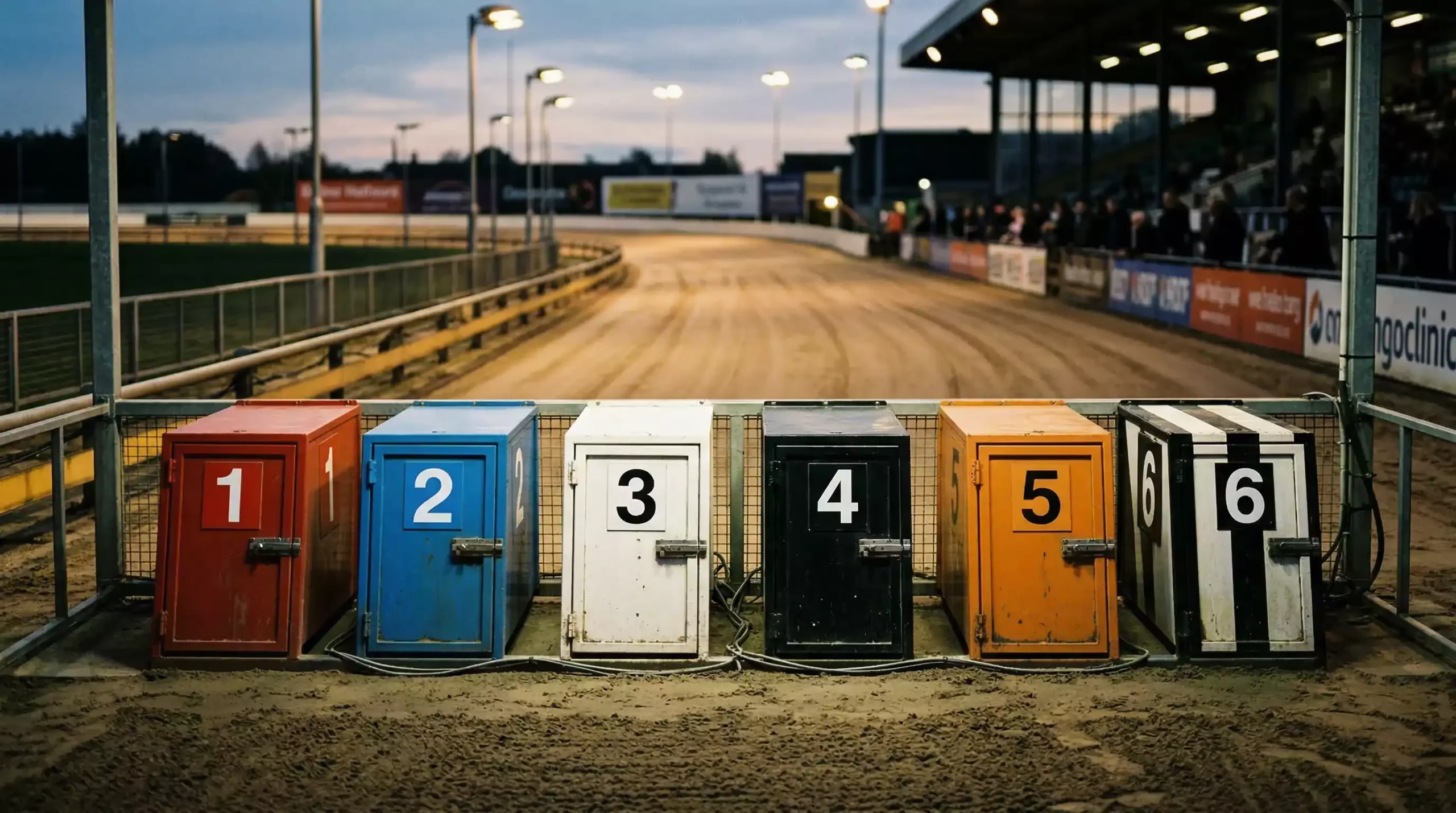
How Trap Position Shapes the Result at Yarmouth
Yarmouth trap statistics tell a story that the finishing order alone cannot. Every greyhound race at Caister-on-Sea begins with a box draw — six dogs, six traps, six different starting positions — and the numbers behind the box draw reveal persistent patterns that no serious bettor should ignore. Trap position does not determine the winner of every race, but across hundreds of meetings and thousands of results, certain boxes produce disproportionately more winners than others. Understanding why, and how those patterns shift across distances, is the foundation of any data-driven approach to Yarmouth.
The bias exists because of physics, not luck. Yarmouth’s 382-metre circumference with five racing distances — 277, 462, 659, 843 and 1041 metres — and a Swaffham outside hare creates a specific geometric relationship between each trap position and the first bend. On a tight circuit, the difference in path length between trap one and trap six is proportionally larger than at a more generous oval. That difference translates into seconds, which translates into positions, which translates into strike rates that deviate from the 16.7 per cent baseline you would expect if all traps were equal.
What follows is a breakdown of Yarmouth’s trap-bias data by distance, an analysis of the inside-versus-outside dynamic, and a practical framework for applying these numbers to the betting market. The numbers behind the box draw are not a secret — the data is available to anyone willing to compile it — but most punters never look. That is the edge.
Why the bias exists is in trap bias explained.
Trap Win Percentages at Yarmouth: the Full Picture
Across all distances combined, Yarmouth’s trap-bias profile follows a pattern familiar to anyone who has studied UK greyhound tracks: inside traps win more often than outside traps, but the margin is not as extreme as at some venues. Trap one typically records a win percentage in the region of 19–21 per cent over a rolling twelve-month sample, comfortably above the 16.7 per cent equal-share baseline. Trap two sits close behind, usually in the 17–19 per cent range. Traps three and four cluster around the baseline, sometimes slightly above, sometimes slightly below. Traps five and six tend to underperform, with strike rates closer to 13–15 per cent.
These aggregate numbers are useful as a starting point, but they mask important detail. The all-distance average blends sprint races — where trap bias is most extreme — with staying races, where the extra bends and longer running time dilute the effect of the initial draw. Treating the aggregate as a single actionable signal is a mistake. A punter who backs trap one in every race at Yarmouth because “it wins most often” is applying a blunt instrument to a problem that rewards precision.
The more revealing analysis is to split the data by distance, by grade level, and by time period. Distance is the dominant variable. Grade level matters because the best dogs often overcome a poor draw through sheer ability — in A1 and A2 races, trap bias is less pronounced than in A7 or A8, where the margin between dogs is smaller and positional advantage counts for more. Time period matters because track maintenance, surface changes, and rail adjustments can shift bias patterns over months, even if the underlying geometry remains the same.
Over a typical six-month sample at Yarmouth, you will see enough races to produce statistically meaningful numbers at the distance level. Over 277 metres, several hundred races a year provide a decent dataset. Over 462 metres, the sample is the largest of any distance, because it is the most frequently scheduled trip. Over 659 metres and beyond, the sample thins out — staying races are scheduled less often, and the data requires a longer accumulation period before the patterns become reliable.
The key principle is this: trap-bias data at Yarmouth is not a shortcut. It is a filter. It does not tell you which dog to back. It tells you which dogs have a structural advantage before the race begins, and which dogs need to overcome a structural disadvantage to win. When you combine that filter with form analysis, trainer patterns, and going conditions, the strike rate improves — not because you have found a magic formula, but because you are making decisions with more information than the market prices reflect.
One further point on methodology: the best trap-bias datasets are built from raw results, not from aggregator summaries. Several websites publish trap statistics for UK tracks, and the numbers are broadly correct, but they often lag behind recent results and may not account for void races, non-runners, or re-draws. Building a personal dataset from meeting-by-meeting results is more effort, but it produces a more accurate picture — and it is the kind of work that distinguishes a profitable approach from a recreational one.
Distance-Specific Bias: 277m, 462m, 659m and 843m
At 277 metres, Yarmouth’s trap bias is at its most extreme. This is a two-bend sprint — the dogs break from the boxes, hit the first bend within a handful of strides, and the race is essentially settled by the time they exit the second turn onto the home straight. Trap one’s advantage over this distance is substantial, with win rates that can exceed 25 per cent in a strong sample. Trap two benefits nearly as much. Traps five and six, by contrast, struggle to reach 12 per cent. The reason is elementary geometry: the inside box has the shortest path to the first bend, and on a 382-metre circuit that path advantage is not a matter of centimetres — it is a full dog’s length or more. Over two bends and 277 metres of running, there is simply not enough race for a wide-drawn dog to recover that lost ground.
The 462-metre distance — four bends, the Derby trip, the most commonly scheduled race at the track — tells a more nuanced story. Inside traps still lead the win-rate table, but the margin is smaller. Trap one over 462 metres typically records a strike rate of 18–20 per cent rather than the 25-plus seen over sprints. Trap six is not hopeless, usually sitting around 14–15 per cent. The extra two bends provide opportunities for re-positioning: a dog drawn wide that gets a clean first bend can work to the rail through the middle section and hold its position on the run-in. This is the distance where the Swaffham outside hare has the most moderating effect on the inside-trap advantage, because dogs in wide traps maintain a better sightline to the lure through the additional bends. In 1977, Westmead Dance broke the 28-second barrier over 462 metres at Yarmouth, setting a record that endured for a decade — a time achieved from a prominent early position. That kind of performance requires the ability to sustain pace through four bends, which is why the 462-metre bias is less extreme than the sprint. Quality can overcome geometry when there is enough track to show it.
Over 659 metres — six bends — the trap-bias signal weakens further. The data still shows a slight overall edge for inside traps, but the gap between the best-performing and worst-performing box narrows to the point where it is within the margin of normal statistical variation in smaller samples. The additional bends mean more opportunities for position changes, more potential for crowding incidents that randomise the finish order, and a greater influence from stamina relative to early speed. At this distance, a dog’s ability to finish strongly — its run-home sectional time — is a better predictor of success than its trap draw. The bias is still there in the aggregate, but it is a weaker signal, and basing a selection primarily on trap position over 659 metres is less reliable than over the shorter trips.
At 843 metres and beyond, trap bias becomes almost negligible in practical terms. Eight-bend races are sufficiently long that the initial draw is one factor among many. The field has time to sort itself into running order, and the strongest stayer will typically find a path regardless of where it started. What little bias remains tends to favour the middle traps — three and four — rather than the extremes, possibly because these positions offer the best combination of early positioning and freedom from rail traffic or wide running. The sample size over marathon distances is smaller at every track, and at Yarmouth the scheduling of 843-metre and 1041-metre races is infrequent enough that the data should be treated with appropriate caution.
Inside vs Outside: Why Bends Matter on a 382m Circuit
The inside-versus-outside dynamic at Yarmouth is ultimately a question of physics. A greyhound racing at full speed — the Scottish Animal Welfare Commission recorded an average racing speed of 65 km/h — generates significant centrifugal force when navigating a bend. The tighter the bend, the greater that force, and the more energy a dog expends to maintain its line. On Yarmouth’s 382-metre circuit, the bends are tight by national standards. A dog running on the inside rail takes the shortest path and experiences the least centrifugal pull. A dog running two or three widths off the rail travels a longer arc and fights more lateral force with every stride.
This is not a trivial difference. Over four bends at 462 metres, a dog running consistently two widths off the rail covers several metres more than one hugging the inside. At 65 km/h, those extra metres translate to fractions of a second — and greyhound races at Yarmouth are regularly decided by less than a length, which corresponds to roughly 0.08 seconds. The geometry that produces a half-length disadvantage from a wide draw is the same geometry that makes inside traps statistically more productive over sprint distances.
The Swaffham outside hare complicates the picture in a way that benefits wide runners relative to what they would experience at an inside-hare track. Because the lure runs outside the racing circuit, dogs in traps four, five and six have a cleaner sightline as they enter bends. They can see the hare without looking across other dogs, which allows them to run a more direct line into the turn. At a track with an inside hare — Romford, for instance — inside traps have both the geometric and the sightline advantage, producing a far more extreme bias. At Yarmouth, the sightline benefit partially offsets the geometric disadvantage for wide-drawn runners, which is why the overall trap-bias numbers are less extreme than at some other venues.
In practical terms, this means a punter at Yarmouth should not dismiss a well-drawn wide runner out of hand, particularly over 462 metres and above. A trap-six dog with proven early pace and a record of running cleanly through the first bend can overcome the geometric disadvantage if the hare sightline helps it hold its position. The punters who lose money on trap bias are usually the ones who apply it rigidly — backing trap one regardless of the dog’s form, or automatically ruling out trap six. The numbers inform the selection; they do not make it. A dog with a two-length ability edge will overcome a half-length positional disadvantage most of the time.
One further nuance: the inside-outside dynamic changes subtly depending on the pace of the race. In a fast-run contest where all six dogs show early speed, the first bend becomes congested and inside runners can be squeezed or checked by dogs drifting off the bend. In a slowly-run race where only one or two dogs show genuine early pace, the inside rail is open and the geometric advantage is fully realised. Knowing whether a race is likely to be fast- or slow-paced — which is a function of the form of the six dogs in the field — is an essential complement to the raw trap-bias data.
Using Trap Data to Find Value in the Betting Market
Trap statistics are worthless unless they translate into better betting decisions. The question is not whether trap one wins more often at Yarmouth — it does — but whether the market already prices that advantage into the odds. If trap one is consistently sent off at shorter prices precisely because the market knows it wins more often, then there is no value in backing it on trap position alone. The edge comes from identifying situations where the trap advantage is underpriced or where a trap disadvantage is overpriced.
The greyhound betting market in the UK is not a small, illiquid niche. Betting shop turnover on greyhound racing reached £794 million between April 2023 and March 2024, according to Gambling Commission data. That volume means the market is reasonably efficient in aggregate — obvious patterns like sprint-trap-one bias are broadly reflected in the prices. But efficiency breaks down at the margins, particularly in lower-grade races, mid-week BAGS meetings, and situations where the form is thin or contradictory. These are the conditions where trap-bias data adds the most value.
Consider a Monday afternoon BAGS card at Yarmouth, 462 metres, A6 grade. The six dogs have patchy form: a couple of recent winners, a couple of also-rans, and two making their first appearance at the track after transferring from other venues. The market struggles to price a race like this accurately because the form sample is shallow and the class differences between dogs are small. In this scenario, a dog drawn in trap one with decent early pace represents a structural edge that the market may not fully account for, because the bookmaker’s odds are driven more by recent finishing positions than by trap-bias analysis. The punter who factors in the elevated strike rate for trap one over 462 metres has a quantitative framework that most of the shop market does not.
The application extends beyond simple win bets. Trap bias can be used to construct smarter forecast and tricast selections. If the data shows that traps one and two together account for a disproportionate share of winners over 277 metres, then a straight forecast coupling the inside two runners — assuming both have reasonable form — has a probability baseline that is considerably more favourable than a random pairing. This does not guarantee a return, but it shifts the expected value in the punter’s favour over a large enough sample.
Another practical application is identifying overlays — dogs whose odds are longer than their true probability warrants. A trap-six dog at 10/1 in a 277-metre sprint might look like poor value on form, but if that same dog is a confirmed railer with a history of cutting across the field and finding the inside line by the first bend, the effective trap disadvantage is smaller than the market assumes. Conversely, a trap-one dog at 6/4 in a 659-metre race may be overbet by punters who assume the inside draw carries the same weight over six bends as it does over two. The data says otherwise. Backing a favourite that is favourite for the wrong reasons is the fastest way to erode a bankroll.
The full picture is in our Yarmouth greyhound results guide.
Limitations of Trap Statistics: Sample Size and Grade Level
Trap statistics are a powerful tool, but they come with limitations that honest analysis must acknowledge. The first is sample size. Over sprint distances and the standard 462-metre trip, Yarmouth produces enough races per month to build meaningful datasets within a few months. Over staying distances — 659 metres and above — the scheduling is sparser, and the data may take a year or more to reach the volume needed for statistical confidence. Drawing firm conclusions from 50 races when the baseline expectation is 16.7 per cent per trap is unreliable. A trap that has won 22 per cent of the time over 50 races may simply have experienced a run of variance that would correct over 500.
Grade level introduces another complication. In high-grade races — A1, A2, open events — the difference in ability between dogs is relatively large. The best greyhound in the race often wins regardless of its trap draw, because it has enough speed and class to overcome a positional disadvantage. In these races, trap bias explains a smaller proportion of the variance in outcomes. In lower grades — A6, A7, A8 — the margins between dogs are tighter, and the structural advantage of an inside draw becomes a bigger factor in the result. The practical implication is that trap-bias data is most useful in mid-to-low-grade BAGS racing, where the fields are most competitive and the draw carries more weight. For feature races and graded opens, form and ability should take precedence.
Seasonal drift is a subtler issue. Track conditions change over the course of a year — the surface is harder in dry summer months, softer in winter, and the bends may be resurfaced or re-railed at intervals. These changes can shift the trap-bias profile. A dataset compiled exclusively from summer meetings may not accurately describe the winter bias, and vice versa. The best approach is to maintain a rolling dataset — say, the last six to twelve months — rather than relying on all-time figures that blend conditions across multiple seasons and possible track configurations.
There is also the question of randomness. Greyhound racing involves live animals, and on any given night an inside-drawn dog might bump on the first bend, a wide runner might get a dream run in the clear, or a dog might simply have an off day. Trap bias is a probabilistic framework, not a deterministic one. It tells you what happens most often, not what will happen in the next race. Punters who treat trap data as a guarantee rather than a probability overlay will eventually encounter a losing streak that shakes their confidence in the numbers — not because the numbers are wrong, but because they were applied with unrealistic expectations.
Joe Scanlon, Chairman of the British Greyhound Racing Fund, captured the broader financial context well when he observed that the voluntary-levy system sustains the sport but acknowledged that “we will reach a point where the income is simply not enough for our ambitions”. That financial reality is relevant even at the level of trap statistics, because it affects the quality and frequency of meetings. If BAGS scheduling changes, or if the number of race days shifts, the data environment for trap analysis changes with it. A robust analytical framework accounts for these moving parts rather than treating the data as a fixed landscape.
None of this diminishes the value of trap statistics. It contextualises them. The numbers behind the box draw at Yarmouth are real, persistent, and grounded in the physics of a 382-metre circuit. Used properly — as one input among several, calibrated for distance, grade and conditions — they give the punter an informational advantage that the casual market participant does not have. Used carelessly, they are just another way to lose money with false confidence. The distinction lies not in the data itself but in how rigorously it is applied.
