
Yarmouth Greyhound Fixtures — Schedule, BAGS and Live Broadcast
 Available in US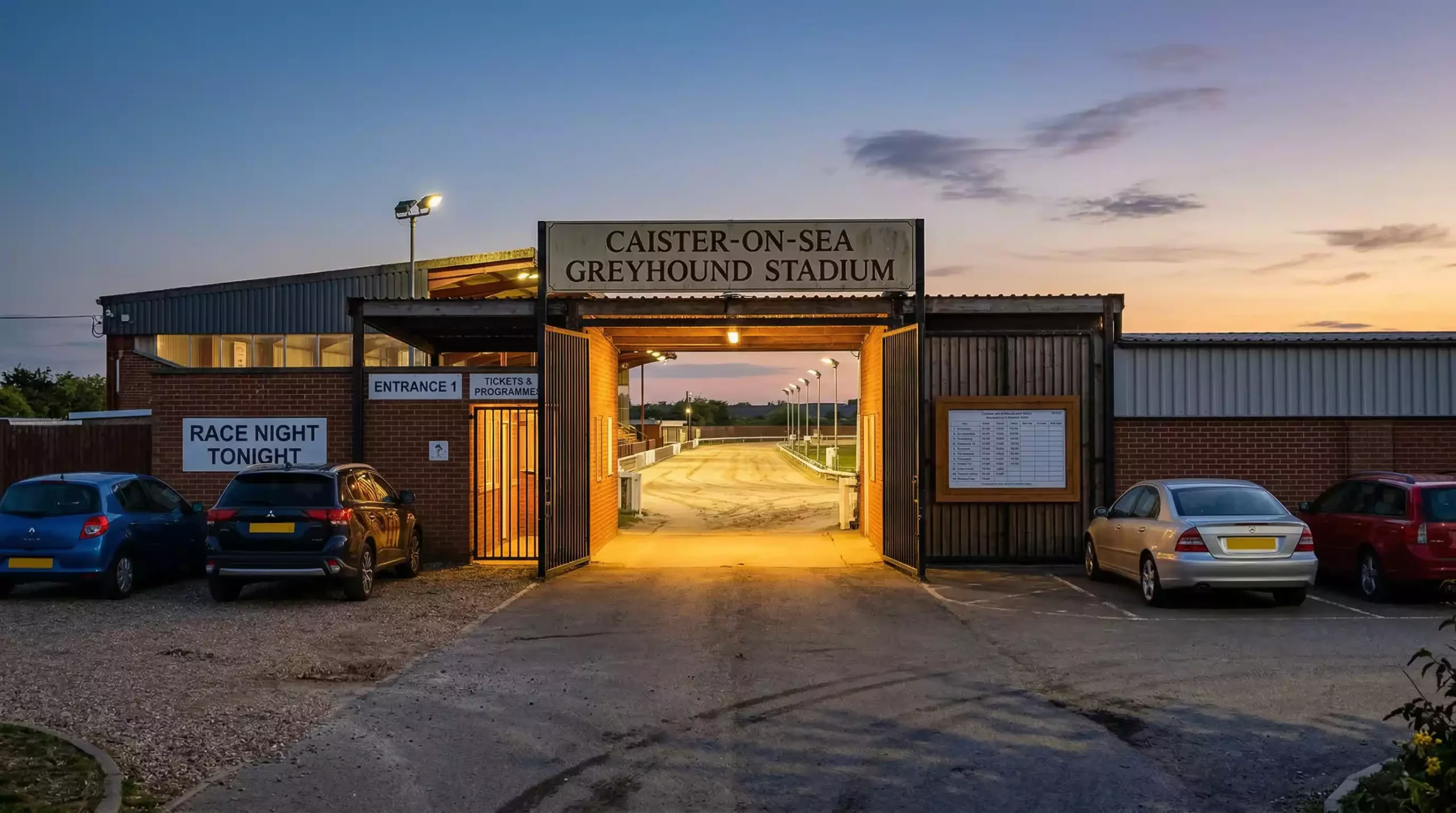
When Does Yarmouth Race and How to Follow Every Meeting
Every meeting, every broadcast, every card — that is what a serious follower of Yarmouth greyhound racing needs to track. The schedule at Yarmouth Stadium is not haphazard. It is shaped by a system of broadcasting contracts, betting-shop demand and regulatory structures that determine not just when racing happens but what kind of racing takes place on any given day. Understanding that system is the difference between turning up on the right evening and staring at a dark stadium.
Yarmouth is one of 18 licensed GBGB stadiums currently operating in Britain, and it operates within the BAGS framework — the Bookmakers’ Afternoon Greyhound Service — which provides the commercial backbone for most licensed greyhound racing in the country. BAGS meetings are scheduled to supply a continuous stream of live races to betting shops and online platforms throughout the day and evening, and the revenue generated by those meetings funds the majority of day-to-day racing at Yarmouth and every other participating track. Alongside BAGS, the stadium hosts open meetings and feature events, including the East Anglian Derby, which operate outside the standard broadcast schedule and attract different fields and different audiences.
The weekly pattern at Yarmouth is consistent but not rigid. Race days, race times and the number of races per card can shift with the season, with broadcast requirements and with the broader scheduling decisions made by Premier Greyhound Racing, the joint venture between Arena Racing Company and Entain that manages the broadcast fixture list. This guide breaks down the weekly schedule, explains how BAGS and open meetings differ, maps the broadcast infrastructure, and flags the seasonal variations that affect the Yarmouth racing calendar.
The afternoon cards come from BAGS racing.
The Weekly Race Schedule at Yarmouth
Yarmouth Stadium typically races on multiple days per week, with the core schedule built around BAGS fixtures that serve the betting-shop market. The standard race days are Monday, Wednesday, and often Saturday, with additional fixtures on other days depending on the time of year and the broadcast schedule. Evening meetings during the summer months start later to take advantage of longer daylight hours, while winter cards tend to run as afternoon or early-evening fixtures.
A typical BAGS meeting at Yarmouth comprises between ten and thirteen races, run at intervals of roughly fifteen minutes. The card opens with the first race at a time determined by the broadcast slot — usually early afternoon for daytime fixtures or early evening for night meetings — and the last race runs approximately two and a half to three hours later. The consistency of this format is deliberate. Betting shops require a predictable product: races at regular intervals, results delivered promptly, and a schedule that allows punters to move between greyhound and horse racing without dead time in the shop.
The race distances on a standard Yarmouth BAGS card are weighted towards the 462-metre standard trip, which typically accounts for the majority of races. Sprint races at 277 metres and middle-distance events at 659 metres appear in smaller numbers, and the 843-metre marathon distance is carded occasionally, usually on featured or open-meeting cards rather than routine BAGS fixtures. This distance mix reflects the grading structure: most dogs at Yarmouth are graded at standard distance, so the bulk of the card serves that population.
Race timing matters for punters beyond the simple question of when to turn up. BAGS meetings are priced by bookmakers from the moment the racecard is published — typically the evening before — and early prices can move significantly between publication and the off. Dogs that attract money in the morning, when the betting-shop market first forms, often drift by the afternoon as more informed opinion enters the market. For punters who bet on-course or via exchanges, the live market in the final minutes before each race is where the most accurate prices are formed. Knowing the race schedule in advance allows for better planning of betting strategy, particularly on days when multiple tracks are running simultaneously and attention is divided.
The Monday and Wednesday fixtures are the bread-and-butter meetings — graded BAGS racing that provides the consistent data stream on which form analysis depends. Saturday meetings, when the track runs alongside horse racing’s busiest day, attract a broader audience and occasionally feature higher-grade races or trial heats for upcoming events. The weekend schedule is also where casual racegoers are most likely to attend in person, which creates a different atmosphere from the mid-week meetings that cater primarily to the betting market.
Grading and field compilation follow a structured process at Yarmouth, as at all GBGB-licensed tracks. The racing manager assesses the pool of available dogs — those declared fit by their trainers and allocated to the stadium through the grading system — and constructs each race to produce a competitive field. The aim is to match dogs of comparable ability, which means grouping them by grade and recent form over the relevant distance. A well-compiled card has six-runner fields in every race, minimal mismatches, and a variety of distances that keeps the programme interesting for punters and fair for the dogs. When the entry pool is thin — typically mid-week in winter, or after a spell of cancellations that disrupts training schedules — race cards may feature fewer runners per race, which affects both the quality of the spectacle and the dynamics of the betting market.
BAGS vs Open Meetings: What the Distinction Means
The distinction between BAGS meetings and open meetings is fundamental to understanding the Yarmouth schedule, yet it is one that many casual followers of the sport overlook entirely. BAGS meetings are commercially driven. They exist to generate a betting product for bookmakers, and the scheduling, field sizes and race composition are all designed with that commercial purpose in mind. Open meetings are sporting events in a more traditional sense — races staged for competition rather than for broadcast, often featuring higher prize money, invited entries, and a quality of field that BAGS racing rarely matches.
At Yarmouth, the vast majority of meetings are BAGS fixtures. These are the Monday, Wednesday and Saturday cards that form the weekly rhythm of the track. The dogs are drawn from the standard grading system — A1 through to A11, plus open and novice grades — and the races are compiled by the racing manager to produce competitive fields with minimal mismatches. The commercial imperative means that race intervals are fixed, field sizes are targeted at six runners where possible, and the distance mix is standardised. There is nothing wrong with BAGS racing as a betting medium; in many respects, the consistency of the product makes it easier to analyse than more variable formats. The financial structure underpinning BAGS is sustained partly through the British Greyhound Racing Fund, which collected £6.75 million in voluntary contributions from bookmakers in the 2024–25 financial year — a levy equivalent to roughly 0.6% of greyhound betting turnover. That funding supports prize money, welfare initiatives and the infrastructure that keeps tracks like Yarmouth operational.
Open meetings operate differently. They are scheduled less frequently — typically a handful of times per year at Yarmouth, with the East Anglian Derby in September being the most prominent. Open meetings may feature invitation races, where the racing manager selects entries based on form rather than grading, or they may include trial stakes for upcoming feature events. Prize money is higher, the quality of the fields is elevated, and the atmosphere at the track is noticeably different from a routine BAGS afternoon.
For the bettor, the distinction matters because the form dynamics differ. In BAGS racing, the grading system ensures that dogs are competing against opponents of roughly similar ability, which makes trap draw, early pace and recent form the dominant selection factors. In open races, ability differentials are wider — the best dog in the race may be several grades above the weakest — and class becomes a more reliable predictor than positional factors. Favourite strike rates tend to be higher in open races because the best dog is genuinely the best, whereas in BAGS racing, where the field is more tightly matched, upsets are more common.
The broadcast arrangements also differ between the two types of meeting. BAGS races are carried by the established broadcast and streaming platforms as part of the daily fixture list. Open meetings may receive additional coverage — commentary, pre-race analysis, enhanced camera angles — that reflects their higher profile. For punters who prefer to watch the race rather than follow it on a results page, the broadcast quality of open meetings at Yarmouth is notably better than the standard BAGS feed.
How Yarmouth Races Reach Screens: PGR, SIS and the Broadcast Pipeline
The infrastructure that delivers live greyhound racing from Yarmouth’s track to betting shops, living rooms and mobile screens is more complex than most punters realise. It involves a chain of organisations, contracts and technology platforms that together determine which meetings are broadcast, where they are available, and in what format.
At the top of that chain sits Premier Greyhound Racing, the joint venture between Arena Racing Company and Entain that manages the broadcast fixture list for licensed greyhound racing. Since 1 January 2024, PGR has coordinated the daily schedule across fourteen tracks, staging fifty-nine meetings per week — a volume designed to ensure that there is always a greyhound race available for the betting market. As Lord David Lipsey, Chair of PGR, put it: “For bookmakers we will provide a race every few minutes; for fans, the best greyhound racing across many platforms.” That promise is the commercial foundation on which Yarmouth’s broadcasting arrangements rest.
Yarmouth’s position within the PGR framework is secured by its media contract with Arena Racing Company. The stadium signed its first ARC media deal in 2018, and a new five-year agreement was announced from January 2025, ensuring that Yarmouth’s meetings will be broadcast through the ARC/PGR network until at least 2029. That contract guarantees the track a fixed number of broadcast slots per week, which in turn guarantees the revenue stream that funds day-to-day racing operations.
The signal itself is carried by SIS — the Satellite Information Services network that has been the backbone of betting-shop content for decades. SIS distributes live audio and video from greyhound and horse racing tracks to bookmakers across the UK, and its coverage extends internationally. The SIS network has historically carried approximately 33,000 UK and Irish greyhound races per year, with a race available roughly every seven minutes during peak broadcast hours. That volume ensures a continuous supply of live content for betting shops and online platforms, keeping Yarmouth’s meetings as part of a daily cycle that runs from late morning through the evening.
For the Yarmouth punter, the practical upshot is straightforward. BAGS meetings at the stadium are available through every major betting platform that carries SIS content. Live video streams are accessible through the websites and apps of major bookmakers, typically free of charge to customers with a funded account. The quality of the stream — a single fixed camera showing the full circuit, with commentary and trap-by-trap form displayed as overlays — is functional rather than cinematic, but it provides the visual information needed to assess how a race was run. For punters who prefer not to bet blind, the stream is an essential tool.
Results delivery is almost instantaneous. Within seconds of a race finishing, the official result — finishing positions, distances, trap draws and running times — is transmitted through the SIS network to bookmakers and data providers. Racecard sites and results aggregators pick up this data and publish it for public consumption, usually within minutes. For the punter following multiple tracks simultaneously, the speed of results delivery allows rapid portfolio management: checking how a selection performed at Yarmouth while preparing for the next race at another venue.
The broadcast infrastructure also supports the international dimension of UK greyhound betting. SIS’s distribution network reaches beyond Britain, carrying live racing to betting operators in Europe, Asia and the Americas. The ARC-GMG five-year deal signed from January 2025 ensures that Yarmouth’s meetings remain part of this global feed for the foreseeable future, which means that the track’s results are consumed not just by Norfolk regulars but by a dispersed audience of bettors who may never visit the stadium in person. That international exposure adds liquidity to the Yarmouth betting market, particularly on exchange platforms where overseas punters contribute to the available odds.
The full picture is in our Yarmouth greyhound results guide.
Seasonal Variations: How the Yarmouth Calendar Shifts Through the Year
Greyhound racing at Yarmouth is a year-round operation, but the character of the schedule changes with the seasons. The differences are not cosmetic. They affect race times, field quality, surface conditions and the type of betting market available on any given card. Punters who treat every meeting as identical are ignoring information that, over time, has a measurable effect on selection accuracy.
Spring and summer bring the longest schedule and the most varied programme. Evening meetings under floodlights are a staple of the May-to-September calendar, with first races typically going off around 18:30 or 19:00. The summer evenings draw larger on-course crowds than mid-week winter fixtures, and the atmosphere at the track is livelier. Field sizes tend to be stronger in the warmer months, partly because more dogs are in active training — winter brings a natural reduction in the greyhound population competing on any given week, as some trainers rest dogs through the coldest months or time their campaigns around the spring and summer feature-race calendar.
The going is typically faster in summer. Firmer sand, warmer air temperatures, and lower humidity combine to produce race times that are quicker than the winter equivalent. Dogs that run their best times on fast going may look less impressive in January and February, when heavier surface conditions slow the entire card. For form analysts, adjusting raw times for seasonal conditions is a routine exercise, but one that many casual punters neglect. A 28.80-second finish in July on fast going and a 29.30 in December on heavy going may represent the same level of performance — the raw numbers just do not show it.
The feature-race calendar clusters in the second half of the year. The East Anglian Derby in September is the highlight, but there are trial stakes, invitation races and open events scattered through the autumn that elevate the quality of racing above the BAGS baseline. The Derby itself generates a preparatory period in July and August when trainers begin trialling their candidates at Yarmouth, producing a stretch of cards where the average quality of the fields is noticeably higher than the rest of the year.
Winter racing is the quietest period on the calendar. Shorter days, colder temperatures and the coastal exposure of the stadium mean that afternoon fixtures replace evening meetings, and the schedule may contract to fewer race days per week. The going is heavier, the wind off the North Sea is sharper, and the crowds thinner. For serious bettors, winter racing at Yarmouth can offer value precisely because it is less popular. Fewer eyes on the card means less market efficiency, and dogs that perform well on heavy going — often older, heavier animals with stamina — can be underpriced by a market that defaults to form from faster conditions.
The broader landscape in 2026 adds context to Yarmouth’s calendar. In 2025, the sport lost three tracks — Crayford, Perry Barr and Swindon — while Dunstall Park opened in Wolverhampton. Each closure concentrates the remaining racing programme on fewer venues, which means more dogs competing for places at tracks like Yarmouth and slightly larger fields on average. For the punter, more competition within the card is generally a positive: it produces tighter races, more competitive markets and more opportunities to find value.
Fixture Changes, Cancellations and How to Stay Current
No schedule is set in stone, and Yarmouth’s fixtures are subject to the same disruptions that affect every outdoor sporting venue. Weather cancellations are the most common cause of changes to the published calendar. A waterlogged track — unlikely given Yarmouth’s coastal drainage but not impossible after sustained heavy rain — can force an abandonment. High winds that make conditions unsafe for dogs are another risk at a venue exposed to the North Sea. Fog, frost and snow are rarer interruptions but have all caused cancellations in the past.
When a meeting is cancelled, the information is typically published through the GBGB’s official channels, the PGR fixture list, and the individual bookmakers that were scheduled to carry the meeting. Most cancellation decisions are made on the morning of the fixture, following a course inspection by the racing manager, which means that punters who have already placed ante-post bets may need to check whether those bets stand or are voided under the bookmaker’s rules. Each firm handles cancellations slightly differently, so knowing the specific terms of your preferred bookmaker is worth the five minutes it takes to read them.
Beyond weather, fixtures can be rescheduled for operational reasons — track maintenance, clash management with other broadcast events, or changes to the PGR fixture list that affect the number of slots available in a given week. These changes are less frequent and are usually communicated with more notice than weather cancellations. The ARC website, the Yarmouth Stadium social media channels and the GBGB’s fixture list are the most reliable sources for confirmed schedules. Third-party results and racecard sites generally reflect the official GBGB data but may lag behind last-minute changes by an hour or more.
For punters who bet regularly on Yarmouth, building a routine around schedule checking is a minor habit with a disproportionate payoff. Knowing that a meeting has been moved from evening to afternoon — which happens occasionally in winter — affects the going, the atmosphere and potentially the strength of the fields. Knowing that an additional meeting has been added to the weekly schedule, perhaps to replace a cancelled fixture at another track, can flag a card where the entries are slightly thinner than usual, which changes the dynamics of the form book. These are small informational edges, but in a sport where margins are tight, they accumulate.
