
BAGS Greyhound Racing Explained — How the Bookmakers Afternoon Service Funds UK Tracks
 Available in US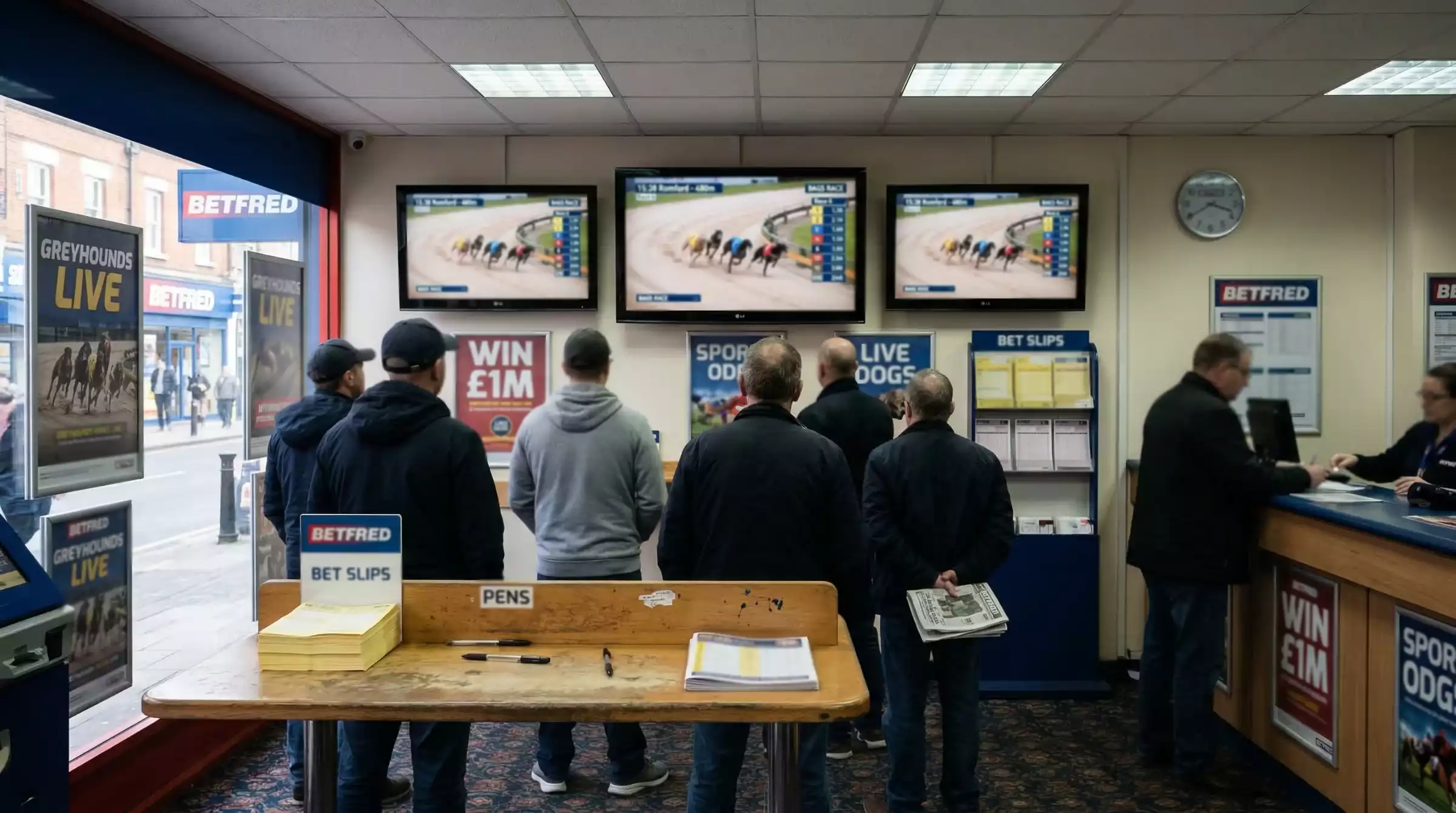
Most Yarmouth meetings are BAGS fixtures — races staged specifically to provide betting content for bookmakers across the country. Understanding BAGS explains why the track races on certain days, why the card is structured the way it is and how the results you see on screen are connected to a funding model that keeps the entire licensed circuit operational. The engine behind every weekday race is, in plain terms, a commercial agreement between the racing industry and the bookmaking trade.
BAGS stands for Bookmakers Afternoon Greyhound Service, though the acronym has long outlived the original afternoon-only scheduling. The concept is simple: bookmakers need a steady supply of live racing to offer their customers, and greyhound tracks need revenue beyond gate receipts. BAGS meetings fill both needs, providing a broadcast product that reaches betting shops and online platforms while generating fixture fees and levy income for the tracks that host them.
This guide explains how BAGS works, how it differs from open meetings, where the money flows and what BAGS fixtures look like on the Yarmouth schedule. If you have ever wondered why a Monday evening card at Yarmouth features twelve races of graded A5-to-A8 dogs — rather than the glamour of a feature event — BAGS is the answer.
Where those cards fall is in the fixture list.
What Is BAGS — Origin and Purpose
The Bookmakers Afternoon Greyhound Service was established to create a reliable supply of live racing content for high-street betting shops. Before BAGS, the connection between tracks and bookmakers was informal — shops might show races from whichever track happened to be running, with no guarantee of regularity or quality. BAGS formalised that relationship, creating a scheduled fixture list that ensured bookmakers could offer greyhound betting to their customers every day of the working week.
The commercial logic is mutual. Tracks receive fixture fees for hosting BAGS meetings, and those fees form a significant part of the revenue that keeps smaller stadiums viable. Without BAGS income, many tracks outside the major metropolitan centres would struggle to cover their operating costs, because the gate receipts from a weeknight meeting at a regional stadium are rarely enough on their own. The British Greyhound Racing Fund collected £6.75 million in the 2024-25 financial year from voluntary bookmaker contributions, levied at a rate of 0.6% of greyhound betting turnover. That fund supports tracks, welfare programmes and prize money across the licensed circuit.
For punters, the BAGS system means that Yarmouth’s weekday card is structured around the needs of the broadcast schedule rather than the preferences of the on-track audience. Races are spaced at regular intervals — typically every twelve to fifteen minutes — to provide a smooth flow of betting opportunities. The field composition is graded rather than open, which keeps the competition level predictable and the betting markets liquid. It is racing designed for the screen, and the results page reflects that purpose.
The service has evolved since its inception. What began as an afternoon product now covers morning, afternoon and evening slots, with different tracks assigned to different broadcast windows to avoid overlap. Yarmouth’s position in the schedule is determined by its media contract and its slot within the Premier Greyhound Racing framework, both of which shape when the track races and which meetings appear on which platforms.
How BAGS Meetings Differ From Open Meetings
The distinction between BAGS meetings and open meetings is fundamental to understanding the quality of racing on any given card. BAGS fixtures are populated with graded races — A4 through A9 at most tracks — where dogs are matched by time-based grading bands. The fields are competitive but not exceptional, the prize money is modest and the primary audience is the off-track bettor watching via a bookmaker stream or in a betting shop.
Open meetings are different in character and ambition. They feature open races (marked OR on the racecard), invited or qualifying entries, higher prize money and often a named event at the centre of the card. The East Anglian Derby, Yarmouth’s September feature, is the most prominent example. Open meetings attract the better dogs, draw bigger trackside crowds and generate more media attention. The racing quality is visibly higher, the form lines are more complex and the betting markets are sharper.
The income dynamics diverge too. BAGS meetings generate revenue through fixture fees and the broadcast levy, while open meetings rely more heavily on gate receipts, sponsorship and tote turnover from the on-track audience. According to BGRF data, the fund’s total income reached £7.3 million in 2023-24, a figure that reflects the scale of the levy-funded system but also its vulnerability — that income declined by four per cent from the previous year’s £7.6 million, signalling pressure on the voluntary contribution model.
For bettors, the practical difference is straightforward. BAGS meetings offer predictable, frequent betting opportunities with moderate field quality and relatively transparent form. Open meetings offer fewer races but deeper competition, where the standard form analysis tools are tested by unfamiliar dogs and variable field composition. Both have their place in a betting strategy, but confusing the two — applying open-meeting expectations to a BAGS card or vice versa — leads to misplaced confidence.
The Funding Chain — From Bet to Track
The money that sustains UK greyhound racing flows through a chain that begins with the punter’s stake. When a bet is placed on a greyhound race — whether in a betting shop, online or via an exchange — the bookmaker retains a margin after paying out winners. A portion of that margin is contributed to the BGRF as a voluntary levy, and the fund then redistributes the income to the sport. The chain is simple in structure but fragile in practice, because every link depends on the next: fewer bets mean less levy income, which means less funding for tracks, which means fewer meetings, which means fewer bets.
The BGRF distributes its income to the sport through several channels. Prize money supplements, track improvement grants, welfare programmes and administrative costs all draw from the fund. Tracks like Yarmouth receive a portion of this distribution in proportion to their contribution to the broadcast schedule — the more BAGS meetings a track hosts, the greater its share of the collective income. This creates an incentive for tracks to maximise their fixture count, which in turn provides bookmakers with more content and the levy base with more turnover.
The vulnerability of this model is well understood within the industry. A voluntary system depends on bookmaker goodwill, and that goodwill can be strained by regulatory changes, shifts in consumer behaviour or competitive pressure from other betting products. If bookmaker margins on greyhound betting decline — due to exchange competition, tax increases or falling customer interest — the voluntary contributions decline with them, and the tracks that depend on BAGS income feel the squeeze first.
For the bettor, the funding chain is invisible in the day-to-day experience of reading a racecard and placing a bet. But it shapes the product. The number of races on a Yarmouth card, the grade composition, the spacing between races, the broadcast quality — all of these are downstream consequences of how much money flows into the sport from the betting market. Understanding the chain does not change your selections, but it explains why the fixture list looks the way it does and why changes to the betting landscape ripple through to the track.
The wider context is set out in our Yarmouth greyhound results guide.
BAGS at Yarmouth — Which Meetings and When
Yarmouth’s weekly schedule is built around its BAGS allocation. The track typically races four days per week — Monday, Wednesday, Saturday and Sunday — with the majority of those meetings classified as BAGS fixtures carrying broadcast coverage through SIS and bookmaker platforms. The exact days and times are subject to the fixture list published by Premier Greyhound Racing and can shift between periods, so checking the current schedule before any meeting is essential.
BAGS meetings at Yarmouth usually feature ten to twelve races per card, run at regular intervals from the first race to the last. The grade mix on a typical BAGS evening spans A5 through A8, with occasional A4 or A9 races depending on the pool of available dogs. Sprint races at 277 metres and staying races at 659 or 843 metres appear less frequently than the standard 462-metre trip, which dominates the BAGS card because the grading bands are deepest at that distance.
Open meetings — which sit outside the BAGS framework — are scheduled less frequently, usually on weekends or around feature events like the East Anglian Derby in September. These meetings may still carry broadcast coverage, but they are organised by the track rather than allocated through the BAGS system, and the prize money, field quality and audience are all different. The racecard will not always distinguish explicitly between a BAGS meeting and an open meeting, but the grade composition gives it away: a card of graded A-races is BAGS; a card with OR entries and named events is open.
For anyone building a regular betting routine around Yarmouth, the BAGS schedule is the foundation. It provides predictable, data-rich racing on consistent days, with form lines that build from meeting to meeting because many of the same dogs return on a two-to-three-week cycle. Open meetings are the exceptions — worth special attention when they occur, but not the bread and butter. The engine behind every weekday race is the BAGS fixture, and it is the fixture that produces the vast majority of results on the Yarmouth card.
