
Greyhound Betting Markets — Forecast, Tricast and Exotic Wagers
 Available in US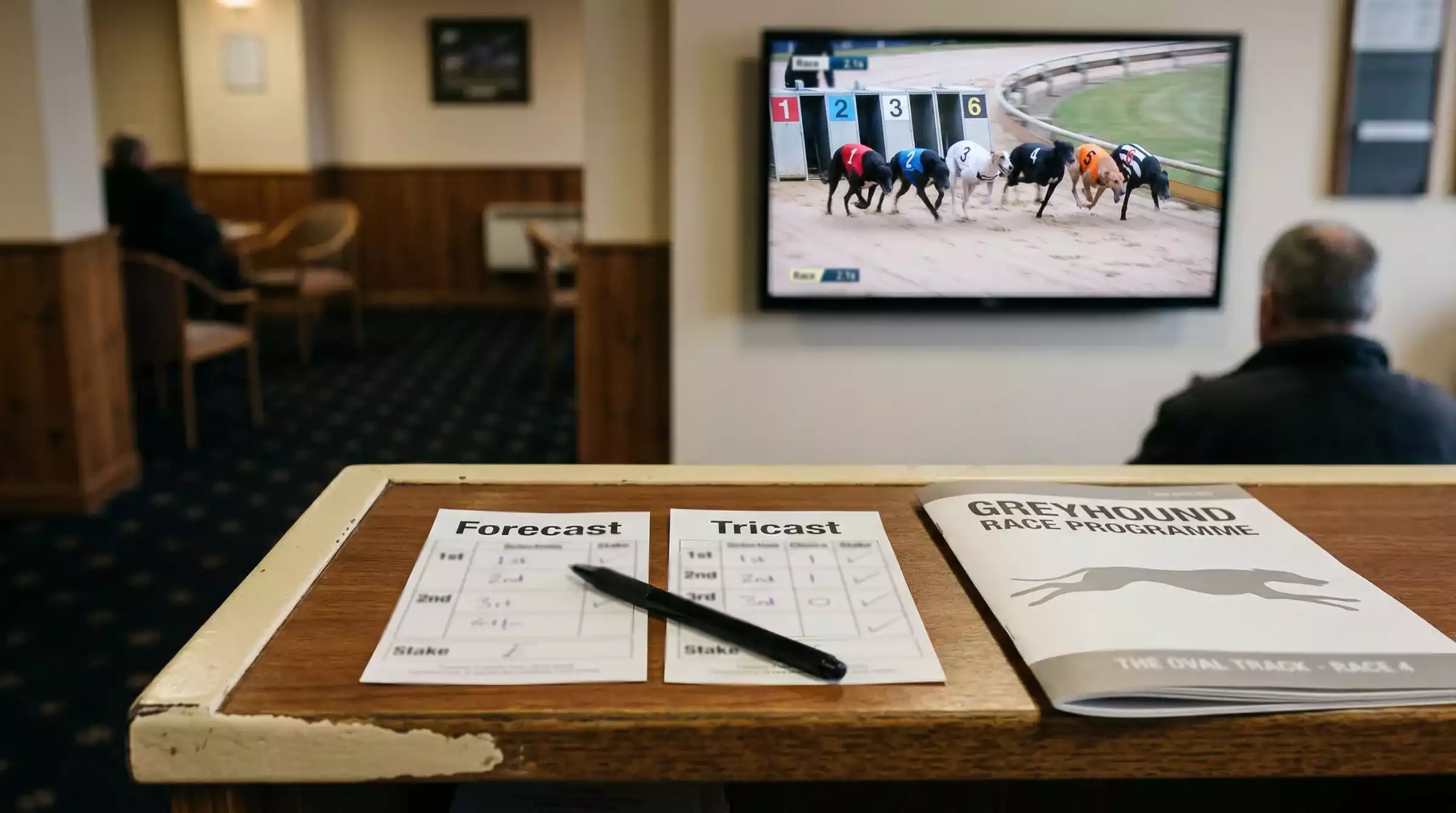
Exotic markets turn a six-dog race into dozens of betting permutations, and for the analytical bettor they represent the clearest route to returns that a simple win bet cannot deliver. Beyond the win and each-way markets, greyhound racing offers forecasts, tricasts, combination bets and pool-based wagers that each carry their own mechanics, payout structures and strategic applications. Beyond the win bet is where the serious money is made — and where the serious mistakes happen, too, when the maths is ignored.
The exotic betting landscape is shaped by two structural features of greyhound racing. First, the six-runner field keeps the number of permutations manageable — 30 possible forecast combinations, 120 possible tricast combinations — which makes exotic bets more tractable than their horse racing equivalents. Second, the volume of racing is enormous: SIS delivers approximately 33,000 UK and Irish greyhound races per year to betting markets, providing a vast dataset for anyone who wants to study how exotic markets behave across different race types, grades and tracks.
This guide covers forecast types, tricast mechanics, the pool-based alternatives and the strategic situations where exotic bets at Yarmouth offer genuine value over simpler wagers.
The prices they settle at are in SP against BSP.
Forecast Types: Straight, Reverse and Combination
The straight forecast — naming the first and second finisher in exact order — is the entry point to exotic greyhound betting. The payout is determined by the Computer Straight Forecast, a formula-based dividend calculated after the race from the starting prices of the first two home. The CSF is not a fixed price; it varies with every result, which means the return on a forecast cannot be known precisely in advance. What can be estimated is the range: a forecast combining two short-priced dogs will typically return in the low single figures per pound staked, while a forecast involving a genuine outsider can return fifty pounds or more.
The reversed forecast removes the need to predict the finishing order between two selections. It covers both possible orderings — A first and B second, or B first and A second — at double the stake. The reversed forecast is the pragmatic choice when form analysis identifies two clear contenders but cannot separate them. The return per unit is lower because you are paying for coverage, but the probability of collecting is higher.
Combination forecasts extend the logic further. Naming three dogs covers six first-and-second permutations; naming four covers twelve. Each additional selection multiplies the cost, and the CSF return needs to exceed the total outlay for the bet to profit. In practice, combination forecasts work best in races where a clear group of contenders exists — three dogs with demonstrably superior form — and the outsiders are unlikely to interfere with the first two places. Identifying that separation is the analytical task, and the form, grade and trap data on the racecard provide the inputs.
The tote pool forecast — offered through on-track tote windows and some online operators — works differently from the CSF. The pool-based payout divides the total money wagered on forecast bets across the winning combination, after a deduction for the operator’s margin. Pool forecasts can occasionally pay more or less than the CSF equivalent, depending on how the betting public has distributed its money. In a race where the public heavily backs one forecast combination and a different one wins, the pool payout on the unexpected result can be substantially higher than the CSF.
Tricast Mechanics and Expected Returns
The tricast requires the first three finishers in exact order, and the payout — the Computer Tricast — reflects the significantly greater difficulty. In a six-runner field, 120 possible tricast combinations exist, and the random probability of any single combination is less than one per cent. The returns compensate: a winning tricast can pay anywhere from twenty pounds to several hundred pounds per unit, depending on the prices of the three placed dogs.
Combination tricasts are the standard approach for most bettors. Selecting three dogs covers six orderings at six times the unit stake. Selecting four covers twenty-four orderings at twenty-four times the stake. The cost escalates quickly, which means tricast betting requires discipline about when to engage. A one-pound combination tricast on three dogs costs six pounds; on four dogs, twenty-four. The expected return needs to justify the outlay, and in competitive races where the top three are evenly matched, the Computer Tricast dividend is often lower because the finishing order was deemed likely by the market.
The highest-value tricast scenarios arise when the field contains a clear favourite for first place but genuine uncertainty about second and third. A straight tricast — naming the favourite to win with two selections for the minor placings in a specific order — costs a single unit and targets the exact outcome your form analysis points to. If your first selection wins, the tricast return is amplified by the uncertainty in the places, because the Computer Tricast formula rewards precision in the exact ordering.
Tricast dividends also vary by meeting type. Open meetings with stronger fields and deeper markets tend to produce lower tricast dividends — the results are more predictable when the quality is higher. BAGS meetings at the middle grades, where the fields are more evenly matched and the outcomes less certain, tend to produce larger dividends. At Yarmouth, the BAGS-heavy schedule means tricast bettors have a regular supply of competitive, evenly graded races to target.
The wider context is set out in our Yarmouth greyhound results guide.
When Exotics Make Sense at Yarmouth: Pool Depth and Field Quality
The strategic case for exotic bets at Yarmouth rests on two factors: the depth of the betting pool and the quality of the field. Pool depth determines the liquidity of the market — how much money is wagered on forecast and tricast combinations — and at a midweek BAGS meeting the pool is thinner than at a Saturday open event. Thin pools can produce volatile payouts, occasionally generating unexpectedly large returns when the public’s money is concentrated on a few popular combinations and a less-backed result occurs.
Field quality determines the predictability of the race. In a race where one dog is clearly superior and two others are competitive but the remaining three have little chance, the forecast and tricast fields are effectively reduced. The three genuine contenders dominate the possible outcomes, and the exotic bet becomes a test of whether you can order them correctly — a more manageable challenge than predicting the exact finishing order in a race where all six runners have a chance.
The interaction between pool depth and field quality creates the optimal scenarios. A BAGS race at A5 or A6 with a clear top three and a thin forecast pool is the prototype: enough form data to justify a combination forecast or tricast, and enough market inefficiency to offer a return that compensates for the risk. High-grade open races, by contrast, attract deeper pools and more informed money, which compresses the CSF and Computer Tricast dividends toward their fair value — less room for the analytical edge to generate outsized returns.
The greyhound betting market underpins these dynamics at considerable scale. According to Gambling Commission figures, betting shop turnover on greyhound racing reached £794 million in 2023-24, and exotic bets represent a significant share of that activity. The six-runner field makes exotics structurally attractive, and the volume of racing — multiple meetings per day, every day — provides the repetition that a profitable exotic strategy needs to generate returns over time. The market is big enough to support the approach; the question is whether the analysis behind each bet is sharp enough to exploit it.
