
History of Yarmouth Stadium — From 1940 to the Modern Era
 Available in US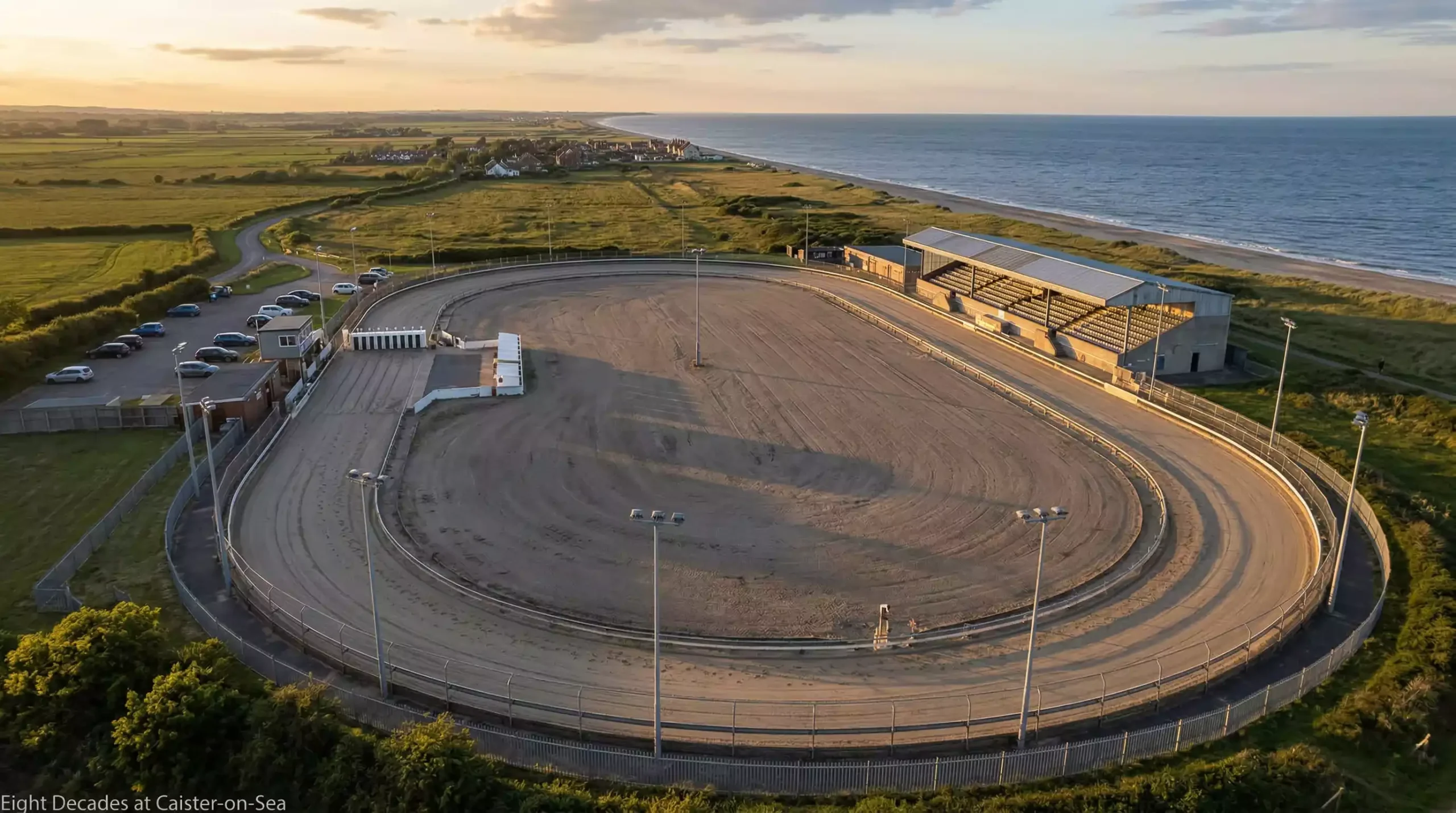
Yarmouth Stadium has hosted greyhound racing since 1946, and its story mirrors the sport’s own evolution — from post-war mass entertainment to a regulated, data-driven discipline that serves both live audiences and a global betting market. Eight decades at Caister-on-Sea is a long tenure for any sporting venue, and the fact that the stadium is still racing while dozens of tracks across Britain have closed tells you something about the resilience of the operation and the community that sustains it.
The history is not a smooth upward line. There have been permit-track years and NGRC-licensed years, periods of investment and periods of stagnation, moments of national recognition and quieter decades when the stadium served its local audience without fanfare. What threads the story together is continuity: the same site, the same sport, the same stretch of Norfolk coastline. This guide traces that continuity from the founding years through to the modern media deals that keep Yarmouth on screens across the country.
Its showpiece race is the East Anglian Derby.
Post-War Origins and the Permit-Track Era (1940s–1980s)
The stadium was founded in 1939 or 1940 — records from the period are imprecise — but wartime restrictions delayed the start of racing. The first meeting took place on 7 December 1946, when the track opened as a permit venue under the independent licensing system that governed greyhound racing outside the major NGRC-regulated circuits. Permit tracks operated with fewer regulatory requirements than NGRC-licensed stadiums, which gave them operational flexibility but also meant less oversight of racing standards and betting practices.
The post-war decades were the golden age of British greyhound racing in terms of attendance. Crowds across the country numbered in the tens of millions annually, and even a regional track like Yarmouth drew significant local audiences on race nights. The sport occupied a social niche that combined entertainment, gambling and community gathering, and the Norfolk coast — with its holiday trade and its working-class population — was fertile ground for a venue that offered all three.
Through the 1950s, 1960s and 1970s, Yarmouth established itself as a solid permit operation. The track hosted regular meetings, developed a local training community and built the East Anglian Derby into a feature event that attracted entries from beyond the immediate region. The first East Anglian Derby final was held on 3 September 1947 — just nine months after the stadium opened — and the competition has run annually since, making it one of the longest-standing feature events in UK greyhound racing. The Derby distance — 462 metres — has remained the standard trip at the track throughout its history, a consistency that has allowed generations of form data to accumulate over the same course and distance.
The permit era also produced one of the stadium’s most notable milestones. In 1987, Yarmouth became the first permit track in Britain to record a tote turnover of £1 million, a figure that reflected both the volume of on-track betting and the stadium’s ability to attract racegoers in numbers that many larger tracks would have envied. That milestone signalled a track operating well above its weight class, and it laid the groundwork for the transition to full licensed status that would come in the following decades.
The £1 Million Tote Milestone and NGRC Transition
The £1 million tote figure in 1987 was not just a number — it was a statement of commercial viability that attracted attention from the national racing authorities. Permit tracks were typically smaller, less regulated and less commercially significant than their NGRC-licensed counterparts, and a permit venue generating that level of tote activity suggested an operation that had outgrown its regulatory category.
The transition from permit to licensed status was a process rather than an event. It involved meeting higher standards for track safety, racing integrity, veterinary provision and financial reporting — all of which required investment from the stadium’s ownership. The benefits of the transition were significant: access to the wider GBGB-regulated racing programme, eligibility for BAGS fixture allocations that brought broadcast revenue, and integration into the national grading system that gave Yarmouth races visibility beyond the local market.
For the training community around Yarmouth, the transition to licensed status was transformative. Trainers at a licensed track could enter dogs into the national programme, compete at other licensed venues and attract owners who wanted their dogs racing on the regulated circuit rather than the permit fringe. The depth of talent at Yarmouth grew as a result, and the track’s fixture list expanded to accommodate the increased demand for BAGS meetings and the higher standard of competition that licensed racing required.
The tote milestone and the subsequent licensing transition were the inflection point in Yarmouth’s history — the moment when the stadium moved from being a successful local venue to becoming a functioning part of the national greyhound racing infrastructure. Everything that followed — the investment in facilities, the media deals, the presence of champion trainers — traces back to that shift.
The wider context is set out in our Yarmouth greyhound results guide.
Modern Investment: Len Franklin Grandstand and ARC Media Deal
The modern era at Yarmouth is defined by two investments that reshaped the stadium’s physical and commercial footprint. The first was the construction of the Len Franklin Grandstand in 2006, a £2.5 million project that replaced the ageing facilities with a 250-seat restaurant, three VIP boxes and a tiered viewing structure overlooking the home straight. The grandstand was a statement of intent: the stadium’s ownership was investing in the venue as a hospitality destination, not just a racing facility, and the result was a track that could host corporate events, family nights and dining experiences alongside the standard BAGS card.
The second investment was infrastructural rather than architectural. In 2012, £190,000 was spent on track improvements — surface upgrades, drainage work and maintenance enhancements — that directly benefited the quality of the racing product. That same year, Mark Wallis trained Blonde Snapper to victory in the English Greyhound Derby, the sport’s most prestigious event, and the coincidence of a Derby winner emerging from a track undergoing modernisation was widely noted. The track improvements were not cosmetic; they addressed the foundation on which every race is run, and the quality of the Yarmouth surface has been a consistent strength since.
The media landscape evolved in parallel. In 2018, Yarmouth signed its first media contract with Arena Racing Company, bringing the stadium into the ARC broadcasting network. A new five-year deal between ARC and GMG took effect from January 2025, securing Yarmouth’s position in the Premier Greyhound Racing schedule through to the end of the decade. The deal guarantees broadcast coverage for the stadium’s meetings, which means Yarmouth races reach betting shops, online platforms and international simulcast networks as a matter of course rather than exception.
Sir Philip Davies, upon becoming chair of the GBGB, described licensed greyhound racing as a sport occupying an important place in British culture across nearly a century of history. At Yarmouth, that history is tangible: the same site at Caister-on-Sea, the same East Anglian Derby, the same commitment to a sport that has adapted to every economic and regulatory shift thrown at it over eight decades. The stadium that opened in 1946 as a modest permit track is now a licensed, broadcast-connected, professionally managed venue that contributes to the national circuit — and the arc from there to here is the arc of British greyhound racing itself.
