
UK Greyhound Racing Industry Overview — 18 Tracks, 500 Trainers, £15.7M in Prize Money
 Available in US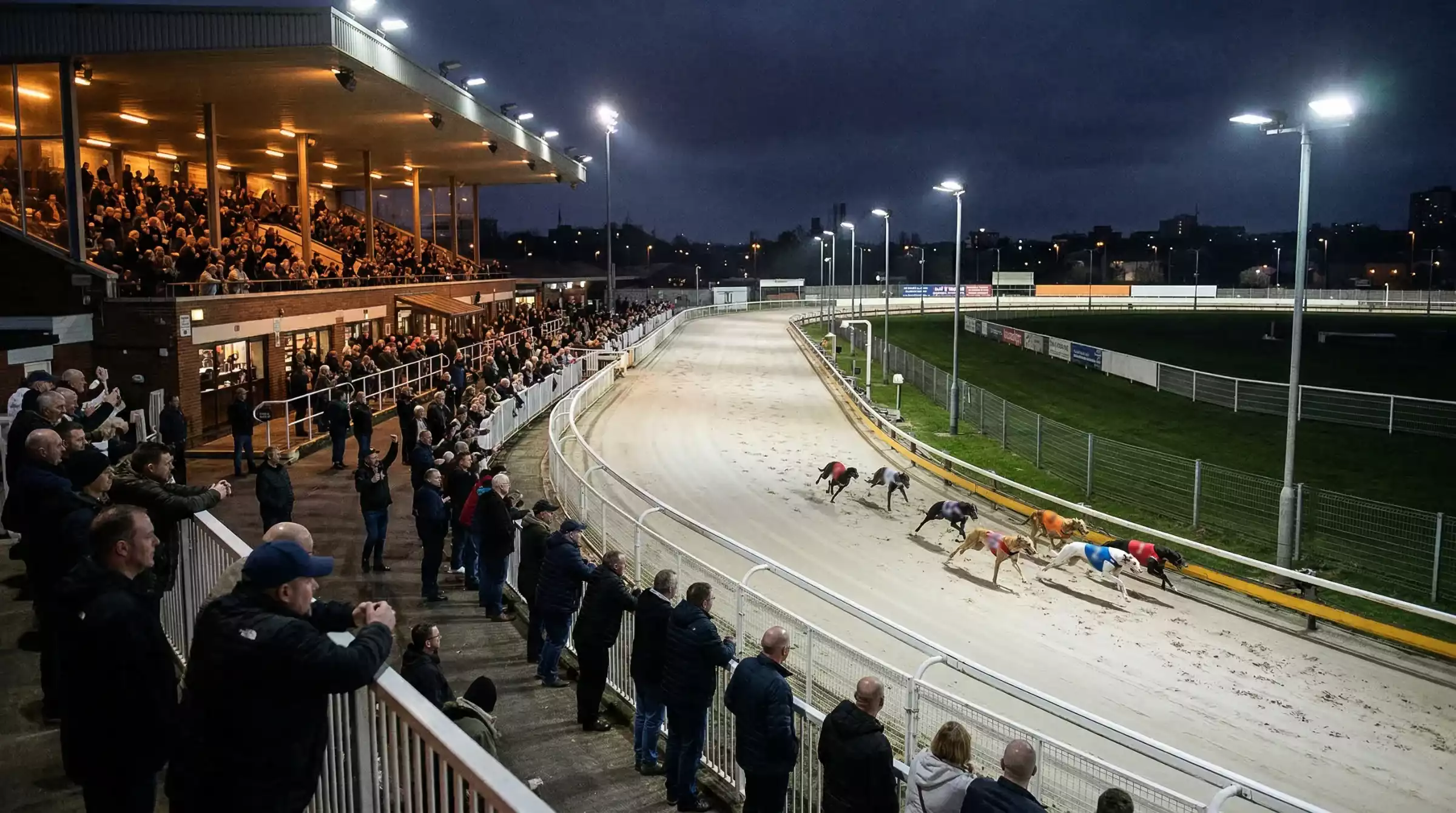
UK greyhound racing operates through 18 licensed stadiums under the Greyhound Board of Great Britain, and together they form a tightly regulated national circuit that sustains thousands of jobs, millions of pounds in prize money and a betting market measured in the hundreds of millions. The circuit behind every racecard is both smaller and more structured than most casual observers realise — a compact ecosystem where regulatory authority, commercial broadcasting and voluntary funding from the bookmaking industry intersect to produce the sport that reaches your screen.
This guide maps the industry’s key dimensions: how many tracks, how many people, how much money flows through the system and where Yarmouth fits within a national circuit that has been contracting in venue count even as it professionalises its operations. The numbers tell a story of a sport that is leaner than it was a generation ago but more intensively managed, more visible through broadcast media and more accountable on welfare than at any point in its history.
The tax pressure on it is in remote gaming duty.
The Numbers: Tracks, Trainers, Owners and Staff
The headline figure is 18 — the number of GBGB-licensed stadiums operating as of early 2025. That number has declined from a peak of several dozen licensed venues in the mid-twentieth century, a contraction driven by rising land values, falling attendances and the shift of betting activity from on-track to off-course and online. Each closure reduces the circuit’s geographic reach but concentrates the remaining racing at venues with the infrastructure and commercial partnerships to sustain operations.
Behind those 18 stadiums sits a workforce and participant base of significant scale. Approximately 500 licensed trainers operate across the circuit, managing the dogs that race at licensed meetings. Around 3,000 kennel staff support the daily care, exercise and conditioning of the racing population. Some 700 track officials — racing managers, grading officers, veterinary surgeons, stewards — administer the meetings. And roughly 15,000 registered owners fund the breeding, rearing and training of the dogs that populate the racecards.
The Scottish Animal Welfare Commission’s 2023 report identified 573 licensed residential kennels across the UK, each housing and training a pool of greyhounds for the licensed circuit. The kennels range from large, multi-trainer operations with dozens of dogs to smaller single-handler setups supplying runners to one or two local tracks. The distribution is uneven: areas with multiple licensed stadiums within driving distance — the Midlands, London and the South East, East Anglia — support denser concentrations of kennels than regions with no nearby track.
The employment and participation figures are modest by the standards of horse racing or football, but they are substantial for a niche sport, and they underpin a supply chain that stretches from breeding farms in Ireland — where the majority of UK racing greyhounds originate — through to the retirement charities that rehome dogs after their racing careers end. The 18 stadiums are the visible front of a much wider operation, and the racecard that a bettor studies on a Yarmouth evening is the end product of an industry that employs thousands and involves tens of thousands.
Prize Money Structure: From BAGS Cards to the English Derby
The total prize fund distributed across all GBGB competitions amounts to approximately £15.7 million per year. That figure covers everything from the modest purses at weeknight BAGS meetings — where first-prize money at lower grades can be as little as a few hundred pounds — to the headline events that define the sport’s competitive calendar. The English Greyhound Derby, the most prestigious single event, offers £175,000 to the winner from a total fund of £235,000, placing it in a different financial universe from the routine midweek card.
The prize money structure is tiered by meeting type and grade. BAGS meetings — which form the bulk of the schedule at every licensed track — carry prize levels funded through the BGRF levy and fixture fees. Open meetings offer higher purses funded through a combination of track revenue, sponsorship and entry fees. Feature events — named competitions like the English Derby, the Scottish Derby, the East Anglian Derby and the various cups and stakes — sit at the summit, with prize funds that reflect the prestige and broadcast profile of the occasion.
The gap between the top and bottom of the prize ladder is wide, and it shapes the composition of racing at different levels. Trainers with elite dogs target the feature events where the financial returns justify the preparation effort. Trainers with solid but non-elite dogs focus on the BAGS circuit, where the volume of racing provides a steady income stream through smaller but more frequent prizes. The two tiers overlap — a dog that wins at BAGS level may earn a shot at an open event — but they function as distinct economies within the same sport.
For bettors, the prize money level is a proxy for field quality. A higher-prized race attracts better dogs, which means more competitive fields, tighter finishing margins and more reliable form lines. A lower-prized race at the bottom of the BAGS card may feature inconsistent performers, recently regraded dogs and newcomers whose ability is unproven. The odds on the card may look similar across both types of race, but the underlying quality — and therefore the predictability — is not the same.
The wider context is set out in our Yarmouth greyhound results guide.
How Yarmouth Fits Within the National Circuit
Yarmouth Stadium occupies a specific position within the 18-track circuit: a mid-sized licensed venue on the Norfolk coast, racing four days a week primarily under the BAGS format, with a flagship event — the East Anglian Derby — that gives it a presence on the national calendar. It is not one of the circuit’s biggest venues by attendance or turnover, but it punches above its weight in several respects, most notably through the training community that surrounds it.
The presence of Mark Wallis — fifteen-time Champion Trainer — and a cluster of competitive handlers in the East Anglian region means that the standard of racing at Yarmouth is higher than the track’s size alone would predict. Dogs trained at Yarmouth and the surrounding area compete successfully at tracks across the country, and the kennel infrastructure that supports the local circuit is among the densest in the UK relative to the number of licensed venues in the region.
Yarmouth’s broadcast position is secured through the ARC-GMG media deal, which places the track within the Premier Greyhound Racing schedule alongside thirteen other stadiums. That integration ensures coverage of every meeting through bookmaker platforms, SIS feeds and RPGTV, which in turn sustains the betting market that funds the track’s BAGS fixtures. Without the broadcast connection, Yarmouth would be a local venue with local significance. With it, the track’s results are visible nationally and internationally, and the form produced at Caister-on-Sea feeds into a data ecosystem that bettors across the country use to inform their selections.
The track’s eighty-year history, its investment in the Len Franklin Grandstand, its ARC media deal and its training community position Yarmouth as a venue with resilience at a time when other tracks have closed. It is not immune to the pressures — declining betting revenue, regulatory scrutiny, the Welsh and Scottish legislative challenges — but it operates within a structure that gives it more commercial security than many of its peers. Within the national circuit, Yarmouth is a track that does its job well: providing consistent, well-managed racing to a betting market that depends on it.
