
Greyhound Racing Centenary 2026 — 100 Years Since Belle Vue
 Available in US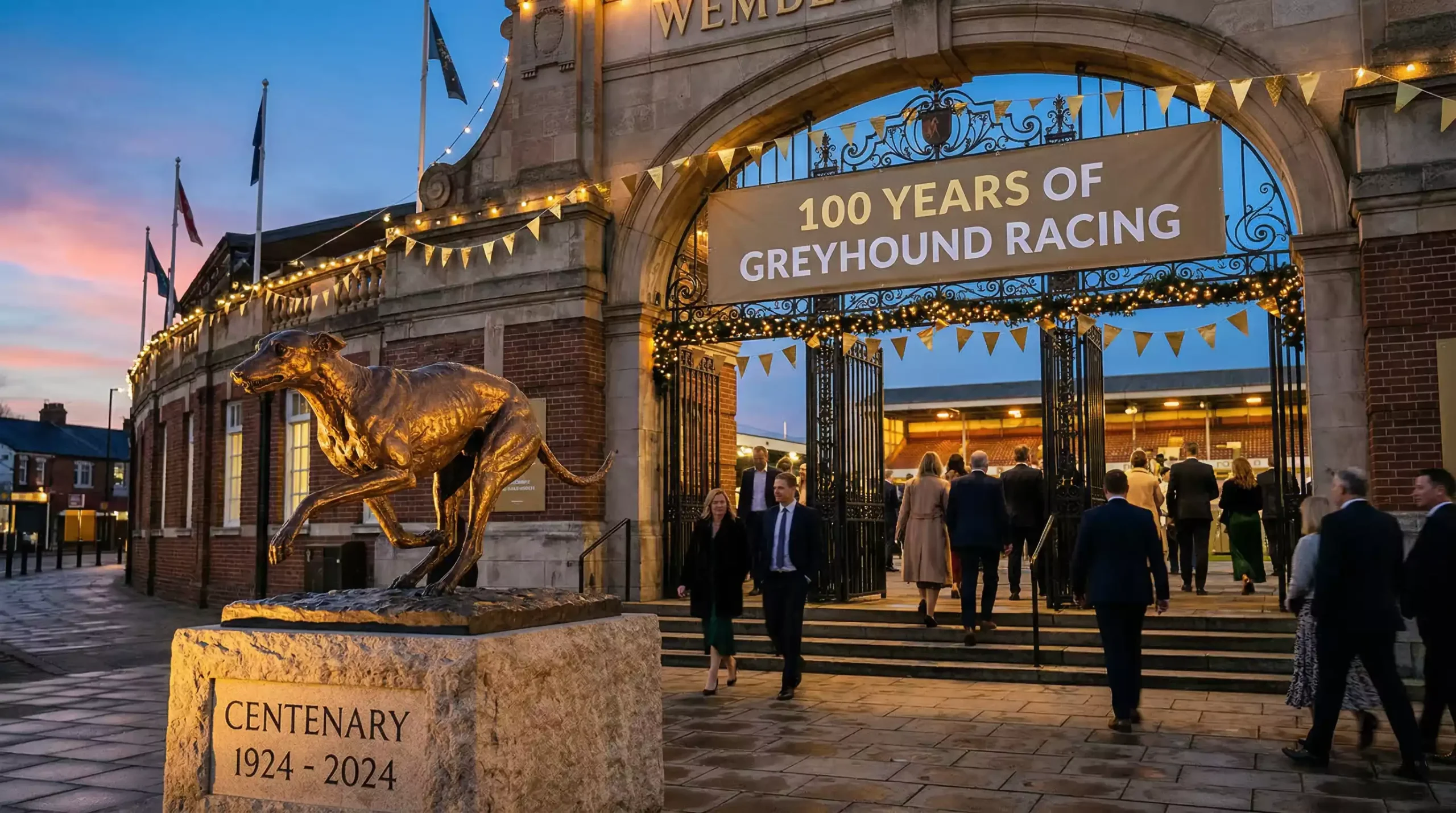
On 24 July 2026 greyhound racing in Britain turns 100, and the sport’s survival itself is the story. A century ago, a crowd gathered at Belle Vue in Manchester to watch dogs chase a mechanical hare around a floodlit track, and the evening launched an entertainment phenomenon that would draw tens of millions of spectators annually at its peak. A century under lights — from post-war mass entertainment to a regulated niche sport broadcast to screens worldwide — and the question the centenary poses is not where greyhound racing has been, but whether the next hundred years are plausible.
The GBGB has announced plans to mark the occasion with commemorative events, a gala dinner and a programme of celebrations designed to connect the sport’s heritage with its current audience. For Yarmouth — a track that has operated since 1946 and will be eighty years old when the national centenary arrives — the anniversary provides a moment to locate a regional venue within a national story. This guide covers the Belle Vue origins, the GBGB’s centenary plans and Yarmouth’s place in a hundred years of British greyhound racing.
Yarmouth’s own eight decades are in the stadium history.
Belle Vue 1926: The Evening That Launched a Sport
The first regulated greyhound race in Britain took place on 24 July 1926 at Belle Vue Stadium in Manchester. The event drew a crowd estimated at 1,700, modest by the standards that would follow, but the concept was immediately compelling: fast dogs, a mechanical lure, a compact track, short races and — crucially — a betting market that gave the audience a financial stake in the outcome. Within weeks, plans for new stadiums were being drawn up across the country.
The Belle Vue model was imported from the United States, where greyhound racing had been trialled with varying success. The British adaptation added two elements that proved decisive: purpose-built oval tracks with standardised distances, and a totalisator system that allowed on-track betting under regulated conditions. The combination of spectacle and wagering was potent. By the end of the 1920s, dozens of tracks had opened across England, Scotland and Wales, and greyhound racing had established itself as one of the country’s most popular spectator sports.
The interwar growth was extraordinary. By the mid-1930s, annual attendance at greyhound meetings across the UK exceeded 50 million — a figure that placed the sport alongside football as a pillar of working-class leisure. The tracks were social hubs: an evening out that combined entertainment, community and the possibility of a winning bet at a price that most families could afford. The sport’s accessibility — cheap admission, short meetings, no specialist knowledge required to enjoy the spectacle — was its commercial engine, and it drove expansion at a pace that no other niche sport in British history has matched.
The post-war decades sustained the momentum, though attendances began a gradual decline from the 1960s onward as television, changing social habits and the legalisation of off-course betting shops shifted the public’s entertainment and gambling preferences. The sport that drew 50 million spectators a year would eventually contract to a fraction of that audience, but the Belle Vue evening of 1926 remains the origin point — the moment when a mechanical hare and a pack of dogs created something that would endure for a century.
The wider context is set out in our Yarmouth greyhound results guide.
GBGB Centenary Plans: Gala, Commemorative Cards and Dunstall Park
The GBGB’s centenary programme centres on 24 July 2026, the exact anniversary of the Belle Vue race. The plans include a gala dinner at Dunstall Park in Wolverhampton — the newest track on the licensed circuit, which opened in 2025 — with a reproduction of the first racing card from the 1926 event. The choice of Dunstall Park is symbolic: a new stadium hosting a centenary celebration signals that the sport is investing in its future while acknowledging its past.
Beyond the gala, the GBGB has outlined a programme of commemorative race meetings across the 18 licensed stadiums, each track hosting a centenary-themed card during the anniversary period. The details of individual track celebrations have been left to local organisers, but the national framework ensures that the centenary is marked across the entire circuit rather than concentrated at a single venue. For bettors and racegoers, the centenary meetings are expected to feature enhanced race programmes, potentially with higher prize money and feature events that draw quality fields.
Mark Bird, the outgoing GBGB chief executive, cautioned against complacency in the anniversary year. He noted that the initiatives of recent years had consolidated significant progress, but warned that the sport could not afford to be self-satisfied about maintaining its social licence in wider society. That remark frames the centenary not as a victory lap but as a checkpoint — a moment to measure how far the sport has come on welfare, governance and public perception, and to assess what remains to be done.
The centenary arrives in a year when the sport faces legislative challenges in Wales and Scotland, financial pressure from the Remote Gaming Duty increase, and an ongoing contraction in the number of licensed venues. The celebrations will take place against a backdrop that is more complicated than any anniversary organiser would prefer, and the tension between celebrating a hundred years of heritage and confronting the pressures of the present gives the centenary its particular character: pride and pragmatism in equal measure.
Yarmouth’s Place in 100 Years of Greyhound Racing
Yarmouth Stadium was founded in 1939 or 1940 and staged its first meeting on 7 December 1946, twenty years after Belle Vue. It will be eighty years old in the centenary year — not one of the original tracks, but a venue that has been present for the majority of the sport’s existence. That longevity is increasingly rare. Of the stadiums that were operating in the 1940s, a significant number have since closed, and Yarmouth’s survival through eight decades of economic, social and regulatory change is itself a minor achievement.
The track’s contribution to the sport’s story includes the East Anglian Derby, which has been run since 1947 and remains one of the longest-standing feature events on the circuit. It includes the training community led by Mark Wallis and the cluster of competitive handlers in the East Anglian region. And it includes the steady, unglamorous work of hosting hundreds of BAGS meetings per year that provide the content on which the betting market — and by extension the sport’s funding model — depends. The £2.5 million Len Franklin Grandstand, opened in 2006, modernised the venue for its next chapter; the ARC-GMG media deal, secured through 2030, guarantees its broadcast presence for the medium term.
In the centenary year, Yarmouth’s role is representative rather than exceptional. It is not the oldest track, not the biggest, not the most famous. But it is a working example of what a licensed UK greyhound stadium looks like in 2026: a venue with modern facilities, a broadcast partnership, a local training base and a fixture list that connects it to the national and international betting audience. If the centenary is about demonstrating that the sport can sustain itself for another generation, Yarmouth — eighty years old and still racing — is one of the 18 stadiums that makes the case.
