
Greyhound Track Closures 2025 — Crayford, Perry Barr, Swindon and What Comes Next
 Available in US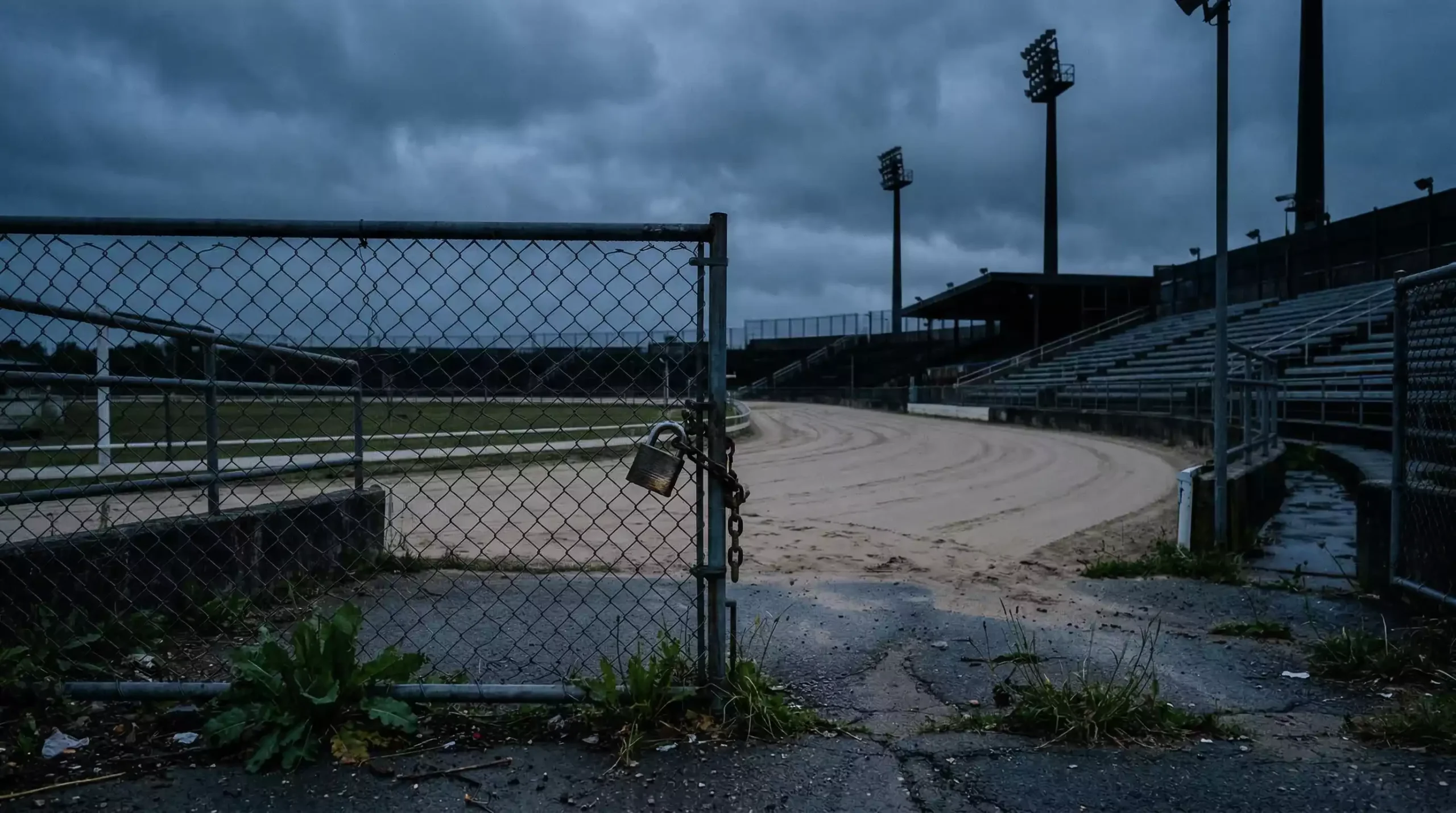
2025 saw three licensed greyhound venues shut their gates — Crayford, Perry Barr and Swindon — and the UK greyhound circuit is now smaller than at any point in its hundred-year history. Each closure removed a venue with decades of racing heritage, redistributed its trainers and dogs across the remaining tracks and reduced the geographic footprint of the licensed sport. Fewer tracks, higher stakes — the phrase captures a circuit that is contracting in venue count while concentrating its resources at the stadiums that remain.
The closures did not happen in isolation. They reflect a convergence of pressures — rising land values, declining betting shop footfall, tightening regulatory requirements and the economic impact of tax changes on bookmaker contributions to the sport. At the same time, one new venue opened: Dunstall Park in Wolverhampton, the first licensed greyhound stadium to launch in years. The net change was a loss of two venues, but the story is more nuanced than the arithmetic suggests.
The scale of what remains is in the UK industry.
Crayford, Perry Barr and Swindon: Individual Closure Profiles
Crayford Stadium in south-east London was one of the most prominent closures. Located in the Dartford area, it served a large catchment of bettors and racegoers across Kent and south London, and its position within the BAGS schedule made it a regular fixture on bookmaker screens. The closure removed a venue that had been racing for decades and left a gap in the south-eastern corner of the circuit that no nearby track can easily fill.
Perry Barr in Birmingham was the most historically significant loss. The stadium had hosted greyhound racing since the pre-war era and was one of the Midlands’ flagship venues, regularly staging feature events and open meetings that drew quality fields. Its closure was driven by redevelopment plans for the site — a pattern familiar across the sport, where the land beneath a greyhound stadium is often worth more as a housing or retail development than as a racing venue. The loss of Perry Barr reduced the Midlands circuit to a handful of tracks and displaced a community of trainers, owners and staff who had built their operations around the venue.
Swindon was the smallest of the three closures in terms of racing output, but its loss was felt locally. The track served the west of England with regular BAGS meetings and provided a racing outlet for trainers in an area with limited alternative venues. With Swindon gone, the nearest licensed tracks for western-based trainers are further away, which increases transport costs and reduces the frequency with which dogs can race — a practical constraint that affects the economics of running a kennel.
Beyond the licensed closures, 2025 also saw the last independent flapping track in Britain close its doors in March, ending a tradition of unlicensed greyhound racing that had run parallel to the regulated sport for most of its history. The flapping circuit, once a sprawling network of small-scale venues operating outside GBGB oversight, had been shrinking for years, and its final closure marked the end of an era — one that the licensed circuit had long sought to distance itself from on welfare and integrity grounds.
Dunstall Park: The One Track That Opened
Against the backdrop of closures, Dunstall Park in Wolverhampton opened as a new licensed greyhound stadium in 2025. The venue was developed on the site of the existing Wolverhampton Racecourse — a horse racing venue — adding a greyhound track to the facility and creating a dual-purpose racing operation. The opening was significant not just for the additional capacity it brought to the circuit but for what it represented: a willingness to invest in new greyhound infrastructure at a time when the trend has been overwhelmingly toward closure.
Dunstall Park enters the circuit with modern facilities, broadcast connectivity through the PGR schedule and the backing of an established racecourse operator. The GBGB has chosen the venue as the location for its centenary gala dinner on 24 July 2026, which positions Dunstall Park as a symbol of the sport’s forward-looking ambitions even as the overall venue count declines. Whether the track proves commercially sustainable over the medium term will be a significant test of the industry’s ability to renew its physical infrastructure.
The net effect of the 2025 changes is a circuit that lost three established venues and gained one new one — a contraction from roughly 20 licensed stadiums at the start of the year to 18. The redistribution of racing is managed through the BAGS fixture list and the PGR broadcast schedule, which reallocate meetings across the remaining venues to maintain the volume of content that the betting market requires. For bettors, the practical impact is a slightly different fixture rotation and, in some cases, larger fields at the surviving tracks as displaced dogs and trainers find new homes.
The wider context is set out in our Yarmouth greyhound results guide.
Impact on the Remaining Circuit and Redistribution of Racing
The closure of three tracks in a single year places additional pressure on the 18 remaining licensed stadiums. The BAGS fixture list, which needs a minimum number of meetings per week to satisfy bookmaker demand for live content, must be redistributed across fewer venues. That means some surviving tracks are asked to host additional meetings, which stretches the available pool of dogs and can lead to thinner fields or more frequent appearances by the same runners — both of which affect the quality of the racing product and the reliability of the form data.
For trainers, the closures create logistical challenges. A kennel that previously raced at Crayford and Romford — two south-eastern venues within easy driving distance — now has one fewer option and may need to travel further to maintain the same frequency of racing. The economic model of greyhound training depends on regular entries: dogs need to race to stay fit, trainers need prize money to cover kennel costs, and owners need results to justify their investment. Every mile of additional travel is a cost that squeezes that model further.
The redistribution of runners is the most immediate practical effect. Dogs that raced at Crayford, Perry Barr or Swindon must be re-trialled and regraded at their new home tracks, a process that takes time and produces a period of uncertain form. A dog graded A4 at Crayford may arrive at Romford and be regraded based on trial times that do not reflect its competitive ability, because the unfamiliar track dimensions and hare system affect the initial performance. For bettors, the weeks following a track closure are a period where the usual form analysis is less reliable, because the field at the absorbing venues includes newcomers whose grades may not yet match their true ability.
The broader question is whether the circuit has reached a sustainable minimum or whether further closures will follow. The pressures that closed Crayford, Perry Barr and Swindon — development value of land, regulatory costs, declining betting shop revenue — have not disappeared. They apply to every remaining venue, though the intensity varies with local conditions. Tracks with long leases, strong broadcast deals and supportive local economies are better insulated than those operating on short-term arrangements or in areas where alternative development interests are circling.
Yarmouth’s position within this landscape is relatively secure. The track’s ARC media deal runs through to the end of the decade, its training community provides a steady supply of runners and its location — while coastal and somewhat remote — is not subject to the kind of urban redevelopment pressure that claimed Perry Barr. The closures of 2025 are a warning, not a direct threat, but they are a reminder that the licensed circuit is not a fixed institution. It is a network that has been shrinking for decades, and each closure changes the map for every remaining venue.
