
SIS Greyhound Broadcasting — How UK Races Reach Global Betting Markets
 Available in US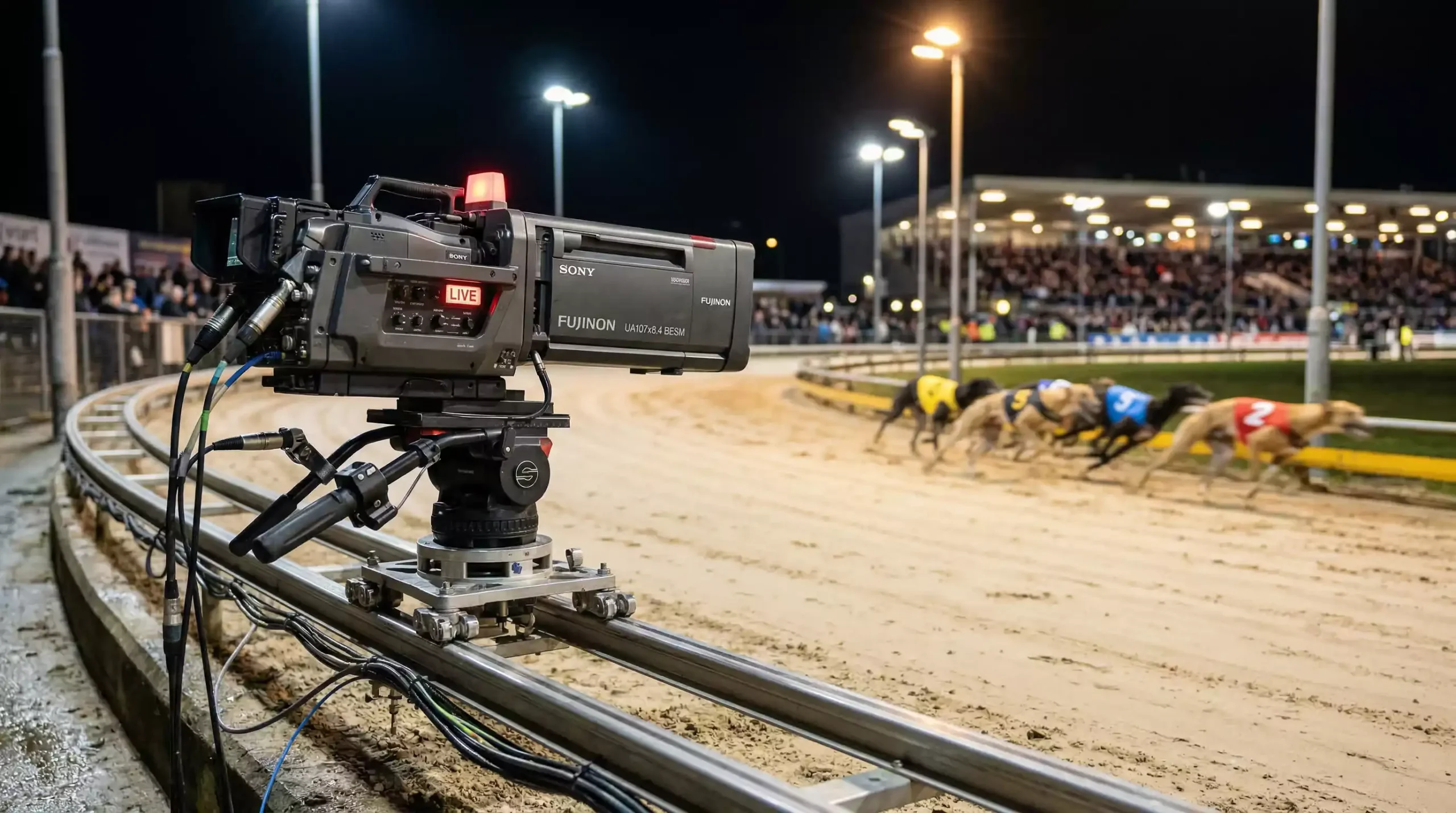
SIS pipes 33,000 UK and Irish greyhound races a year to screens across the world — a race every seven minutes during peak broadcast hours. That volume is the infrastructure on which the greyhound betting market depends: without the signal, there is no live product in the bookmaker’s shop, no stream on the punter’s phone and no wagering revenue flowing back to the tracks. A race every seven minutes is both a description of the broadcast schedule and a statement of the sport’s commercial model — content at scale, delivered continuously, monetised through the betting market it serves.
SIS — Satellite Information Services — is the broadcast backbone of UK greyhound racing, handling the capture, distribution and international syndication of live race footage from licensed stadiums. The company’s role sits between the tracks that produce the races and the bookmakers that consume the content, and understanding how SIS operates explains why Yarmouth’s Monday evening card reaches a betting screen in a William Hill shop in Manchester and, via simulcast, a wagering terminal in the United States.
Where to watch it yourself is in the live stream guide.
How SIS Broadcasting Works: From Track Camera to Bookmaker Screen
The broadcast chain begins at the stadium. SIS installs and maintains camera systems at licensed greyhound tracks, positioning units at the traps, the first bend, the back straight and the finish line. The cameras feed into a local production unit at the stadium, which mixes the angles into a broadcast-quality output with graphics overlays — dog names, trap colours, race number, distance and running order. Commentary is added either live at the track or from a remote studio, and the finished signal is uplinked to SIS’s satellite distribution network.
From the satellite, the signal is distributed to multiple endpoints simultaneously. Betting shops receive the feed through dedicated SIS receivers that display the live pictures on in-shop screens alongside odds, results and upcoming race information. Online bookmakers receive the signal through internet-based distribution, which they embed in their websites and mobile apps as a streaming option for customers with funded accounts. RPGTV receives a selection of the output for its free-to-air broadcast. International simulcast partners receive the feed for redistribution to their own markets.
The latency of the signal — the delay between the real-time event at the track and the image appearing on screen — varies by platform. The SIS in-shop feed is typically the fastest, with a delay of one to two seconds. Online bookmaker streams may carry an additional two to three seconds of latency due to internet distribution buffering. RPGTV’s delay depends on its broadcast processing chain. For in-play bettors, these differences matter; for standard pre-race wagering, they are irrelevant.
The scale of the operation is considerable. SIS covers every BAGS meeting at every licensed track, which means multiple simultaneous broadcasts running from late morning through to the final evening meeting. The scheduling is coordinated with Premier Greyhound Racing to ensure that races from different tracks are staggered — each track’s races are timed to fall between the races at other venues — so that the combined output provides a near-continuous stream of live content. The result is the one-race-every-seven-minutes rhythm that defines the greyhound betting product.
US Simulcasting: The Transatlantic Revenue Stream
The collapse of domestic American greyhound racing — down to just two operating tracks with live wagering of $8.8 million in 2023 — has created a demand vacuum that UK and Irish content fills. SIS’s international feed delivers UK greyhound races to American wagering platforms during the afternoon EST window, typically from 13:30 to 16:30, covering a period when domestic US horse racing is active but greyhound content is otherwise unavailable.
The American audience for UK greyhound racing is primarily a wagering audience. The races are consumed as betting events rather than spectator entertainment, and the platforms that carry the content — advance deposit wagering sites, simulcast facilities at racetracks and off-track betting venues — treat UK dogs the same way they treat any other imported racing product: as a stream of opportunities to bet. The cultural and emotional connection to individual dogs or tracks is minimal; the commercial connection, measured in wagering handle, is substantial enough to justify the cost of the transatlantic feed.
For UK tracks like Yarmouth, the American simulcast market represents an additional revenue layer that did not exist a generation ago. The media rights associated with the SIS international feed generate income that flows back to the tracks through the PGR and ARC frameworks, supplementing the domestic BAGS fixture fees and BGRF distributions. The irony is not lost on the industry: a country that has effectively banned greyhound racing within its own borders is simultaneously one of the largest consumers of UK greyhound content through simulcast channels.
The sustainability of the US simulcast market depends on several factors beyond UK control — American regulatory attitudes toward imported racing content, the competitive position of greyhound wagering against other betting products, and the commercial health of the simulcast platforms that carry the feed. None of these are guaranteed, but for now the transatlantic revenue stream is a meaningful contributor to the economics of UK greyhound broadcasting.
The wider context is set out in our Yarmouth greyhound results guide.
Where Yarmouth Sits in the SIS Broadcast Schedule
Yarmouth’s meetings are integrated into the SIS broadcast schedule through the track’s position within the PGR fixture framework. The stadium’s four weekly race days — Monday, Wednesday, Saturday and Sunday — are each assigned broadcast windows that fit within the staggered national timetable. The first race at Yarmouth is timed to avoid clashing with the first race at whichever other PGR track is broadcasting in the adjacent slot, ensuring that the SIS feed switches between venues without dead air.
Evening meetings at Yarmouth — the most common format — typically begin between 18:00 and 19:30 UK time. At that hour, the SIS feed has already carried a full day of afternoon meetings from other tracks, and Yarmouth’s slot falls in the late segment of the broadcast schedule. For domestic UK bettors, this is a natural viewing time — after work, accessible on a phone or computer, with the bookmaker stream providing live pictures alongside the betting interface. For US simulcast viewers, Yarmouth’s evening slot translates to early-to-mid afternoon EST, placing it within the SIS international distribution window.
The quality of the Yarmouth broadcast has benefited from the standardisation that SIS has imposed across licensed stadiums. Camera positions, graphic overlays, commentary standards and production values are consistent between tracks, which means a bettor watching Yarmouth on an SIS feed receives essentially the same broadcast experience as one watching Romford, Nottingham or any other PGR-covered venue. That consistency is deliberate — it reduces the friction of switching between tracks and reinforces the perception of a unified national product rather than a collection of independent stadiums.
For bettors who follow Yarmouth regularly, the SIS feed is the constant: the medium through which every race, every result and every finish-line photograph reaches the audience. The dogs, the trainers and the conditions change from meeting to meeting. The broadcast infrastructure that carries them does not, and that reliability is one of the quieter achievements of the SIS-PGR partnership that keeps UK greyhound racing visible to a global betting market.
