
Yarmouth Greyhound Track Guide — Distances, Layout and Racing Surface
 Available in US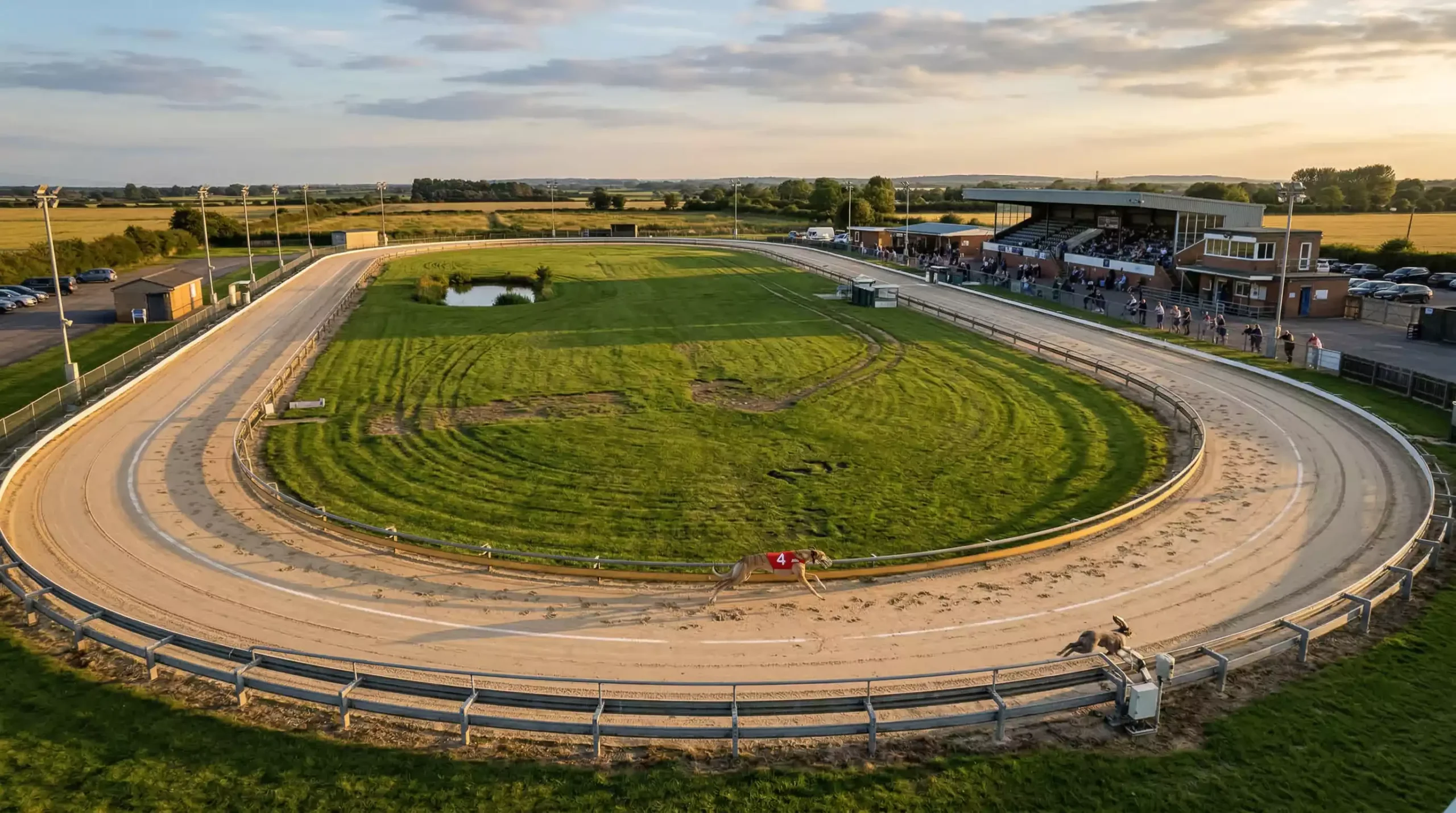
What Makes the Yarmouth Circuit Unique Among UK Greyhound Tracks
Every greyhound track has a personality. Some are long, galloping circuits that reward stamina over speed. Others are tight, technical ovals where the first bend decides half the card. Yarmouth — properly known as Yarmouth Stadium, Caister-on-Sea, Norfolk — sits firmly in the second camp. This is a Yarmouth greyhound track guide built around what the circuit itself tells you, because at a venue that has hosted racing continuously since 1946, the track’s geometry is not just a backdrop to the results. It is, in a very real sense, the co-author.
Norfolk’s 382-metre circuit is among the more compact ovals in British greyhound racing. That compactness is not a disadvantage. It creates a particular kind of race — intense, positional, and often settled before the back straight. Punters who treat every GBGB venue the same are throwing away information. The turn radius here is tighter than at larger venues like Nottingham or Towcester. The Swaffham outside hare pulls dogs along a slightly different sightline than the inside-rail systems used elsewhere. Five distinct distances — 277, 462, 659, 843 and 1041 metres — each produce different tactical demands, different trap biases, different kinds of winner.
Yarmouth Stadium was founded in 1939 and reopened after the war on 7 December 1946. Eighty years on, the track remains one of the most active in the eastern region, running four days a week under the BAGS and PGR broadcast structure. Understanding how the physical layout shapes results here is not an academic exercise. It is the foundation of every serious selection. What follows is a detailed, section-by-section breakdown of the circuit — circumference, distances, hare system, racing surface, and the sectional-time data that ties it all together.
The lure that leads them round is the Swaffham hare.
382 Metres of Racing: Circumference and Turn Radius
The single most important number at any greyhound track is the circumference. It determines the radius of every bend, which in turn determines how much centrifugal force a dog absorbs at full speed, how much ground a wide runner loses, and how quickly a race can be decided by traffic on the inside rail. At Yarmouth, that number is 382 metres — a figure that places it in the lower half of the UK circuit by size.
To put that in context, the largest licensed tracks in Britain run closer to 450–480 metres around. Towcester, before its complicated history, operated on one of the biggest ovals in the sport. Nottingham’s Colwick Park circuit is generously proportioned. Yarmouth is a different proposition entirely. The shorter circumference means tighter bends, and tighter bends mean two things that punters should never ignore: first, inside runners have a shorter path to the first bend, which amplifies the draw advantage of traps one and two on sprint distances; second, wide runners lose more ground per bend than they would at a bigger track, because the arc they travel is proportionally longer relative to the inside rail.
The turn radius at Yarmouth is not published in official documentation — no UK track puts it on the racecard — but it can be estimated from the circumference and straight lengths. With two straights of roughly 80–85 metres each, the remaining distance is distributed across four bends on a standard race. That gives an approximate bend radius notably sharper than at circuits above 420 metres. For a greyhound running at racing speed, the physics are non-trivial. Tighter turns demand more muscular effort to maintain balance, which favours dogs with good cornering technique over those who rely on raw straight-line pace.
This has direct consequences for form analysis. A dog that has been running at a larger track — say, Monmore or Doncaster — and transfers to Yarmouth may look like a certain improver on times alone. But if that dog is a wide runner by nature, the tighter bends at Caister-on-Sea may negate the apparent time advantage. Conversely, a dog that looked moderate at a bigger venue but corners tightly could find Yarmouth’s compact oval the making of it.
The circumference also affects race tempo. On a compact circuit, the first bend arrives sooner. There is less straight-line running before the pack compresses into the turn, which means early pace is disproportionately important. Dogs that show quick early speed — even if they fade slightly in the closing stages — win more often at Yarmouth than at tracks where the first bend is further from the boxes. This is a structural feature of the track, not a trend that drifts in and out. It has been true for decades, and it shapes the trap statistics in ways that become visible once you look at the data by distance.
The Five Distances — From 277m Dash to 1041m Marathon
Yarmouth offers five race distances: 277, 462, 659, 843 and 1041 metres. That range is broader than many UK tracks provide, stretching from a two-bend sprint to a genuine marathon that requires a dog to negotiate ten bends and sustain effort for over a minute. Each distance produces a different type of race, a different tactical profile, and — critically for bettors — a different relationship between trap draw and finishing position.
The 277-metre sprint is the shortest standard distance in British greyhound racing. Two bends, no room for error. The race is effectively a test of box speed and first-bend positioning. A dog that finds the rail coming out of the first turn is almost impossible to peg back over such a short trip, because there simply is not enough track for a rival to recover lost ground. Trap one carries a measurable statistical advantage at this distance, and for good reason: the inside box has the shortest route to that first bend on a track of this size. Wide runners drawn in traps five and six need to be significantly faster early just to stay level.
The 462-metre standard distance is where the bulk of the racing takes place. This is the four-bend race, the East Anglian Derby distance, and the trip over which most form comparisons are made. It is also the distance that carries the deepest historical data at Yarmouth. In 1977, Westmead Dance became the first greyhound to break the 28-second barrier over 462 metres at the track, a record that stood for a decade and established the benchmark around which grading times at Yarmouth are still, loosely, calibrated. At 462 metres the race is long enough for a strong finisher to recover from a moderate start, but short enough that early pace still matters. The trap bias is less extreme than over 277 metres, though inside traps retain a slight edge on aggregate.
At 659 metres the race extends to six bends, and the character changes again. This is middle-distance territory, where stamina begins to matter as much as speed. The extra two bends mean more opportunity for crowding, more bends where a wide runner loses ground, and more scope for a patient closer to work through the field. Dogs racing at 659 metres at Yarmouth typically need a combination of reasonable early pace — enough to avoid being trapped behind traffic — and genuine run-home strength. The sectional data over this distance shows a much wider spread in finishing splits than over 462 metres, because the demands on sustained effort are greater.
The 843-metre stayer distance and the 1041-metre marathon are scheduled less frequently. Staying races appear on open-meeting cards and occasionally on Saturday fixtures, but they are not a staple of the Monday and Wednesday BAGS schedule. Over 843 metres a greyhound negotiates eight bends, and the race is often more tactical than the shorter trips. Dogs that lead early can fade visibly, and closers who stay sound through the middle sections often produce dramatic finishes. Over 1041 metres — ten bends — the race is a genuine endurance test. Fields tend to be smaller, and the form is harder to assess because fewer dogs are tested regularly at this distance. For the punter, marathon races offer bigger-priced winners but demand a different analytical approach: raw times matter less than the ability to sustain pace under fatigue.
One structural point often missed by casual observers: the 462-metre distance is not just the most common trip on the card because of tradition. It maps neatly onto four bends of the circuit, starting and finishing on the same straight. This means dogs that race at 462 metres negotiate the same set of bends in the same configuration every time, which makes form comparison over this distance more reliable than over 659 metres, where the staggered start means different dogs pass through different sections of the track relative to the traps. For anyone building a serious form database, the 462-metre distance at Yarmouth is the richest seam of comparable data.
Swaffham Outside Hare: How It Shapes the Run
The type of mechanical hare used at a greyhound track is one of the least discussed yet most consequential variables in the sport. It affects where dogs look during a race, how they position themselves on the bends, and which traps derive the greatest positional advantage from the draw. Yarmouth uses a Swaffham outside hare — a lure that runs on a rail positioned outside the running track, rather than along the inside rail or on a central mechanism.
An outside hare changes the sightline dynamics fundamentally. When the lure is on the outside, dogs running in the wider traps — four, five and six — have a more natural, direct sightline to the hare as they enter bends. Inside runners, by contrast, need to look across the pack to sight the lure, which can cause them to drift slightly wide or lose focus in crowded races. This does not eliminate the inside-trap advantage on sprint distances, where the shorter path to the first bend is purely geometric, but it does moderate that advantage compared to tracks running an inside hare.
At tracks with an inside-hare system — Romford is the classic example — the rail-side dogs have both the geometric advantage (shorter path) and the sightline advantage (direct view of the lure). This double benefit makes inside traps overwhelmingly dominant in statistical terms. At Yarmouth, the Swaffham outside system partially decouples these two factors. Inside traps still benefit from geometry, but outside traps benefit from sightline. The result is a more balanced trap-bias profile than you find at many inside-hare venues, particularly over the longer distances where multiple bends allow sightline advantages to accumulate.
The Swaffham hare also affects race shape in subtler ways. Because dogs are drawn towards the outside rail where the lure runs, the pack tends to spread slightly wider through bends than it would under an inside system. This reduces — though does not eliminate — the frequency of first-bend crowding incidents. At a tight circuit like Yarmouth, where the bends arrive quickly, anything that reduces bunching has a measurable effect on race outcomes. Dogs that would be knocked sideways in a compressed inside-hare first bend sometimes find enough room to run their race cleanly under the Swaffham system.
For punters assessing dogs that are switching tracks, the hare type is a critical variable. A dog that has been racing at Romford (inside McGee hare) and transfers to Yarmouth (outside Swaffham) may show a very different running style. If the dog is a confirmed inside runner that benefits from sighting the lure on the rail, it may struggle to settle at Yarmouth, where the visual reference point is on the opposite side of the track. Conversely, a wide runner from a track like Nottingham — which also uses a Swaffham outside hare — should adapt to Yarmouth quickly, because the sightline geometry is already familiar. This kind of detail never appears on a racecard, but it separates informed selections from guesswork.
Surface, Drainage and How Weather Affects Going at Yarmouth
The hare system shapes how dogs run the bends; the racing surface shapes how fast they run them. Yarmouth Stadium sits roughly 200 metres from the North Sea at Caister-on-Sea, and that geography is not incidental. The racing surface is sand-based, as at all UK greyhound tracks, but the coastal location subjects it to environmental conditions that inland venues rarely face. Salt air, onshore wind, and the particular humidity profile of the Norfolk coast all contribute to how the surface behaves on any given evening — or afternoon, for the BAGS matinee cards.
A sand track’s primary variable is moisture content. When the surface is dry, it firms up and becomes faster. Dogs produce quicker times, the bounce off the bends is sharper, and early-pace runners tend to hold their speed more effectively because the ground returns energy efficiently. When it rains — or when the ambient humidity from the sea is high — the sand absorbs moisture, becomes heavier, and slows. Times lengthen, dogs work harder through the bends, and stamina becomes a greater factor even over sprint distances. The distinction between fast going and slow going on a sand track is less dramatic than the difference between firm and heavy going on a turf horse-racing course, but it is real and measurable. Over 462 metres at Yarmouth, the gap between a quick-going card and a rain-affected evening can be a full second or more — which, in a sport decided by fractions, is significant.
Track maintenance at Yarmouth follows the standard GBGB protocols: the surface is graded and levelled between meetings, with particular attention to the bends, where the sand tends to build up on the outside and thin on the inside as dogs push through turns. After heavy rain, the groundstaff may water the surface less before a meeting, relying on natural moisture to provide the necessary cushion. On dry summer evenings, irrigation is used to prevent the sand from becoming too firm, which increases injury risk — dry, compacted sand provides less shock absorption, and the hind limbs take more impact on landing from the double-suspension gallop.
The coastal wind is another factor that rarely features in pre-race analysis but is relevant at Yarmouth. A strong onshore breeze — coming from the east, off the North Sea — runs across the track and can create a headwind on one of the straights. Dogs running into a headwind expend more energy per stride, which affects sectional times unevenly: one straight may show slower splits than the other, not because of the dog’s effort but because of the wind direction. On evenings with a stiff breeze, early-pace dogs are at a slight disadvantage if the headwind hits on the opening straight, because they are working harder at the point in the race where they are already running near maximum effort. Closers, who tend to cruise through the early stages and finish strongly, can benefit from the wind dropping or shifting to a tailwind on the run-in.
Seasonal patterns matter here too. Summer evening meetings at Yarmouth tend to run on firmer, faster ground with lighter winds. Winter matinees, particularly in January and February, are more likely to produce heavier going and stronger coastal breezes. The best punters at this track factor conditions into their selections as a matter of routine, adjusting raw times by an estimated going allowance before comparing form across meetings. It is not an exact science, but it is the kind of marginal-gains thinking that compounds over a season’s worth of cards.
The full picture is in our Yarmouth greyhound results guide.
Reading the Track: What Sectional Times Reveal About Yarmouth
A finishing time tells you who won and how fast the race was. It does not tell you how the race was won. That is what sectional times are for. At Yarmouth, sectional data — the split times recorded at intermediate points around the circuit — reveals where speed was gained and lost, which dogs ran efficiently and which ones were compromised by traffic, and, most importantly, which animals have more ability than their finishing time suggests.
Over the standard 462-metre distance, a race at Yarmouth can be broken into broadly four phases: the run to the first bend, the middle section covering bends two and three, the back straight, and the run-home from the final bend to the finish line. Timing gates or photo-finish technology capture splits at key points, and these splits tell stories that the overall time cannot. A dog that records a 28.40-second finish might have run 4.20 to the first bend, 12.50 through the middle, and 11.70 on the run-home. Another dog, also clocking 28.40, might have shown 3.90 early, 12.80 through the middle, and 11.70 closing. Same finish time, very different races. The first dog was slow out but sustained its effort. The second was quick out, faded through the middle, and recovered. Over a different draw or a cleaner run, the first dog might improve markedly, while the second is already at its limit.
The first-bend split is particularly revealing at Yarmouth because of the tight circumference. On this track, the run to the first bend is short. Dogs that show rapid early speed — a first-bend split under four seconds over 462 metres — are almost always in a leading or prominent position by the time the field hits the first turn. At a bigger track, a slow start can be recovered over a longer straight. At Yarmouth, there is no such luxury. The data consistently shows that dogs posting the fastest first-bend splits have a disproportionately high win rate, particularly over 277 and 462 metres. This is a structural consequence of the circuit, and it should inform every selection.
Run-home time is the other split that rewards close attention. This is the final section of the race, from the last bend to the finish line, and it measures a dog’s ability to sustain pace under fatigue. A strong run-home time — particularly when the early pace was moderate — indicates genuine stamina and the potential to produce a fast overall time with a cleaner run. Conversely, a weak run-home after fast early splits suggests a dog that is at the limits of its ability over the distance. When two dogs have identical recent form, the one with the stronger run-home split is, on balance, the better bet at Yarmouth’s 462-metre trip.
Sectional analysis also helps account for trouble in running. A dog that was checked on the first bend — knocked sideways, forced to check stride, or boxed in behind a wall of bodies — will show a slow mid-race split that drags down its overall time. Without sectional data, that dog looks like a poor performer. With it, you can see that the slow time was a consequence of interference, not of limited ability. This is where Yarmouth’s tight bends are both a challenge and an opportunity: traffic problems are more common on a compact circuit, which means there are more races where a dog’s true ability is disguised by trouble. The punter who reads sectional data accurately will find value that the market misses.
“Licensed greyhound racing is a fantastic sport that has occupied an important place in the fabric of our country for almost a century,” Sir Philip Davies, Chair of the Greyhound Board of Great Britain, noted upon taking the role — and the depth of data the sport produces is part of what makes it a serious analytical exercise. At Yarmouth, where the track’s physical characteristics create distinctive race patterns, sectional times are not a luxury. They are the minimum analytical standard. The numbers behind Norfolk’s 382-metre circuit reward anyone willing to look beyond the headline result.
