
659m and 843m Staying Races at Yarmouth — Stamina, Pace and Marathon Form
 Available in US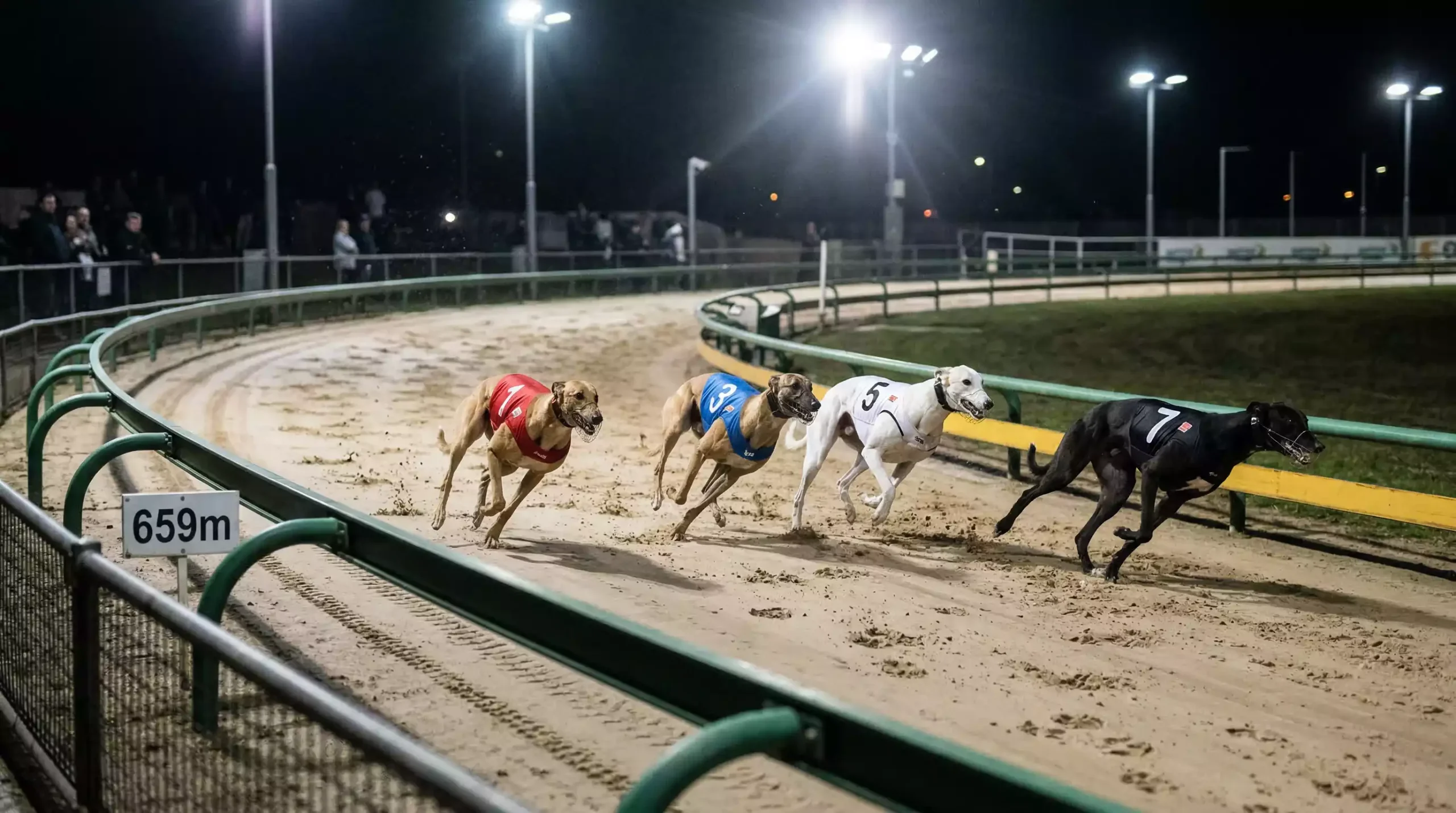
Over 659 metres and 843 metres the race unfolds across six and eight bends respectively, and early speed alone will not win. The staying distances at Yarmouth are scheduled less frequently than the standard 462-metre trip, draw smaller fields and attract a different type of greyhound — one built for endurance rather than explosive acceleration. For bettors who default to the same analysis they use over four bends, these races are a trap. For those who understand what stamina separates the field, they are an opportunity hiding in plain sight on the card.
Staying races reward patience, both from the dogs and from the punters who study them. The form lines are shorter because fewer staying events are scheduled, the market is thinner because casual bettors often skip the longer trips and the outcome depends more heavily on running style, race fitness and the ability to sustain speed through multiple turns. This guide breaks down both distances, examines how form translates between trips and explains what to look for when a dog steps up from the standard distance into staying territory.
Every trip is listed in race distances.
659m: Six Bends, Two Styles of Winner
The 659-metre race at Yarmouth covers six bends on the 382-metre circuit, with the field completing just over one and a half laps. The additional bends compared to 462 metres change the race character fundamentally. At the standard distance, an early leader with enough pace to hold position through four turns can win despite limited stamina. At 659 metres, that same dog faces two more turns where its speed advantage erodes and the closers start to arrive.
Two types of winner emerge over this trip. The first is the front-runner with genuine staying power — a dog fast enough to lead from the traps and strong enough to maintain the effort through the fifth and sixth bends without fading. These are rare animals, and when they appear on the card they tend to be short-priced, because the market recognises their dual quality. The second type is the closer: a dog that settles in third or fourth through the opening bends, saves energy through the middle of the race and delivers a sustained run from the fourth bend to the line. The closer wins by attrition, picking up tiring rivals one by one, and its hallmark is a fast run-home split relative to its position at the midpoint of the race.
Trap draw matters less at 659 metres than at 277 or 462. Six bends provide repeated opportunities for the field to reshuffle, which means a dog drawn in an unfavourable trap can recover ground that would be irrecoverable over a shorter trip. That said, early crowding at the first bend still costs energy, and a dog that gets badly baulked in the opening strides burns reserves it cannot replenish over the remaining distance. The ideal draw for a staying dog is one that provides a clean break without demanding a sprint to the front — middle traps often suit the profile.
Form analysis over 659 metres requires a different lens from the standard distance. Finishing positions matter less than sectional times, particularly the run-home split. A dog finishing fourth at 462 metres with a fast run home may be a first or second at 659, because the extra distance gives its closing speed room to operate. Conversely, a dog winning at 462 with a slow run-home time — holding on rather than pulling away — is unlikely to sustain that form over two additional bends. The transition between distances is not a leap of faith; it is a calculation, and the data to make it is already on the racecard.
Fields over 659 metres at Yarmouth are typically five or six runners, but five-dog races are not uncommon. A smaller field changes the forecast and tricast maths — fewer permutations mean cheaper combination bets — and reduces the crowding through the first bend, which tends to produce cleaner races with fewer hard-luck stories. Bettors who find five-runner staying races manageable enough to study in depth can often identify the first two or three with more confidence than in a full six-runner sprint.
843m: Yarmouth’s Marathon Test
The 843-metre trip is Yarmouth’s longest regularly scheduled distance, covering eight bends over more than two full laps. Races at this distance are rare — sometimes only one per meeting, sometimes none at all — and the pool of genuine marathon dogs at any track is small. The scarcity of the event creates a peculiar dynamic: the dogs entered at 843 metres are often specialists with limited form at shorter distances, which means the market has less data to work with and the prices reflect that uncertainty.
Marathon racing is almost entirely about stamina and racing intelligence. The greyhound that wins at 843 metres is not necessarily the fastest dog in the field; it is the one that manages its effort most efficiently. According to the Scottish Animal Welfare Commission, racing greyhounds average approximately 65 km/h. Over 843 metres, maintaining anything close to that average demands aerobic endurance that pure sprinters simply do not possess. The speed distribution across the race looks different from a 462-metre contest: a more even pace throughout, less dramatic acceleration at the start, a longer sustained effort through the middle bends and a finish that is often decided by which dog decelerates the least.
Tactical awareness from the dogs is surprisingly evident at this distance. Some marathon runners settle at the back of the field deliberately, allowing the front-runners to expend energy through the first lap before picking them off on the second. Others lead from the start and dare the field to catch them, banking on a fast-enough pace to break the chasers before the final bends. The style often reflects the trainer’s approach — some kennels are known for producing front-running stayers, others for closers — and this is one of the few contexts in greyhound racing where the trainer profile becomes a significant form variable.
Betting on 843-metre races at Yarmouth is a niche activity, and the market is often thinner than at any other distance. Prices can be volatile in the minutes before the off, particularly when late non-runners reduce a six-dog field to five or four. For the analytical bettor, the thinness of the market is the opportunity: less money chasing the result means less efficient pricing, and a well-researched selection in a marathon race can find value that simply does not exist in a well-covered 462-metre BAGS event.
The wider context is set out in our Yarmouth greyhound results guide.
Stayers vs Sprinters: How Form Translates Across Distances
The question that arises whenever a dog steps up from 462 to 659 or 843 metres is whether its existing form translates. The answer depends on the specific data within the form line rather than the headline finishing positions. A dog that has won three times at 462 metres might look like a natural step-up candidate, but if those wins came from leading early and holding on with a slow run-home split, the dog is a sprinter disguised as a winner — and the extra distance will expose the disguise.
The strongest step-up indicators are a fast run-home time and a pattern of finishing positions that improve through the later stages of the race. A dog that is consistently fourth or fifth at the first bend but third or second at the finish is one that improves its position as the race extends. That pattern suggests untapped stamina — the dog is running out of track at 462 metres and would benefit from the additional bends that 659 or 843 metres provide.
Weight is a secondary indicator. Heavier greyhounds sometimes carry more endurance, though the relationship is not universal. A dog at 33 or 34 kilogrammes with a strong late finish may be better suited to staying trips than a lighter, quicker dog at 28 or 29 kilogrammes, because the heavier frame supports the muscular effort required over a longer distance. The racecard lists the weight; the question is whether the weight profile aligns with the running style that the form figures describe.
Going the other way — a dog dropping from 659 to 462 metres — is a simpler assessment. If the dog lacks early pace at 659 but finishes well, the shorter trip may not suit. If the dog has enough early speed to be competitive through the first two bends but has been racing over 659 because the trainer wanted to develop its stamina, the drop in distance can produce an immediate improvement. Distance switches are one of the clearest signals a trainer can send, and reading them correctly — using form, times and running style rather than assumption — is a habit that pays for itself across a season of racing.
