
Greyhound Racing Grades at Yarmouth — A1 Through A11 on the Norfolk Card
 Available in US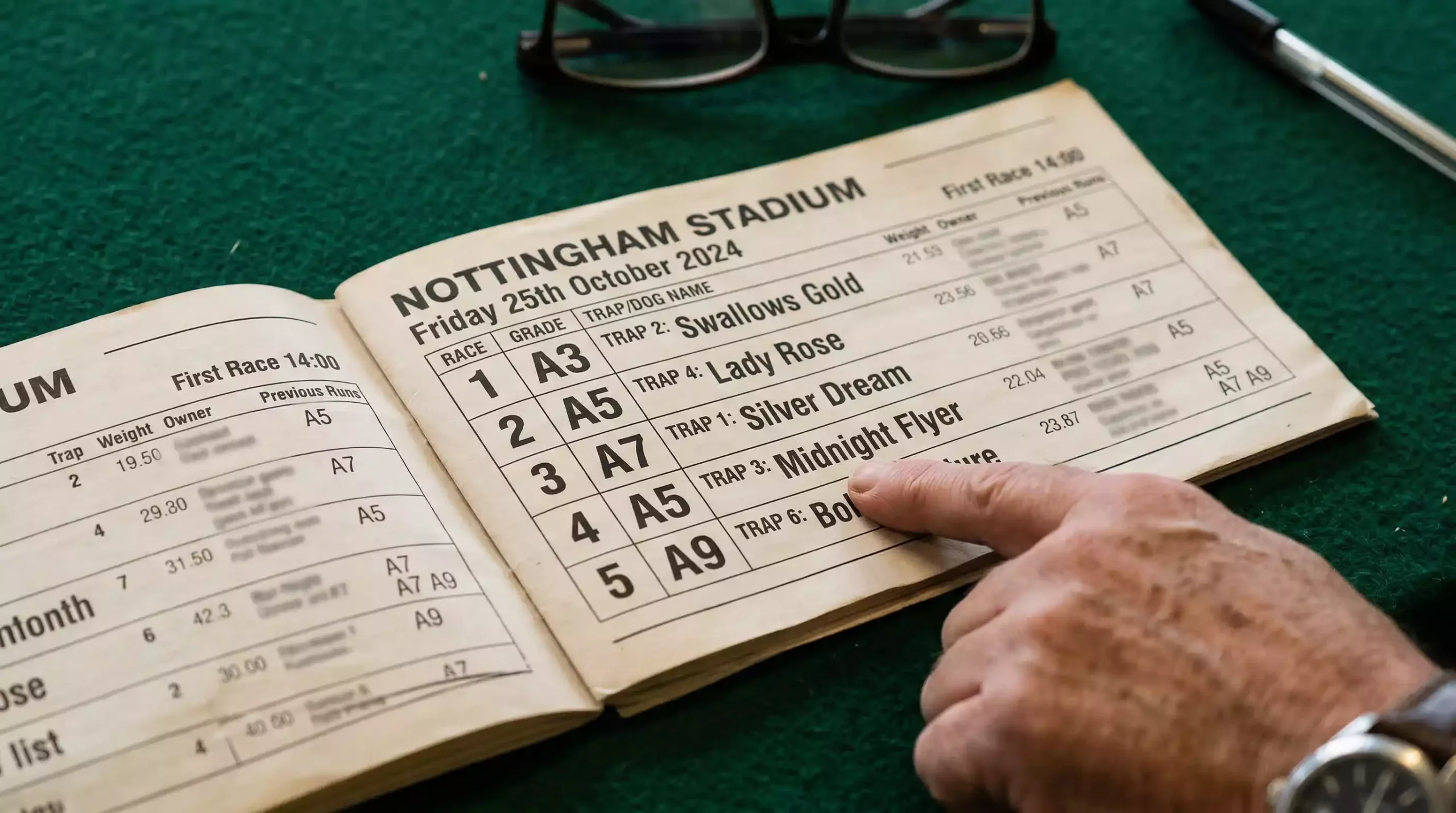
Yarmouth’s cards span A2 to A9 on most nights, and the grade mix tells you the quality of the meeting before a single trap opens. The grade shapes the race — it determines which dogs are eligible, what times they are expected to run and how competitive the field will be. Across the licensed GBGB stadiums in the country, each track sets its own grading bands, and Yarmouth’s reflect the particular characteristics of its circuit: a tight 382-metre loop with a Swaffham outside hare that produces distinctive time profiles. Around 500 trainers and approximately 15,000 owners participate in the licensed sport nationally, and the grading system is the mechanism that keeps competition fair across all of them.
Understanding how grades work specifically at Yarmouth — which grades dominate the card, how reclassification operates in practice and what a grade change signals about a dog’s trajectory — gives bettors a structural advantage over those who treat the grade column as decoration. This guide applies the system to the Norfolk card, showing what the letter and number actually mean when they appear beside a dog’s name at this particular track.
The system behind them is in grades explained.
Which Grades Appear on a Typical Yarmouth Card
A standard BAGS evening at Yarmouth features ten to twelve races, and the grade distribution follows a predictable pattern. The middle grades — A5, A6 and A7 — account for the majority, because these bands contain the largest population of active dogs at the track. The grading office allocates races to meet demand: where the most dogs are available, the most races are scheduled, and at Yarmouth the sweet spot sits in the mid-table range.
Higher grades — A2, A3 and A4 — appear less frequently on BAGS cards and are more common at open meetings. These races attract the quickest dogs on the circuit, and the time bands are tighter, which means the performance gap between one grade and the next is smaller at the top. A dog graded A3 at Yarmouth is posting times that place it in the upper tier of the track’s population, and the field it faces is measurably stronger than what it left behind at A5.
Lower grades — A8, A9 and occasionally A10 — fill the bottom of the card with dogs that are either new to the track, returning from injury or simply slower. These races are sometimes dismissed by bettors as uncompetitive, but they can be the most profitable to analyse, because the market pays less attention and pricing is correspondingly less efficient. A dog dropping into A9 after running creditably at A7 — perhaps following a regrading triggered by a single slow trial — can represent genuine value that the odds do not reflect.
The distance dimension adds a further layer. Grading at Yarmouth applies independently to each of the five race distances — 277, 462, 659, 843 and 1041 metres. A dog graded A5 over 462 metres may hold a different grade over 277 or 659, because the time bands are distance-specific. The racecard specifies both grade and distance for each race, and reading them together is essential: an A5 at 462 metres is a different proposition from an A5 at 659, even though the label is identical.
Open races — marked OR — sit outside the grading system entirely and appear on the card primarily around feature events. The East Anglian Derby is an open event that attracts dogs across all levels. When an OR designation appears, the grade column becomes irrelevant and the assessment shifts to raw form, time and trap analysis without the grading framework as a filter.
How Dogs Are Graded and Reclassified at Yarmouth
The racing office at Yarmouth maintains a set of time bands for each distance, and grading is administered mechanically against those bands. After a dog runs, its finishing time is recorded and compared. If the time falls within the A5 band over 462 metres, the dog is graded A5 for its next entry at that distance. The logic is transparent: run a fast time, get promoted; run a slow time, get demoted.
Wins trigger automatic regrading. A dog that wins is typically promoted by one grade — A6 to A5, for instance — regardless of the exact time. The reasoning is that a winner has demonstrated superiority over its current level and should face stiffer competition next time. Some racing offices apply a two-grade promotion for a dominant victory, though the specifics vary. Consecutive wins at the same grade almost always result in promotion, because the system is designed to prevent one dog from sweeping a level repeatedly.
Demotion follows the inverse pattern. A dog finishing poorly in several consecutive races, posting times slower than its grade band expects, will be dropped. The racing office may also reclassify after a single particularly slow run, especially if the time suggests injury or condition loss. Demotion is not punishment — it is recalibration, placing the dog where it can compete again.
For bettors, the reclassification trail is a rich source of information. A dog promoted from A7 to A5 is stepping into stronger company, and its A7 form may not survive the upgrade. A dog demoted from A4 to A6 may be entering softer fields than its ability warrants, particularly if the demotion was triggered by a single bad run from an awkward trap rather than a genuine decline. The grade history — available on most data services — tells you not just where a dog sits now but how it arrived, and that trajectory is often more informative than the current grade alone.
The wider context is set out in our Yarmouth greyhound results guide.
Grading Moves as a Form Signal: What a Drop or Rise Means
A grade rise is the most visible signal of improvement. The dog has been running fast enough or winning consistently enough for the racing office to upgrade it, and the market typically responds by shortening the price in its first race at the new level. The question is whether the promotion is justified by a genuine step forward or represents a peak the dog will not sustain. Looking at the winning margins and the times — rather than just the fact of the wins — gives a clearer picture of whether the upgrade is a platform or a ceiling.
A grade drop is more complex. It can mean the dog is declining — ageing, carrying an injury, losing fitness — or it can mean the dog has been unlucky: bad traps, first-bend interference, a sequence of difficult draws that suppressed finishing positions without reflecting actual ability. The distinction matters enormously. A dog genuinely in decline will continue to lose at the lower grade. A dog that was simply placed poorly at a higher grade may dominate the lower one, and the initial odds — reflecting the recent losing form — can represent significant value.
The most profitable grading scenarios at Yarmouth involve dogs dropping one or two grades after a spell of poor results that can be explained by factors other than declining ability. A trap draw analysis of the dog’s recent races — checking whether it was repeatedly drawn on the wrong side for its running style — often reveals the explanation. If the form figures show 4-5-5-6 but the draws were consistently against the dog’s natural line, the demotion may be undeserved, and the first race at the lower grade becomes a high-confidence selection backed by data rather than hope.
Trainer behaviour adds context. A dog that switches to a longer distance, records a slow time, triggers a demotion and then immediately returns to its preferred trip is a pattern worth noting. The racecard — with its distance and grade columns — provides the raw data to spot these moves, and the attentive bettor who reads across several weeks of cards will find them before the market adjusts. The grade shapes the race, but the story behind the grade shapes the bet.
