
Greyhound Racing Grades Explained — From A1 to A11, Open Race and Introductory Trials
 Available in US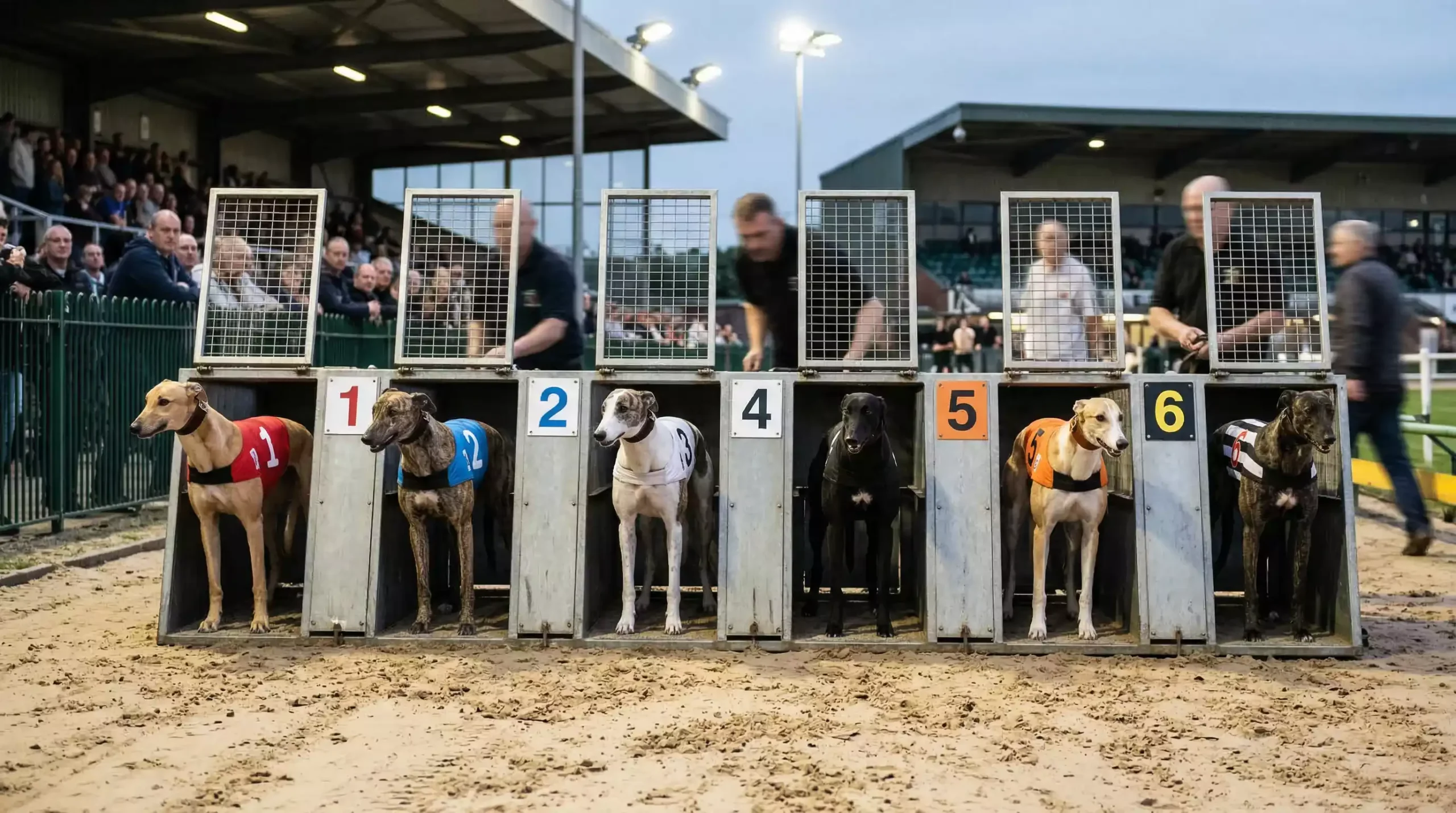
Greyhound racing grades explained in plain terms: they are the mechanism that keeps competition fair. Without grading, the fastest dog at a stadium would win every race, prize money would pool at the top and the sport would lose its unpredictability — which is, of course, the thing that makes it worth watching and worth betting on. The grading system ensures that a dog is matched against opponents of similar ability, measured primarily by race time, so that every contest on the card has a genuine competitive shape.
The system sounds simple in principle, but the detail matters. Grades are track-specific, not universal. A dog can be classified at one level at Yarmouth and another at Nottingham, because each stadium sets its own time bands according to its circuit characteristics. The letter and number on a racecard — A1, A5, A9 — tells you where a dog sits in its current track’s hierarchy, and understanding what the letter and number actually tell you is the first step to reading any card with real confidence.
This guide covers the full ladder from A1 to A11, explains how open races and introductory trials sit alongside the grading structure, and shows what happens when a dog switches tracks or gets reclassified. It is not complicated once you see the logic, and the payoff for understanding it is immediate: you stop treating grade as background information and start using it as a filter for every selection you make.
How they fall locally is in grades on the Yarmouth card.
The A-Grade Ladder — A1 (Elite) to A11 (Beginners)
The grading ladder at most GBGB-licensed stadiums runs from A1 at the summit to A11 at the base, though many tracks use only a portion of that range. A1 represents the fastest dogs at the circuit — those posting the sharpest times over the standard distance. A11 is the entry point for the slowest qualifiers. The majority of races on a typical weeknight card at any of the 18 licensed stadiums in the United Kingdom fall somewhere in the middle: A4 through A7 at a busy venue, A5 through A9 at a smaller one.
The mechanism behind grading is time-based. After a dog runs at a track, its finishing time is recorded and compared against published bands that the racing office maintains for each distance. A dog posting a time within the A3 band will be graded A3 for its next race at that distance. Win a race, and the dog is typically promoted — bumped up one or two grades depending on the winning margin. Lose several in a row while recording slower times, and demotion follows. The system is dynamic, which means grades on a racecard are a snapshot, not a permanent label.
This creates a useful analytical layer for anyone studying the card. A dog recently promoted from A6 to A4 is stepping up in class; its form figures at A6 may look stellar, but the competition it is about to face is measurably quicker. Conversely, a dog dropping from A3 to A5 might appear to be losing form, yet the reality could be a deliberate placement by the trainer into a softer grade where a confidence-boosting win is more achievable. The grade column on the racecard is not just classification — it is strategy made visible.
Not every stadium employs the full A1-to-A11 range. Smaller tracks with shallower pools of dogs might grade from A2 to A8, while larger venues with deeper competition can stretch the ladder further. The key point is that each track publishes its own bands, and those bands are calibrated to the circuit’s geometry, surface speed and typical field quality. An A4 time at a tight 382-metre track is a different proposition from an A4 time at a long, galloping circuit, which is why grades cannot be compared across stadiums without first consulting the time bands at each venue.
For bettors, the grade tells you two things immediately: the approximate quality of the field and whether a dog is moving up, down or staying put. A card full of A3 races is a stronger meeting than one loaded with A8 contests. Within a single race, a dog that has been regraded downward after running in higher company may carry latent ability that the market undervalues. These are small edges, but they are freely available to anyone who knows where to look — and the racecard puts the number right beside the dog’s name.
Open Races, OR and Special Categories
Open races exist outside the grading ladder. Marked OR on the racecard, they accept entries regardless of a dog’s current grade, which means an A2 runner can line up alongside an A6 dog if the trainer believes the conditions suit. In practice, open races tend to attract the better animals at a stadium, because the prize money is usually higher and the prestige matters to trainers building a dog’s profile for feature events.
The most prominent open races are the named competitions: derbies, cups and feature stakes. The East Anglian Derby at Yarmouth, for instance, is an open event run over 462 metres with a winner’s prize of £15,000. Entry is by invitation or qualification, not by grade, and the field often includes dogs that have been specifically prepared for the race over several weeks. When an OR designation appears on a racecard next to one of these events, it signals a contest where grading is irrelevant and raw ability — adjusted for distance, track and trap — is all that counts.
Some stadiums also schedule handicap races and special categories that bend the grading logic in different ways. A handicap race might give slower dogs a head start over a staggered distance, theoretically levelling the field. These are less common at licensed stadiums than they once were, but they still appear on certain cards, and the format will be noted alongside the race details. For the newcomer, the rule of thumb is straightforward: if the card says OR, forget the grade and focus on the form, the time and the trap. Everything else is noise.
The wider context is set out in our Yarmouth greyhound results guide.
Introductory Trials (IT) — How New Dogs Enter the System
Before a greyhound can be graded at a track, it must complete an introductory trial — marked IT on the racecard. The trial is exactly what it sounds like: the dog runs over a standard distance at the stadium, under race conditions, and its time is recorded. That time determines the initial grade. No prize money is at stake, and the trial may or may not form part of the public meeting; some tracks run trials before the main card begins.
For the bettor, IT entries on a racecard are inherently uncertain. The dog has no form at this track, which means the usual analytical framework — past positions, trap history, time comparison — is largely absent. What you can work with is the trainer’s reputation, the dog’s form at other tracks if available, and its breeding. Some punters treat IT races as ones to watch rather than bet on, using the trial as a data-gathering exercise for future cards. Others look for value precisely because the market tends to be wide open when nobody has form to lean on.
Trainers sometimes use introductory trials strategically, entering a dog at a new track to take advantage of a softer grading band or a different circuit profile that suits the animal’s running style. A dog that has been mid-table at a long track might thrive on a tighter circuit, and the IT run is the first signal of whether that theory holds. It is worth noting these results when they appear — the dog may look anonymous on the card today, but its regraded entry a fortnight later could be the value bet you would have missed without paying attention.
Re-Grading and Track Switches — What Happens When Dogs Move Tracks
When a greyhound moves from one stadium to another, it does not carry its grade with it as a fixed label. The new track’s racing office assesses the dog’s recent times and maps them onto its own grading bands. A dog classified A3 at a fast, sweeping circuit could arrive at a tighter track and find itself graded A4 or A5, simply because the geometry produces slower times and the bands are calibrated accordingly. The reverse is equally possible: a dog dropping grades at a slower venue might rise when it moves somewhere the surface or shape suits its stride.
This reclassification process creates opportunities that attentive bettors exploit. A track switch followed by a grade drop often signals a dog entering softer company than its ability warrants. The form figures might show modest recent performances at the previous track, but if those performances came against stronger opposition on a less favourable circuit, the new grade could understate the dog’s real chance. The card will show the new grade and, on many providers, the previous track alongside recent form — giving you enough information to spot the mismatch without needing to dig through external databases.
Re-grading also happens without a track switch. A dog that posts significantly quicker or slower times than its current grade expects will be reclassified by the racing office, sometimes after a single run if the margin is wide enough. Trainers are aware of this mechanism and occasionally manage their entries to control the grading trajectory — running a dog at a longer distance where times are naturally slower, for instance, to avoid premature promotion. Whether you consider this shrewd or cynical depends on your perspective, but the fact remains: the grade on the racecard is the product of a system, and understanding the system is part of reading the card.
