
Greyhound Speed and Physiology — The Racing Athlete Explained
 Available in US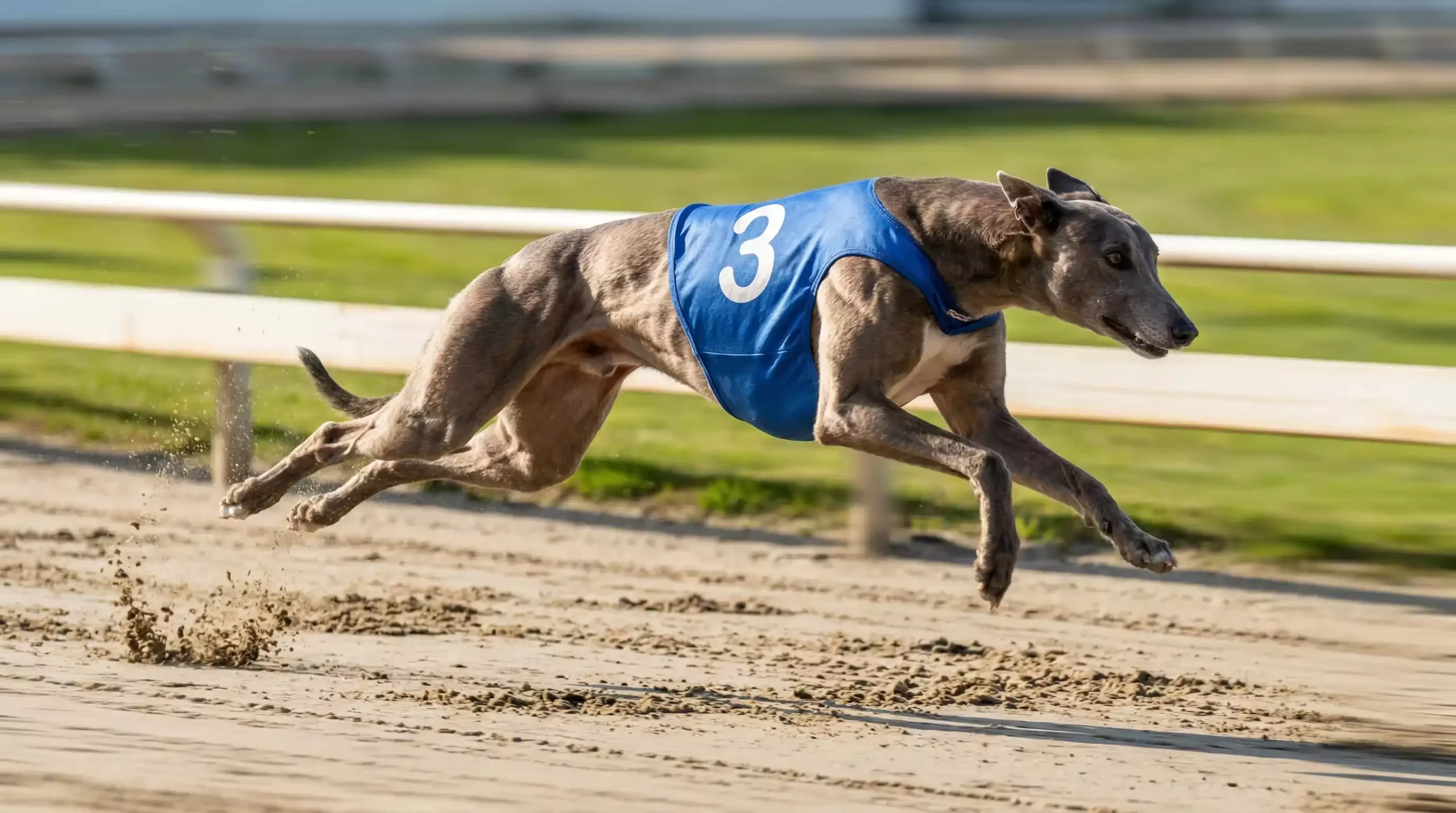
A racing greyhound hits 65 km/h on track, and every element of its physiology is built for that burst. The breed is not fast by accident — it is the product of centuries of selective breeding for speed, aerobic capacity and a running gait that is unique among domestic dogs. Understanding the physical machine behind the racecard number is not just a matter of curiosity; it informs how you assess form, interpret injuries and evaluate a dog’s suitability for different distances and track conditions. Built to run is not a metaphor — it is a literal description of a breed shaped by function.
This guide covers the biomechanics of greyhound speed, the dominance of Irish-bred dogs in the UK racing population, the injury patterns that the breed’s physiology predisposes it to and the welfare debate that surrounds the use of a purpose-bred athlete in a commercial sport.
What that speed produces is in trap statistics.
Speed and Biomechanics: The Double-Suspension Gallop
The greyhound’s signature running motion is the double-suspension gallop — a gait in which all four feet leave the ground twice during each stride cycle. The first suspension occurs when the legs are fully extended, the body stretched out in a straight line. The second occurs when the legs are gathered beneath the body, the spine flexed into a tight arc. This dual airborne phase is what produces the explosive speed that the Scottish Animal Welfare Commission measured at an average of approximately 65 km/h on track.
The physiology that supports this gait is specialised in every dimension. The greyhound’s heart is proportionally larger than that of other dog breeds of similar body weight, providing the cardiac output needed to deliver oxygenated blood to working muscles during a sprint. The lung capacity is greater, the red blood cell count is higher and the proportion of fast-twitch muscle fibres — the fibres responsible for explosive power — is significantly elevated compared to breeds not selected for speed.
The body shape is equally optimised. The deep chest houses the oversized heart and lungs. The narrow waist allows the extreme spinal flexion that characterises the gathered phase of the gallop. The long legs provide the stride length that translates muscular power into ground speed. The low body fat percentage — typically well under 5% in a racing-fit greyhound — minimises the weight that the muscular system must propel. Every visible feature of the greyhound’s build is a functional adaptation for high-speed running, and the racecard data that records a dog’s time over 462 metres is, in essence, measuring the output of a biological machine refined over generations.
The top speed of an individual greyhound exceeds the 65 km/h average — some dogs reach 70 km/h or more in the opening strides from the traps — but the average reflects the sustained speed across a full race, including the deceleration through bends and the slowing effect of cumulative effort over the final 100 metres. For bettors, the distinction between peak speed and sustained speed is relevant: a dog that reaches the first bend fastest is not necessarily the dog that finishes first, because bends scrub speed and stamina determines how much speed is retained through the final straights.
Irish-Bred Dominance: 86.7% of the UK Racing Population
The Scottish Animal Welfare Commission’s 2023 report documented a striking statistic: 86.7% of greyhounds racing on the UK licensed circuit in 2021 were bred in Ireland. That figure makes the Irish breeding industry the primary supplier of talent to the British greyhound racing system, and it raises questions about the supply chain that connects a breeding farm in Tipperary or Limerick to a trap draw at Yarmouth or Romford.
The dominance of Irish breeding reflects historical, economic and regulatory factors. Ireland has a long tradition of greyhound breeding, with an infrastructure of farms, coursing clubs and sales events that produces thousands of puppies annually. The Irish Greyhound Board regulates the domestic industry, but the export market — selling young dogs to UK trainers — is a significant revenue stream that operates across a national border with different welfare standards. Dogs bred in Ireland are typically exported to the UK at around 12 to 18 months of age, after initial rearing and early training in Ireland.
The welfare implications of this cross-border supply chain are a recurring theme in the UK debate. The GBGB’s welfare data tracks dogs from the point of registration in the UK system, but the pre-import period — breeding, rearing and early training in Ireland — falls outside British regulatory oversight. Campaigners have argued that the welfare of greyhounds before they enter the UK system is a blind spot that the current framework does not address, and the SAWC report flagged the import dependency as a structural vulnerability in the welfare regime.
For bettors, the Irish breeding pipeline is relevant in one practical sense: the bloodlines that produce UK racing greyhounds are concentrated in a relatively small gene pool, and the sire and dam information on the racecard can indicate predispositions toward speed, stamina or particular running styles. A dog by a sire known for producing fast early-pace runners may be a stronger sprint prospect than its form alone suggests, especially if it is making its debut at a new distance. Breeding data is a secondary factor behind form and trap draw, but it is available on the racecard and costs nothing to check.
The wider context is set out in our Yarmouth greyhound results guide.
Common Injury Types and Why Hind Limbs Are Most Vulnerable
The same physiology that makes greyhounds fast also makes them vulnerable to specific injury patterns. The GBGB’s 2024 injury data identified the three most common injury types on licensed tracks: hind limb muscle injuries (1,013 cases, 0.28% of all runs), hock joint injuries (718 cases, 0.20%) and wrist injuries (566 cases, 0.16%). The concentration of injuries in the hind limbs is not random — it reflects the biomechanical forces that the double-suspension gallop imposes on the rear of the body.
During the gathered phase of the gallop, the hind legs absorb the full impact of landing as the dog’s weight transfers forward over the flexed spine. The muscles, tendons and joints of the hind limbs experience forces several times the dog’s body weight on every stride, and over the course of a race those repeated impacts accumulate. Through the bends, the forces are asymmetric — the inside hind leg bears more load than the outside — which is why track geometry and bend sharpness are relevant factors in injury incidence. A tighter track like Yarmouth’s 382-metre circuit places greater centrifugal demand on the hind limbs than a larger, more gradual circuit.
The hock joint — the equivalent of the human ankle — is particularly susceptible because it acts as the primary shock absorber during the landing phase. Repetitive loading under racing conditions can produce stress fractures, ligament damage and joint inflammation that require rest or veterinary treatment to resolve. Wrist injuries follow a similar pattern, with the front limbs absorbing impact during the extended phase of the gallop when the dog is landing on its forehands.
The Cut the Chase Coalition, a welfare campaign group, has highlighted the cumulative toll of racing injuries, noting that approximately 1,100 dogs died on UK tracks between 2018 and 2024 according to aggregated GBGB data. That figure sits alongside the record-low injury rate of 1.07% in 2024 and the 94% rehoming success rate — a set of numbers that the industry and its critics interpret very differently. The industry reads the data as evidence of improvement. The critics read it as evidence that improvement is not enough. The physiology of the greyhound — a body built for speed, running on a commercial circuit, producing injuries that are inherent to the activity — is the ground on which both arguments stand.
