
How to Read a Greyhound Racecard — Every Field Explained for Beginners
 Available in US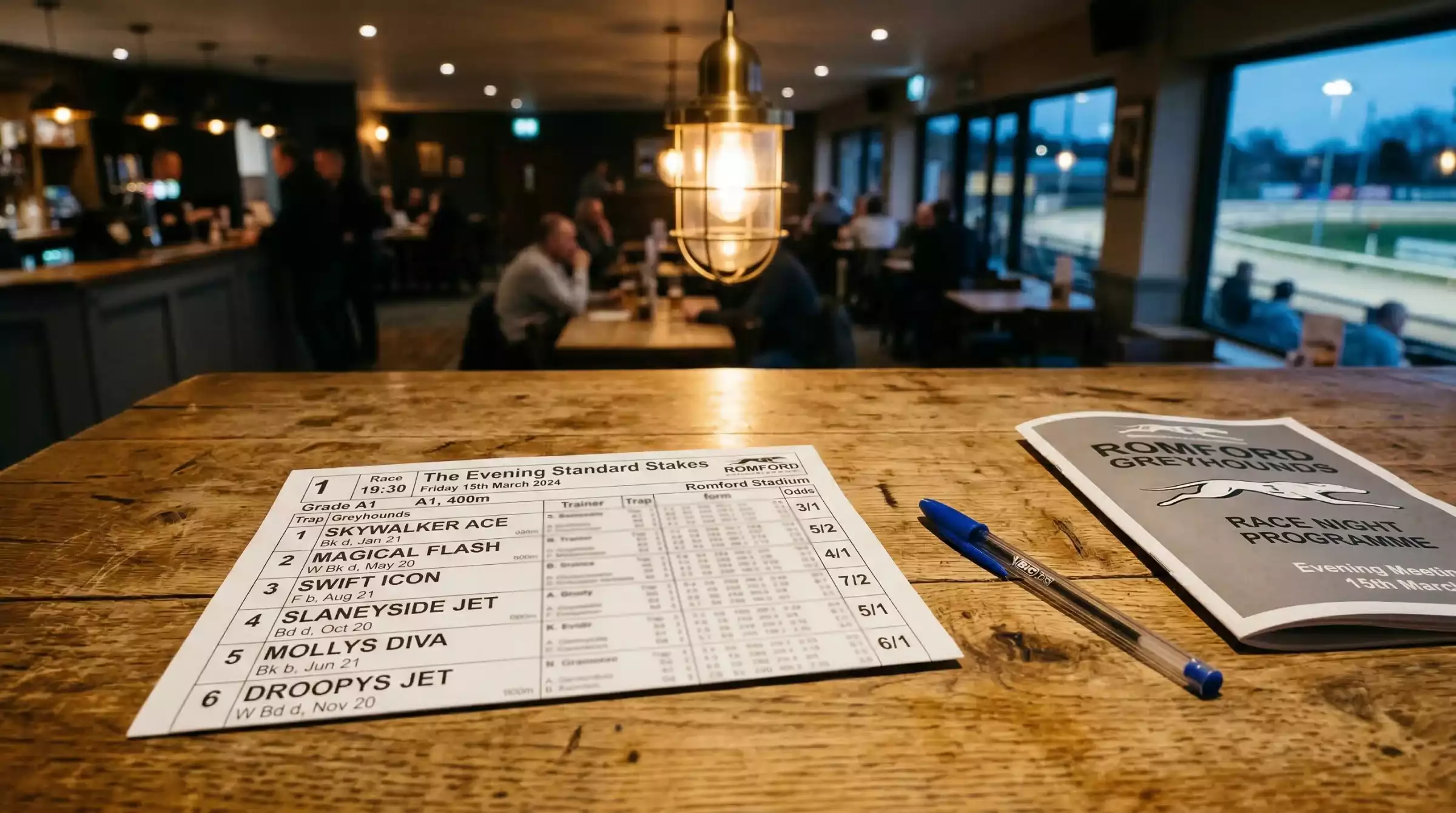
Learning how to read a greyhound racecard is, without exaggeration, the single most useful skill a newcomer can develop before placing a bet. The card is not decoration. It is the compressed biography of every dog in the race — form, fitness, breeding, draw — laid out in a grid that rewards anyone willing to spend five minutes studying it. Skip the card and you are guessing. Read it properly and you have the same raw material the sharpest regulars at any track in the country rely on.
The format is broadly standardised across all GBGB-licensed stadiums, though the order of columns can shift between providers. What stays constant is the information itself: trap number, dog name, trainer, recent form, grade, weight, season status, parentage and — depending on the source — sectional times and comments from the racing manager. Each field answers a specific question about the dog’s chance in this particular race, and ignoring any one of them leaves a gap in the picture.
This guide walks through every element on the card from left to right, using practical examples that apply whether you are checking results at Yarmouth, Romford or Nottingham. By the end, a racecard should read less like a wall of numbers and more like a story — one that tells you which dog is in form, which is drawn badly and which might be about to surprise everyone. Read the card like a regular, and the races start making a different kind of sense.
Where to get one is in Yarmouth racecards.
Trap Number and Colour — What the Draw Means
Every greyhound racecard begins with a number from one to six, each tied to a fixed colour: trap one is red, two is blue, three is white, four is black, five is orange and six wears the black-and-white stripes. These colours are not cosmetic. They correspond to the physical starting box the dog will break from, and that position has a measurable effect on how the race unfolds — particularly through the first bend.
On a track like Yarmouth, where the circuit measures 382 metres and offers five race distances from 277m to 1041m, the trap draw shapes the run differently at each trip. Over the 277m sprint there are only two bends, which means the dog drawn in trap one has a short rail run to the first turn. Over 462m the field negotiates four bends and positional advantage can compound or dissolve depending on early pace. The important takeaway is that a trap number is not random — it is a variable, and the card tells you exactly where to find it.
Experienced punters cross-reference the trap draw with two other pieces of information: the dog’s known running style (railer, middle runner, wide seeker) and the track’s historical trap bias. A dog that naturally runs the rail drawn in trap one at a track that favours inside boxes is a different proposition from the same dog in trap six. The racecard gives you the first part of that equation; track statistics provide the second.
One practical point worth noting early on: some racecards list a reserve runner, typically marked with an R beside the trap number. Reserves only run if a declared dog is withdrawn, and the card will be updated closer to race time to reflect the change. Always check for late amendments before treating the initial draw as final.
Form Figures — How to Decode Past Performances
The form line is the densest strip of information on any racecard, and it is where most beginners either level up or lose interest. A typical sequence might read something like 3214-1. Each digit represents a finishing position in a recent race, read from left to right with the most recent result on the right. That sample tells you the dog finished third, then second, then first, then fourth, had a break (the hyphen), and won its last outing. That trajectory — inconsistent early, improving late — is exactly the kind of pattern the form line is designed to reveal.
A zero in the sequence usually means the dog finished outside the top six or was involved in an incident that prevented a classified finish. Some cards use a letter instead: T for a trial, M for a mid-season break, or a dash to indicate a longer gap between runs. The meaning of each symbol can vary slightly between data providers, but the core logic is always positional. First is best, sixth is worst, and anything else is context.
What makes form figures genuinely useful is comparison. A dog showing 1111 looks dominant, but the numbers mean nothing until you know the grade it was racing in, the track it ran at and the times it posted. A string of firsts in A8 company at a slow track is not the same achievement as a single second in an A3 race at a quick circuit. The racecard supplies the finishing positions; your job is to weigh them against everything else on the card.
The trap number from which the dog ran in each previous race is sometimes shown alongside or beneath the form figures. This is a valuable detail. A dog that keeps finishing second from trap six might simply be running into crowding on the first bend. Switch it to trap one and the form could transform overnight. Equally, a dog with poor form from inside traps that is now drawn wide might find room it never had before. Reading form without checking the trap history is reading half the story.
One last convention to know: the number of races shown in the form line varies. Some cards show the last six runs, others show eight or more. If fewer runs are displayed, the dog may be recently graded, returning from injury or new to the track. Fewer data points do not necessarily mean worse data — they just mean you need to pay closer attention to whatever is there.
The wider context is set out in our Yarmouth greyhound results guide.
Grade, Weight, Season and Breeding
The grade column tells you the competitive level of the race. GBGB-licensed stadiums use a grading ladder — typically A1 at the top through to A11 at the bottom — based on race times at each specific track. The 18 licensed stadiums in the United Kingdom each set their own time bands, which means a dog graded A4 at one venue might be reclassified when it moves to another. Open races (marked OR) sit outside this ladder entirely, inviting dogs regardless of grade, and events like the East Anglian Derby at Yarmouth fall into this category.
Weight is listed in kilogrammes and usually reflects the dog’s most recent weigh-in. Significant weight change between races — a kilogramme or more — can signal a dog that is either peaking in fitness or struggling. A steady weight over several runs suggests consistency. Some punters pay close attention to weight trends; others treat the figure as background noise. Either approach is defensible, but the data is there on the card for those who want it.
Season status applies to female greyhounds and indicates whether a bitch is in season, approaching season or recently returned from a season break. The abbreviation varies between cards — some use S or SZN, others spell it out — but the practical implication is consistent: a bitch in or near season can run differently, sometimes faster, sometimes less predictably. Trainers often withdraw a bitch during season, so a recent return after a gap in the form line may correlate with this. It is a small edge, but it is free, and the racecard hands it to you without asking.
Breeding information — sire and dam — appears on most detailed racecards. Greyhound pedigree can indicate a predisposition to speed, stamina or a particular running style, though in practice most punters use breeding as a secondary factor behind form, trap and grade. Where it becomes genuinely useful is in trial races (marked IT for introductory trial), where the dog has no form history at the track. In that scenario, knowing the sire’s progeny tend to be fast early can at least frame an expectation where no other data exists.
Trainer and Kennel Data
Every dog on the card is assigned to a trainer, and that name carries more information than most beginners realise. A trainer’s kennel is the operation behind the dog — the feeding, the exercise, the race-day decisions about distance and meeting selection. Trainers with a high strike rate at a particular track have usually figured out which distances suit their dogs and which meetings offer the softest opposition. That knowledge is embedded in the pattern of entries, even if the card does not spell it out in words.
Some data providers now include kennel statistics alongside the trainer name: runners in the last fortnight, winners, placed dogs, percentage strike rate. Where that information is available, it can shortcut hours of manual research. A trainer running hot — say, four winners from ten runners in the past week — is placing dogs where they can win, and that momentum tends to persist for a spell before reverting to the mean.
Seasonal patterns also matter. Certain trainers are known for peaking their dogs at specific times of year, often aligned with feature events. A trainer entering a dog at a distance or grade it has never run before might be experimenting, or might know something that the form line alone will not show for another two weeks. The racecard tells you who the trainer is. Everything else — reputation, patterns, intent — is context that builds over time the more cards you read.
