The Swaffham Outside Hare — How Yarmouth's Lure System Shapes Every Race
 Available in US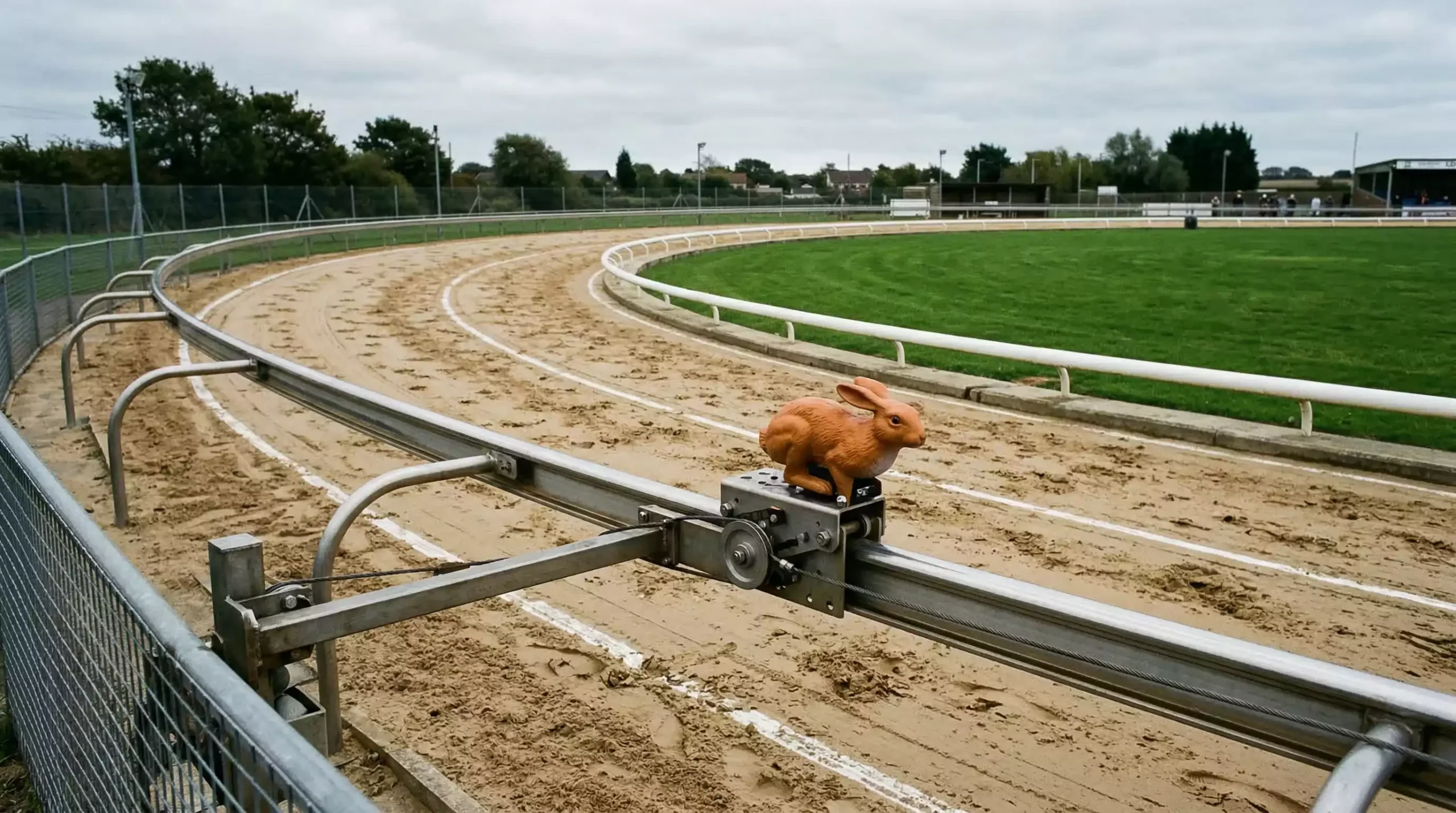
Of all the variables that shape a greyhound race, the lure system is the one most people never think about. Trap draw gets discussed. Form gets analysed. Weather gets blamed. But the mechanical hare — the thing every dog in the race is actually chasing — rarely features in pre-race conversation, which is odd, because it determines the opening trajectory of the entire field. At Yarmouth, that hare is a Swaffham outside model, and the lure nobody talks about has a measurable effect on every result the track produces.
An outside hare runs beyond the outer rail, which means the dogs leave the traps looking outward rather than inward. That single difference changes sightlines, alters which traps get the cleanest run to the first bend and shifts the typical race shape away from the pattern you would expect at an inside-hare venue. For anyone studying Yarmouth results without understanding the Swaffham system, a chunk of the data makes less sense than it should. For anyone who does understand it, the lure position becomes one more edge to fold into the selection process.
This piece explains what an outside hare is, how it reshapes race dynamics at Yarmouth, how the Swaffham model compares to systems at other UK tracks and what it means in practical terms when you sit down with a racecard and a list of runners.
What it does to the draw is in trap bias.
What Is an Outside Hare?
A mechanical hare in greyhound racing serves one purpose: it gives the dogs something to chase. The lure travels on a rail that loops the circuit, always staying ahead of the field, and its position relative to the running track determines how the dogs orient themselves during the race. Three broad configurations exist across UK stadiums: inside hare (running along the inner rail), on-rail hare (mounted on the rail itself) and outside hare (running beyond the outer rail). Yarmouth uses the third option — a Swaffham outside model — on a 382-metre circuit that offers distances from 277 to 1041 metres.
The Swaffham name refers to the manufacturer and design lineage of the hare system. It is one of the more common outside-hare setups in British greyhound racing, used at several licensed venues beyond Yarmouth. The hare itself is a synthetic lure — no live animal is involved — attached to an arm that extends from a motorised rail running outside the outer fence. From the dogs’ perspective, the lure is visible above and beyond the outer rail, moving at a speed calibrated to stay just ahead of the leading runner without pulling so far ahead that the field loses interest.
The critical distinction is sightline. When the hare runs inside the rail, dogs in the lowest-numbered traps — trap one and trap two — have the most direct line of sight to the lure as they break from the boxes. They look inward and down toward the rail. When the hare runs outside, the opposite applies: dogs in the highest-numbered traps — trap five and trap six — have the clearest view of the lure, because they are positioned closest to it. That sightline advantage in the first two or three strides out of the box can influence which dog reaches the first bend with the best position, and at racing speed those fractions of a second compound through every subsequent turn.
None of this means outside-hare tracks always favour wide traps. The geometry of the bend still rewards the rail line, and a dog that gets to the inside first will save ground regardless of where the hare sits. What the outside hare does is moderate the usual inside-trap advantage by giving wider-drawn dogs a cleaner initial run, which makes the overall trap bias pattern at Yarmouth flatter than at a typical inside-hare venue.
Race Shape Under an Outside Hare
The moment the traps open at Yarmouth, every dog’s eyes are drawn outward. That initial orientation means the field tends to fan slightly wider in the first few strides than it would at an inside-hare track, where the natural pull is inward toward the rail. The practical consequence is a fractionally different pattern of crowding at the first bend. Inside-hare tracks often see the field compress toward the rail almost immediately, with outside-drawn dogs cutting across at sharp angles to find the inside line. Under an outside hare, wider-drawn dogs have less reason to cut in immediately — they are already running toward the lure — and the compression happens a beat later, sometimes not until the second bend.
This delayed compression benefits dogs with a wide running style. A greyhound that naturally drifts toward the outside of the track — a wide seeker, in racing parlance — finds more room under a Swaffham system than it would have done at tracks that historically used inside-hare setups. At Yarmouth, the wide runner can maintain its preferred line through the opening bends without losing as much ground to the rail runners, because the sightline to the lure rewards staying wide rather than penalising it.
First-bend crowding still happens, of course. Six dogs leaving adjacent boxes at full speed will always contest the same piece of track through the first turn, regardless of where the hare sits. But the nature of the crowding differs. At an inside-hare venue, the danger zone is the rail itself — dogs converging on the same inside line create interference for those drawn in the middle traps. At Yarmouth, the danger zone shifts slightly outward, and the dogs most likely to experience trouble are those in the middle traps (three and four) who are caught between the rail-seekers and the hare-followers running wider. Trainers who understand this dynamic choose their entries accordingly, and the effect shows up in the results over a large enough sample.
Over longer distances, the hare’s influence on race shape diminishes. By the third and fourth bends, the field has settled into running order and the dogs are chasing position as much as the lure. The Swaffham system’s biggest impact is concentrated in the first 100 metres — the breakaway, the first bend and the transition onto the back straight. After that, the race becomes a contest of speed, stamina and racing intelligence, just as it would at any track. But those opening moments set the frame for everything that follows, and the outside hare is the hand that draws it.
The wider context is set out in our Yarmouth greyhound results guide.
Comparing Hare Systems Across UK Tracks
The 18 GBGB-licensed stadiums in the United Kingdom operate a mix of hare systems, though the Swaffham outside model now predominates across the circuit. Yarmouth and Nottingham both use Swaffham outside hares, as do Romford, Monmore and most other licensed venues. Historically, inside-hare systems such as the Inside Sumner were common — Romford itself used one until Coral’s refurbishment in the late 1970s — and some tracks ran Inside MacWhirter models. Each track’s trap bias data reflects its particular hare type, which is why understanding whether a venue has changed its system is essential before interpreting historical trap statistics.
The most instructive comparison is between current outside-hare tracks and the historical inside-hare configuration. When Romford ran an Inside Sumner system — as it did for decades before switching to an outside Swaffham — trap one’s natural geometric edge was amplified by a direct sightline to the lure, making it statistically the most successful starting position over sprint distances. Under the current outside Swaffham system at both Romford and Yarmouth, that initial sightline advantage is redistributed toward the higher traps, which means the traditional assumption that low-numbered boxes dominate is less reliable. The winner spread across all six traps tends to be noticeably more even at outside-hare tracks than the historical data from inside-hare eras suggested.
Nottingham offers a useful parallel with Yarmouth: both run Swaffham outside hares, both have tight circuits, and both show a more balanced spread of winners across trap positions. Since Romford also now runs an outside Swaffham, dogs moving between any of these three venues face minimal adjustment to the hare system. The more significant variable when dogs switch tracks is the circuit geometry — circumference, bend radius and run-up distance — rather than hare type, which is now largely uniform across the licensed circuit.
Towcester, before its various closures and reopenings, operated an outside hare on a much larger circuit, which produced yet another distinct pattern. The longer straights and wider bends at Towcester diluted the hare’s influence compared to Yarmouth’s tighter geometry. The lesson is consistent: hare type and track dimensions interact, and the combination produces a unique racing character at every stadium. Knowing which hare a track uses is the first filter; knowing the circuit shape is the second.
Practical Implications for Selections
When a dog arrives at Yarmouth from an inside-hare track, the most common adjustment failure is at the first bend. Dogs conditioned to angle inward from the traps may take a stride or two longer to pick up the outside lure’s sightline, losing early position to rivals more familiar with the system. This is not a permanent disadvantage — most dogs adapt within one or two runs — but it means that a dog’s first outing at Yarmouth after a transfer should be treated as a form-building exercise rather than a confident betting proposition.
Conversely, when inside-hare tracks existed, a dog transferring from an outside-hare venue would initially run wider than the track rewarded, because its instinct was to orient toward an outside target. Trainers who moved dogs between different hare systems were aware of this and would sometimes enter a dog in a trial or lower-grade race at the new track before committing to a competitive card. Although virtually all current licensed tracks now use outside-hare systems, this principle still matters when analysing historical form data from the era when hare types varied widely across the circuit.
For ongoing Yarmouth selections, the hare system should influence how you interpret trap draw. Wide-drawn dogs — traps five and six — deserve respect at any outside-hare track, because the outside lure gives them a cleaner initial sightline and a more natural racing line through the bends. Inside-drawn dogs retain the geometric advantage of a shorter path to the rail, but they lack the sightline reinforcement that would make low traps dominant under an inside-hare setup. The net effect at Yarmouth is a track where the best trap to have is whichever one gives a particular dog a clean run, rather than a track where one trap dominates regardless of the runner.
The Swaffham outside hare is not a secret — it is listed on every track guide and data sheet. But the number of bettors who actually factor it into their selections is smaller than you might expect. Acknowledging it, understanding its effect on race shape and adjusting for it when dogs switch between hare systems is a straightforward edge that costs nothing to apply. The lure nobody talks about is, quietly, one of the most important variables on the Yarmouth card.
