
Weather and Track Conditions at Yarmouth — How Coastal Climate Affects Greyhound Results
 Available in US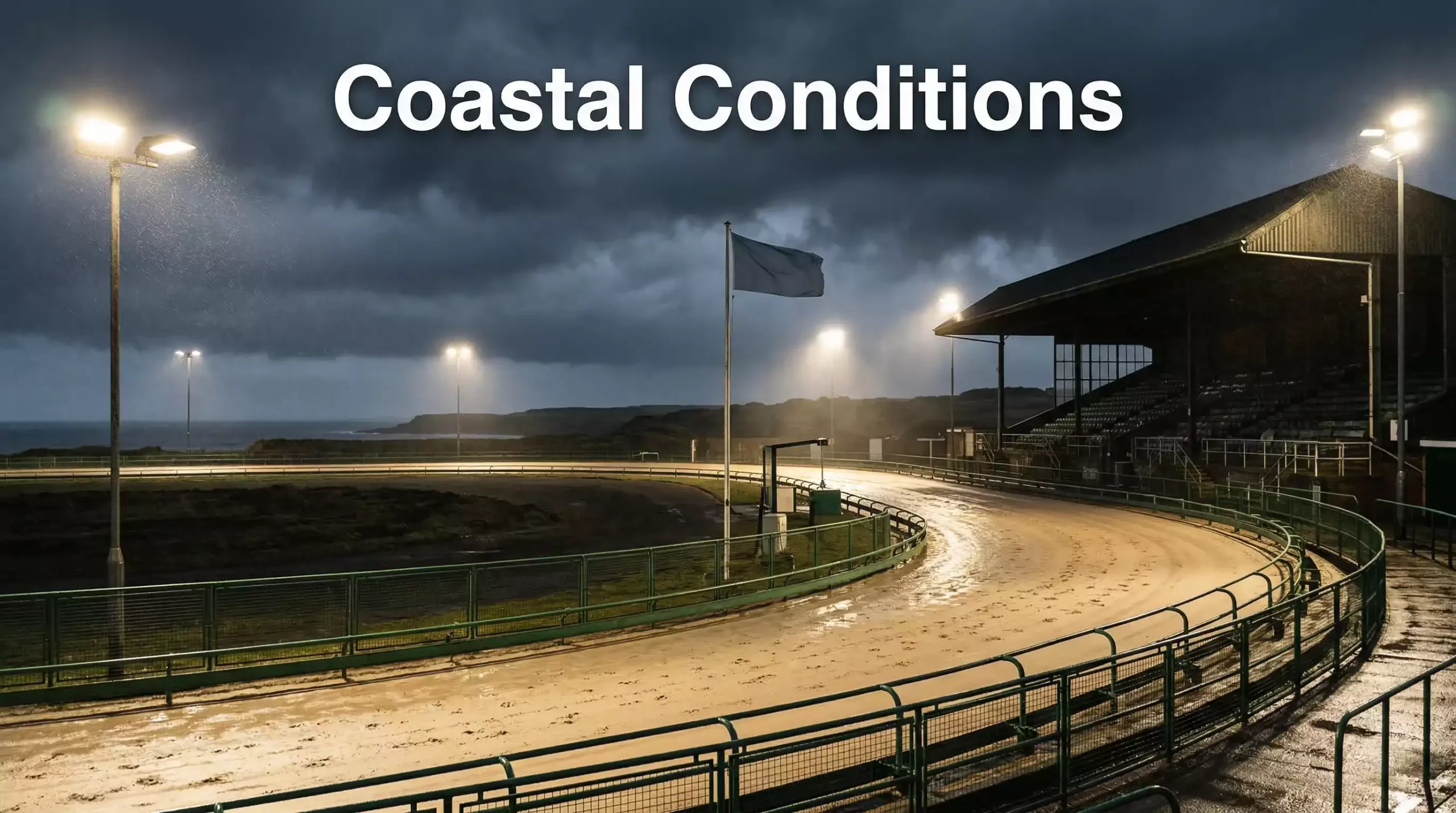
Yarmouth Stadium sits barely 200 metres from the North Sea at Caister-on-Sea, and that proximity is not a footnote — it is a factor in every race. The coastal location exposes the track to weather patterns that inland venues simply do not experience: onshore winds that change the aerodynamics of the back straight, salt air that affects surface moisture, and temperature fluctuations driven by the sea rather than the land. Most greyhound tracks deal with weather as an occasional disruption. At Yarmouth, the North Sea factor is a permanent feature of the racing environment, and the bettors who account for it have a structural edge over those who do not.
This guide examines how the sand surface responds to moisture, how coastal wind reshapes the race from the invisible side, how seasonal patterns alter dog performance and how to factor conditions into selections before the first trap opens.
The surface itself is described in the track guide.
Sand Surface and Moisture Levels
Yarmouth’s racing surface is sand-based, which means it responds to moisture differently from the loam or clay surfaces found at some other venues. When rain falls on a sand track, the water drains relatively quickly compared to heavier soils, but the surface retains enough moisture to change the going from fast to slow within a single shower. A light drizzle tightens the surface and can actually produce faster times, because the compacted wet sand provides firmer grip. Heavier, sustained rain softens the surface and slows the going, because the sand becomes loose enough to absorb energy from each stride rather than returning it.
The relationship between surface condition and injury risk is documented in industry data. Across all GBGB-licensed tracks, the injury rate reached a record low of 1.07% in 2024 — 3,809 injuries from 355,682 individual runs. Track surface management is one of the factors behind that improvement: better drainage, more consistent preparation and a deeper understanding of how moisture levels affect the running surface have all contributed. At Yarmouth, the coastal environment adds a variable that the groundstaff must manage more actively than at inland tracks, because the ambient moisture from the sea can keep the surface wetter than the weather alone would predict.
For bettors, the practical question is how surface condition affects different types of dog. Early-pace runners — those who rely on explosive acceleration from the traps — tend to prefer faster going, because firm sand rewards quick footwork. Stamina dogs — those who grind out results over longer distances — are often less affected by heavier going, because their style is built on sustained effort rather than sharp bursts. When the going is reported as slow or heavy at Yarmouth, the race shape tilts toward closers and stayers. When it is fast, front-runners and sprinters have the edge.
Former GBGB Chair Jeremy Cooper emphasised that welfare considerations sit at the heart of the sport through its long-term strategy, and track conditions are a direct component of that commitment. A well-maintained surface is a safer surface, and the investment in drainage and groundskeeping at Yarmouth reflects an awareness that the coastal environment demands more attention than a sheltered inland circuit would require.
Coastal Wind — The Invisible Variable
Wind at Yarmouth is not the occasional gust that other tracks experience. It is a near-constant presence, driven by the proximity of the North Sea and the flat, open topography of the Norfolk coast. The prevailing wind direction is broadly onshore — from the east or north-east — which means it hits the back straight of the circuit head-on in many conditions. A headwind on the back straight slows the field, particularly front-runners who are fully extended and presenting the largest profile to the wind. Closers, tucked behind the leaders, experience less drag and can use the wind shadow to conserve energy before accelerating on the run home.
When the wind shifts to an offshore direction — blowing from the west — the dynamic reverses. The back straight becomes a tailwind section, which benefits front-runners who can extend their lead with the wind behind them. The run home, now into the wind, favours dogs with the strength to maintain pace against resistance. Wind direction is not published on the racecard, but a quick check of the forecast for Caister-on-Sea before the meeting tells you which scenario to expect.
The intensity of the wind matters as much as its direction. On calm evenings — rare but not unknown on the Norfolk coast — Yarmouth races play out in conditions closer to those at an inland track, and the form analysis from previous meetings applies with fewer adjustments. On blustery nights, when gusts exceed twenty miles per hour, the wind becomes a dominant variable that can override trap bias, form and even class. Dogs that have shown resilience in windy conditions — identifiable through consistent performances at Yarmouth across different seasons — carry an advantage that is invisible on the racecard but real on the track.
The wider context is set out in our Yarmouth greyhound results guide.
Seasonal Patterns — Winter vs Summer Racing at Yarmouth
Summer racing at Yarmouth takes place in longer daylight and milder conditions, with evening meetings starting around 19:00 under natural light that gives way to floodlights as the card progresses. The surface is typically faster in summer — less rain, more evaporation, firmer sand — and times reflect this. A dog posting 29.00 over 462 metres in July is running on a surface that is objectively quicker than the same track in January, and direct time comparisons between summer and winter meetings are misleading without adjustment.
Winter racing is a different proposition. Meetings move to afternoon or early evening slots to avoid the worst of the dark and cold. The surface is slower, heavier and more variable within a single meeting as conditions change. Wind chill from the North Sea can drop the effective temperature well below the air reading, and dogs — like any athlete — perform differently in the cold. According to the Scottish Animal Welfare Commission, racing greyhounds average approximately 65 km/h on track, but that figure fluctuates with conditions, and winter performances at Yarmouth routinely produce times half a second or more slower than summer equivalents over the same distance.
Abandonment risk is the other winter consideration. Waterlogged or frozen surfaces can force a meeting to be called off, sometimes at short notice. Yarmouth’s coastal position makes freezing less likely than at inland tracks — the sea moderates extreme cold — but persistent rain can overwhelm even a well-drained sand surface. Bettors who have committed to a meeting’s card through advance bets or forecast selections face the risk of cancellation, which is why checking the weather for Caister-on-Sea on the morning of a winter meeting is not optional. It is part of the preparation.
Factoring Conditions Into Your Selections
The simplest pre-meeting routine is a three-step check: surface condition, wind direction and temperature. Surface condition can often be inferred from the weather over the preceding 24 hours — rain in the morning means slower going by evening. Wind direction is available from any forecast app. Temperature affects the dogs but also the surface, since cold sand behaves differently from warm sand under foot. None of this takes more than two minutes, and all of it can alter your assessment of the card.
When conditions shift during a meeting — a rain shower arriving after the third race, for example — the form analysis you did pre-meeting becomes partially outdated. Dogs in the later races are running on a different surface from the one you assessed. The adjustment is to favour stamina types and closers in the later races if the surface has softened, and to stick with early-pace dogs if conditions have dried out. This is not an exact science, but it is a better approach than ignoring the change entirely.
Over time, tracking which dogs perform well at Yarmouth in poor conditions creates a personal database of all-weather runners — dogs whose form holds up regardless of surface or wind. These animals are disproportionately valuable in the winter months, when the weather eliminates the dogs that need fast going to produce their best. The racecard does not have a column for weather resilience, but the form line, read in context, does. A dog that keeps posting competitive times through November and January at Yarmouth is telling you something the summer form book cannot.
