
Yarmouth Race Distances — What Each Trip Demands From Sprinter to Marathon Dog
 Available in US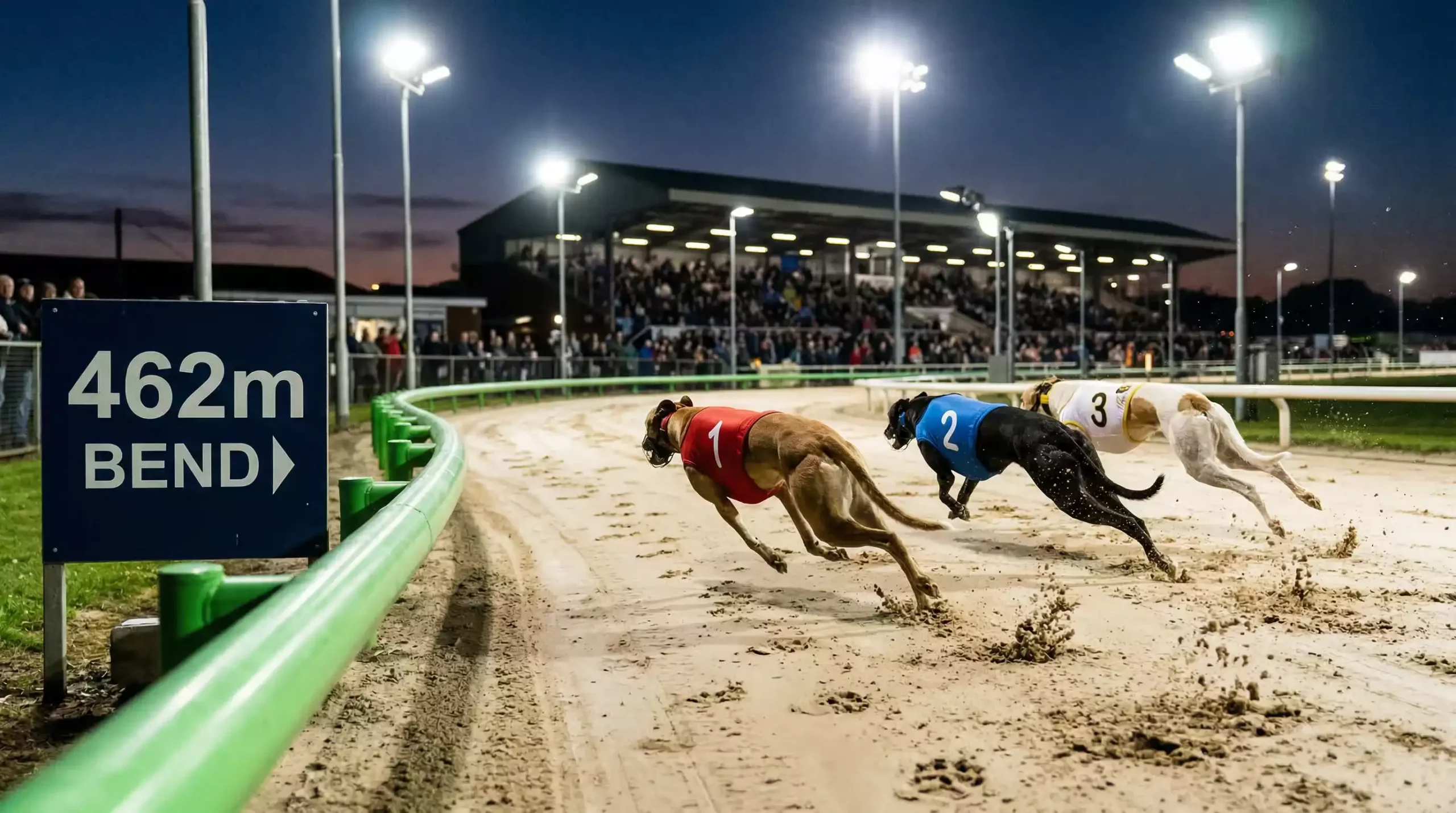
Yarmouth greyhound race distances span five trips — 277, 462, 659, 843 and 1041 metres — and each one demands a fundamentally different type of dog. The sprinter that dominates over two bends at 277 metres would be running on empty by the fourth turn of an 843-metre staying race, while the marathon specialist that grinds down opponents over six bends would never see the front at 277 before the race is already decided. Matching the dog to the distance is one of the sharpest edges available to any bettor studying the card, yet it is consistently undervalued.
According to Greyhound Racing Times, the Yarmouth circuit measures 382 metres in circumference, with the five distances designed so that each trip presents a different number of bends — two, four, six, eight and beyond — and therefore a progressively different balance between raw speed and stamina. The shorter the race, the more the trap draw and early pace matter. The longer the race, the more a dog’s ability to sustain speed through multiple turns separates the field.
This guide breaks down each distance individually, explaining what kind of greyhound thrives over each trip, how the race shape changes with every additional bend and what to look for on the racecard when a dog is entered at a distance it has not run before. Five distances, five different contests, one track.
The longest trips are analysed in staying races.
277m — The Sprint
The 277-metre race at Yarmouth is a two-bend affair that lasts barely sixteen seconds. There is almost no time for a slow starter to recover, no room for a closer to make up ground and very little margin for error through the first bend. It is the purest test of trap speed and early pace on the card, and the dog that leads into the first turn wins more often than at any other distance.
Trap draw is disproportionately important over 277 metres. The inside traps — particularly one and two — have the shortest run to the first bend, which gives the dogs drawn there a natural advantage in the scramble for the rail. Under Yarmouth’s Swaffham outside hare, sightlines favour wider-drawn runners slightly more than at an inside-hare track, but the geometry still rewards whichever dog reaches the first bend in front. The sprint is essentially a one-corner race: whoever commands the rail after the first turn is almost certainly leading off the second.
From a form perspective, the sprinter profile is distinctive. These dogs tend to be lighter, with explosive acceleration out of the boxes and a running style that favours the rail. Their form at longer distances is often unremarkable — they cannot sustain their top speed through four or six bends — but over two turns they are devastating. When analysing a 277-metre race on the card, early-pace sectional times are the single most predictive factor. Finishing times matter less than the split to the first bend: the dog that gets there first usually stays there.
Sprint races are scheduled less frequently than the standard 462-metre trip, which means smaller sample sizes for trap bias analysis and fewer data points in each dog’s form line at this distance. That scarcity can create value in the betting market, because the odds are sometimes set more on general form than on distance-specific ability. A dog with modest results over 462 metres but a string of fast 277-metre trials may be underpriced when it returns to the sprint.
462m — The Standard and Derby Distance
The 462-metre trip is the backbone of the Yarmouth card. It accounts for the majority of scheduled races, forms the basis of the grading system at the track and is the distance over which the East Anglian Derby is run each September. If you only study one distance at Yarmouth, this is the one — and the depth of available data makes it the most analysable trip on the circuit.
Over four bends, 462 metres requires a balance between early pace and sustained speed that neither the sprint nor the staying distances demand. A dog can lead from the traps and still lose if it fades through the third and fourth bends; equally, a closer can make up significant ground if it stays out of trouble through the first two turns. The race shape is more variable than at 277 metres, and that variability is what makes form analysis both more complex and more rewarding.
The track record over 462 metres belongs to Westmead Dance, who in 1977 became the first greyhound to break the 28-second barrier at Yarmouth, trained by John Wells. That record stood for a decade, and its significance goes beyond the stopwatch: it established 462 metres at Yarmouth as a trip where genuine quality is needed to post elite times. The four-bend configuration punishes dogs that drift wide or lose concentration, and only those with both speed and track intelligence run close to the limits.
For betting purposes, the 462-metre distance offers the richest dataset for trap bias analysis, form comparison and grade-level assessment. Because so many races are run at this trip, the statistical samples are large enough to be meaningful. Trap win percentages over 462 metres at Yarmouth are more reliable than those at 277 or 659, simply because the volume of races generates a more stable pattern. When you see a dog entered at 462 metres, you have more information to work with than at any other trip on the card, and the dog that makes best use of that information is not always the one on the track — it is the one holding the racecard.
The wider context is set out in our Yarmouth greyhound results guide.
659m — The Middle Distance
At 659 metres, the race extends to six bends and the character of the contest shifts decisively toward stamina. Dogs that lead over four bends by virtue of early speed begin to feel the strain through the fifth and sixth turns, and the field tends to compress in the final 100 metres as front-runners decelerate and closers arrive. The 659-metre trip is where you see the most dramatic late-race positional changes on the Yarmouth card.
The type of dog that excels at this distance typically shows a different form profile from the 462-metre specialist. Run-home times become critical: a strong run-home split from a previous 462-metre race often translates into a competitive performance when the dog steps up to 659. Conversely, a dog that leads at 462 but records a slow final section may struggle over the extra distance, because the additional two bends expose the stamina deficit that the shorter trip concealed.
Trap draw still matters at 659 metres, but its influence diminishes relative to the sprint and standard distances. Six bends provide more opportunities for positional reshuffling, which means a dog drawn in an unfavourable trap can recover ground that would be irrecoverable over 277 or even 462 metres. That said, early crowding remains a risk — getting badly baulked at the first bend is costly regardless of distance, because the energy spent recovering position cannot be recovered. The best middle-distance dogs combine enough early pace to avoid trouble with enough stamina to sustain their effort through the final two turns.
Middle-distance races appear less frequently on the card than the standard trip, which means betting markets can be thinner and less efficient. A dog with a proven 659-metre record returning after a spell at 462 can catch the market off guard, especially if its shorter-distance form was middling. Distance switches are one of the clearest signals a trainer can send, and when a dog drops back to its preferred trip, the form often improves sharply.
843m and 1041m — Stayer and Marathon
The staying distances at Yarmouth — 843 metres over eight bends and 1041 metres over ten — are rare on the card and entirely different in character from anything at 462 or below. These are endurance races. The winner is almost never the fastest dog in the field; it is the one that maintains a consistent pace while others fade. Speed matters for the initial positioning, but from the third bend onward the contest is about attrition, racing intelligence and sheer physical resilience.
Fields over 843 and 1041 metres are typically smaller than at the standard distance, because fewer dogs at any track are genuine stayers. A five-runner 843-metre race is common; a full six-runner field is the exception. Smaller fields change the betting dynamic: fewer possible outcomes make forecast and tricast bets cheaper in terms of permutations, but the races themselves are harder to predict because form at staying distances is sparse and the sample sizes for each dog are tiny. A dog might have run 843 metres only two or three times in its career, making trend analysis difficult.
What characterises the staying dog on the racecard is a form line that shows consistent mid-to-late finishing positions at shorter distances — the dog that always finishes third or fourth at 462 metres, unable to quicken but never stopping, is often the one that thrives when the race is long enough for its stamina to outlast the speedsters. Weight can also be a factor: heavier dogs sometimes carry more endurance, though the correlation is not absolute.
For bettors, staying races offer a niche within a niche. The market is thinner, the form guides are shorter and the track bias data is less robust than at 462 metres. All of which means opportunities exist for anyone willing to do the homework. A dog that has shown stamina in mid-race splits over 462 metres and is now entered at 843 for the first time might be underestimated by a market that focuses on finishing positions rather than running style. The racecard alone will not tell you everything, but it will tell you enough to frame the right questions.
